Standard Labs
Research Use Only Longevity compounds
Standard Labs · 2026 Research Edition

The Longevity
Guide

Eighteen compounds are discussed for aging, cell stress and tissue repair. This guide keeps the model attached: cells in a dish, worms, mice or people — and whether the study could measure lifespan at all.

Telomeres, senescent cells and immune signals are read the same way. Study type comes before the benefit, dose records are marked unverified, and no compound is graded. No dosing advice.

30 pages 18 compound profiles No grades, no dosing advice
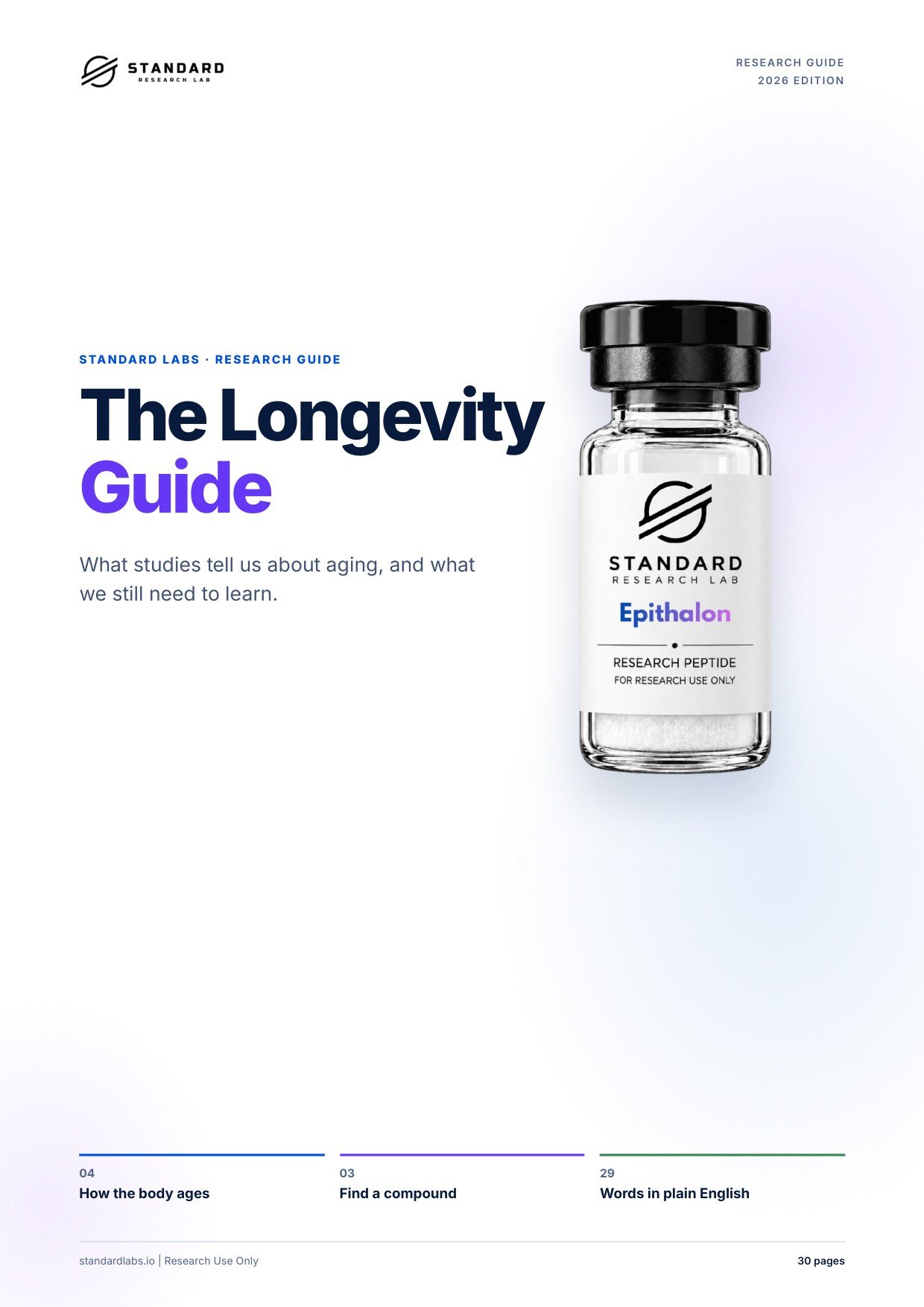
The Longevity Guide — 30-page research edition cover
Free PDF
18 compound profilesAging, cells, tissue repair
30Pages
18Compound profiles
6Biology questions
2026Edition
What's inside

Cells, animals, people.

Not a ranking and not a protocol. Every profile runs the same questions, so two compounds can be read side by side without one getting a better edit than the other.

What the study measured

A lab test can show a change in one cell. An animal study can show a change in a mouse or a worm. A human study can track a biomarker — but only a study that follows people for years can speak to lifespan.

cell · animal · human · years

What the study found

Worms made to produce more humanin lived an average of 19.0 days versus 17.7 days. A related form changed some health measures in mice without a clear gain in lifespan. Epithalon lengthened telomeres in human cells grown in dishes.

worm · mouse · dish · no lifespan

Where the evidence stops

No study cited in the guide shows that any of these compounds makes people live longer. Forms and routes differ, human safety data are thin, and a change in a lab measure is not the same result as a longer life.

no human lifespan · forms differ · safety gaps

Plus: an 18-name index, six biology questions, a page on reading longevity research, a plain-language glossary and the sources behind every profile.

30 pages2026 edition
The directory

Eighteen compounds, six groups.

The guide groups research questions rather than ranking compounds. The grouping is a reading aid — not an evidence score, not a treatment category, and not a statement that any of them is safe for human use.

Cell stress & aged cells

3

Humanin · MOTS-C · FOXO4-DRI

Tissue repair

2

Thymosin Beta-4 · BPC-157

Telomeres

2

Epithalon · TA-65

Immune system

4

Thymosin Alpha-1 · Thymulin · Thymomodulin · Thymopentin

Skin & hormones

3

GHK-Cu · Melanotan II · Oxytocin

Growth, clock & nerve

4

GDF-11 · IGF-1 · Melatonin · BDNF

The groups overlap. A compound can sit in more than one research question, and the guide says so rather than forcing one label.

Why this guide exists

Most longevity content is written to sell a promise.

This one keeps the model attached. A telomere in a dish is not a longer life; a mouse result is not a human one. The guide says which model the study used, what it measured, and where the answer stops. A lab measure is not a lifespan.

18Profiles
6Questions
30Pages
2026Edition
Who it’s for

Made for the reader who checks.

For you if…

You have seen a compound described as “anti-aging” and want to know whether the result came from a dish, a worm, a mouse or a person — and whether the study measured lifespan at all.

Not for you if…

You want a protocol, a dose or a promise. The guide does not tell you what to use, and it does not claim that any compound here extends human life.

Get the research guide

Where should we send it?

Enter your email and we'll send the 30-page PDF. Then a short series on the distinction that decides most longevity claims: what model was used, and what it measured.

  • The full 30-page PDF. Free. No account needed.
  • A short email series on reading a longevity claim, then occasional research updates. One-click unsubscribe.
  • No third-party list. We do not sell or share your email.

Send me the research guide

One email, then the 30-page PDF.

Research use only. 18+. Not medical advice. Unsubscribe anytime.

✓

Check your inbox.

We sent a confirmation link to the email you entered. Click it and the guide will arrive.

Nothing in 5 minutes? Check spam, or contact us.

Open the peptide calculator
FAQ

Straight answers.

Who is this for?

Adults reading about aging research who want the evidence and the limits in the same place. No lab background is assumed. It is not a clinical manual, a protocol, or a review of Canadian approval status.

Is the guide really free?

Yes. The PDF is free. We ask for your email so we can send it, confirm your consent and follow up with a short series on reading a longevity claim. You can unsubscribe at any time.

Is this medical advice?

No. The guide is educational material for research. It does not tell you what to take, and it does not replace a licensed healthcare provider. Products referenced are supplied for laboratory research use only.

Does any of this make people live longer?

No study cited in the guide shows that. The results described are changes in cells, worms or mice, or changes in a human biomarker. A biomarker is not the same as years of life, and the guide says so in every profile.

What is a telomere, and does a longer one mean a longer life?

A telomere is a cap at the end of a DNA strand. A change in telomere length in cells grown in a dish is a lab result; it does not establish that a person will live longer or stay healthy longer.

Does it tell me what to take?

No. Where a trial assigned doses, those are printed as study groups, not recommendations. Amounts reported in forums are marked unverified. No compound is graded strong, moderate or weak.

Why are some numbers marked “unverified”?

Because they arrived without a study, a test group, a date or a named author. Reprinting a number is not the same as validating it, so every number is printed with its status attached.

What's in the 30 pages?

A reading map, six biology questions, an 18-name index, 18 compound profiles, a page on reading longevity research, a plain-language glossary and the sources behind each profile.

Do you sell these compounds?

Some of them are in the Canadian research catalogue. The guide is not a ranking of what we stock, and a catalogue listing does not validate any claim about a compound.

Is my email shared?

No. We do not sell or share your email with third parties. The form stores your name, email, interest and consent record so we can honour your preferences. Every email has a one-click unsubscribe.
Researching appetite or blood sugar instead? Read the free metabolic guide.

Researching muscle or recovery? Read the Muscle Growth & Recovery Guide.

New to research peptides altogether? Start with the 51-page beginner’s guide.