What it's studied for
The research question, the pathway being explored, and why anyone thought that pathway might matter. A mechanism is named as a research idea, never as a proven benefit.
BDNF / TrkB · GABA · orexin · opioid receptors
Standard Labs sells research peptides exclusively to qualified researchers and laboratories for in vitro and laboratory use. Please confirm before continuing.
By proceeding you affirm the statements above are true. Products are not for human or veterinary use, not for use in diagnostic procedures, and have not been evaluated by the U.S. Food and Drug Administration.
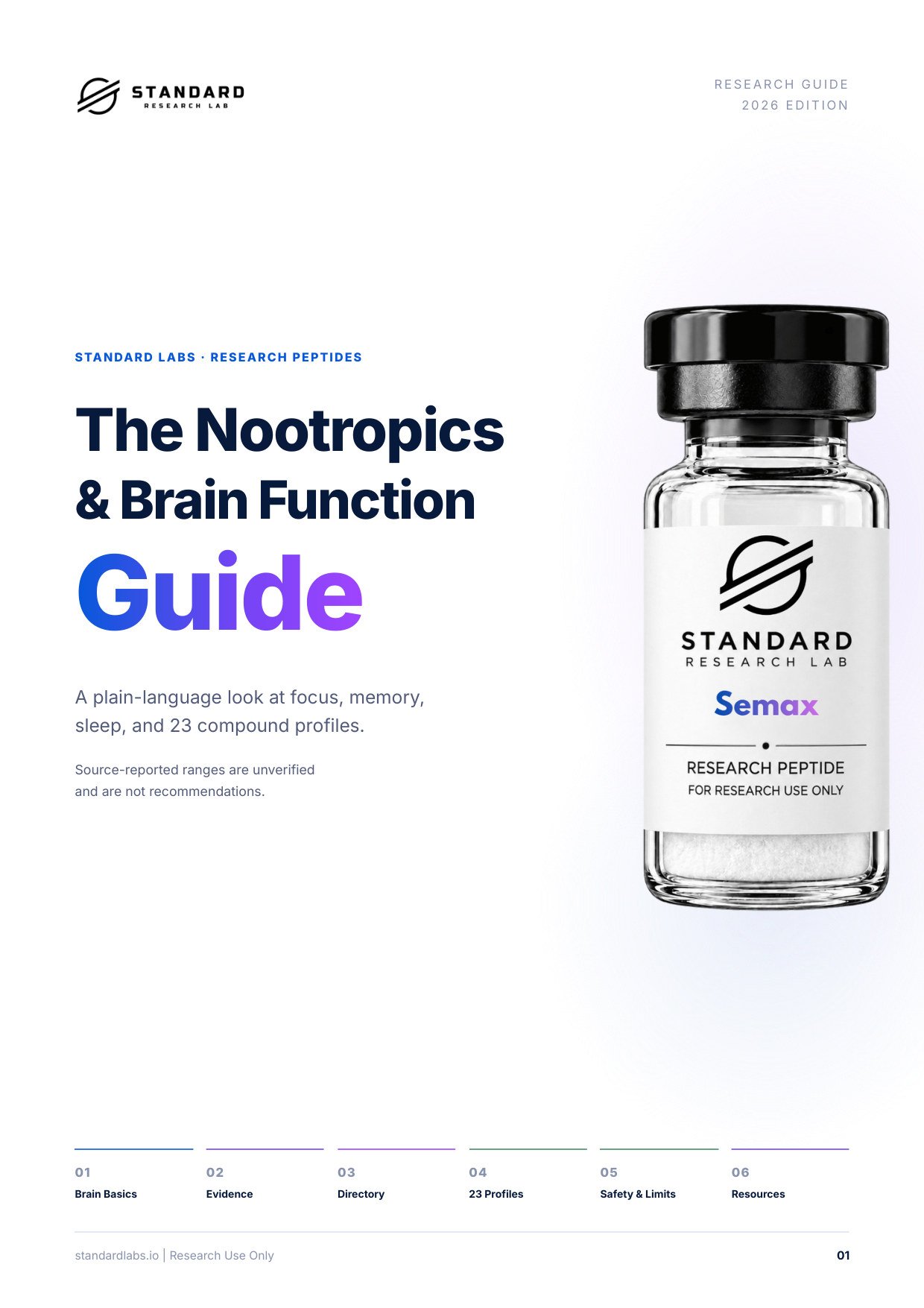
23 compounds are sold on promises about focus, memory and sleep. This guide takes each one apart: what it is studied for, the pathway being explored, and where the evidence stops.
Every profile answers the same four questions. Reported amounts, routes and cycles are printed exactly as the source gave them — marked unverified, and not recommendations. No compound is graded, because the material cannot support a grade.
Not a catalogue and not a ranking. Every profile runs the same four questions, so two compounds can be read side by side without one getting a better edit than the other.
The research question, the pathway being explored, and why anyone thought that pathway might matter. A mechanism is named as a research idea, never as a proven benefit.
The study type behind each mechanism — rat, mouse, cell or human trial — stated before the benefit. Where the work is animal or in-vitro, the profile says so instead of borrowing the human word.
Names that stay unresolved — PE-22-88, IPAM, RG3, FGL. One 8–12 week cycle repeated across every profile with no citation. A safety list that names classes of medicine, not medicines.
Plus: a 20-term glossary, a map of six research themes, a safety-gap table and 27 references you can check.
The guide groups research questions rather than ranking compounds. The grouping is a reading aid — not an evidence score, and not a treatment category.
Dihexa · FGL · NSI-189
Semax · Semax/N-Acetyl · Cerebrolysin · PE-22-88 · P21 · Pinealon · Noopept · RG3 · BDNF · IPAM
Selank · Selank/N-Acetyl · Melanostatin
Orexin · DSIP
Vasopressin · TRH · ACTH · Oxytocin
Enkephalins
The themes overlap. They are reading aids, not treatment categories or an evidence score — and the guide says so rather than forcing one label per compound.
This one was written to survive a researcher reading it. It keeps the source material exactly as it arrived, marks what is unverified, and names what the screenshots never showed: no author, no studies, no test groups, no dates. An honest map beats a confident promise.
You have seen Semax or Selank described in one line — “focus”, “calm” — and want the mechanism and the study type behind the word before you accept the benefit.
You want a stack, a dose or a promise. The guide assigns no grades, gives no protocol and recommends no compound. It is a reading aid, not a plan.
Enter your email and we'll send the 39-page PDF. Then a short series on the four things that decide whether a cognitive claim is worth your time: study type, mechanism, naming, and what “not listed” really means.
One email, then the 39-page PDF.
We sent a confirmation link to the email you entered. Click it and the guide will arrive.
Nothing in 5 minutes? Check spam, or contact us.
Open the peptide calculatorAdults reading about cognitive research who want the evidence and the limits in the same place. No lab background is assumed. It is not a clinical manual, a protocol, or a review of Canadian approval status.
Yes. The PDF is free. We ask for your email so we can send it, confirm your consent and follow up with a short series on reading a brain claim. You can unsubscribe at any time.
No. The guide is educational material for research. It does not tell you what to take, and it does not replace a licensed healthcare provider. Products referenced are supplied for laboratory research use only.
Because they arrived without a study, a test group, a date or a named author. The original material is kept in the source package. Reprinting a number is not the same as validating it, so every number is printed with its status attached.
No. No compound is graded strong, moderate or weak — the supplied material cannot support those grades without a separate review. Reported amounts, routes and cycles are source-reported only.
Six sections: brain basics, how to read evidence, the compound directory, 23 profiles, safety and limitations, and resources. Plus a 20-term glossary, a research-theme map and 27 references.
Some of them. Semax, Selank, Pinealon, DSIP, P21, Cerebrolysin and VIP are listed in the Canadian catalogue under cognitive and neuroprotective research. The guide is not a ranking of what we stock, and a listing does not validate any source claim.
A confirmation, the guide, then a short series over about ten days. After that, occasional research updates. Every email has a one-click unsubscribe.
No. We do not sell or share your email with third parties. The form stores your name, email, interest and consent record so we can honour your preferences.
Researching appetite, blood sugar or weight instead? Read the free 23-page metabolic guide.
Researching muscle, recovery or aging? Read the Muscle Growth & Recovery Guide or The Longevity Guide.
New to research peptides altogether? Start with the 51-page beginner’s guide.