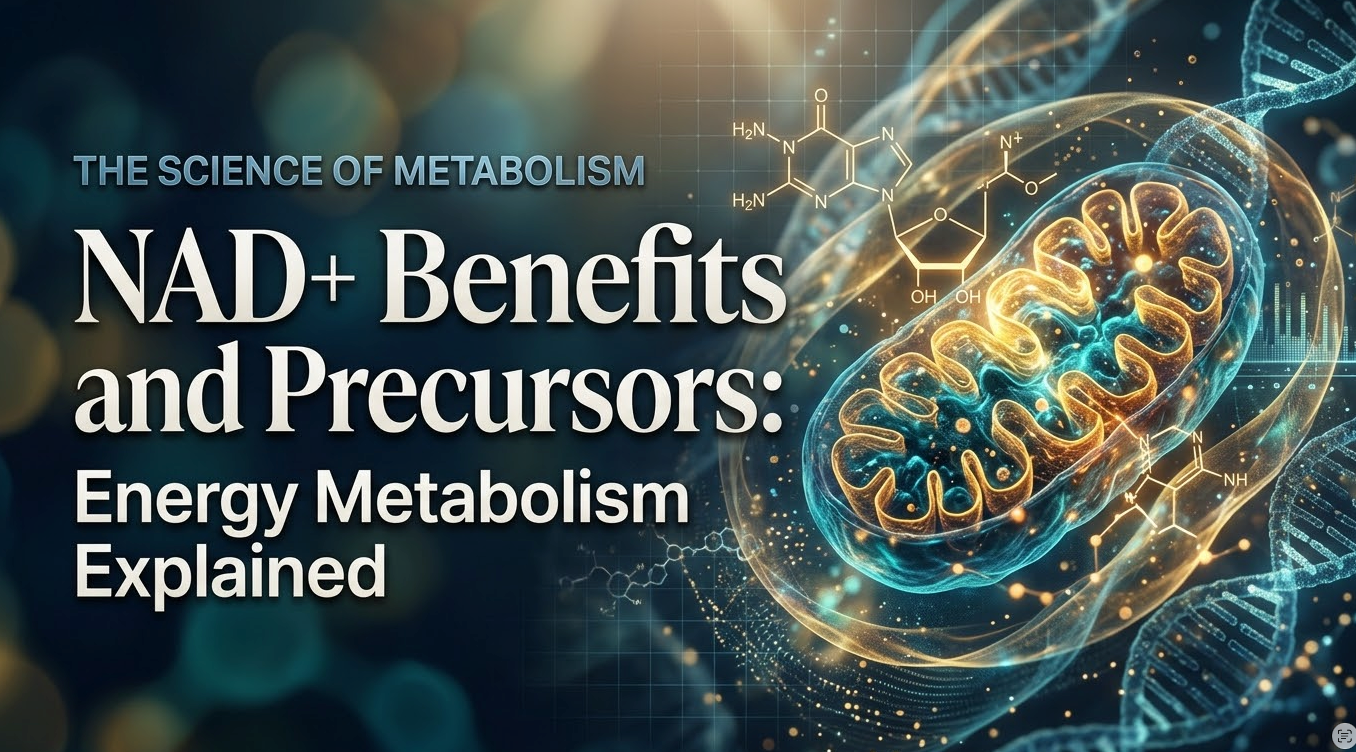
Nicotinamide adenine dinucleotide (NAD+) is the central currency of biological life, serving as an obligatory coenzyme for mitochondrial ATP generation and a consumed substrate for DNA repair enzymes and longevity-regulating sirtuins. However, the scientific debate surrounding NAD vs NAD precursors has challenged researchers for years. Because intact NAD+ is a large, negatively charged molecule that cannot freely diffuse across plasma membranes, understanding how cells actually assimilate exogenous NAD+ versus oral precursors like Nicotinamide Mononucleotide (NMN) and Nicotinamide Riboside (NR) requires examining cellular transporters, ecto-enzymes, and human metabolomic tracking data.
⚡ Quick Summary: NAD+ vs. NAD Precursors
Quick Answer: The fundamental difference between NAD+ and its precursors (NR, NMN, NAM) centers on molecular size, enzymatic cleavage, and cellular transport routes. Intact NAD+ (~663.4 Da) is too bulky and hydrophilic to freely cross most cell membranes. Instead, extracellular NAD+ is rapidly broken down by cell-surface enzymes (CD73 and CD38) into NR or NAM, which then enter cells via equilibrative nucleoside transporters (ENTs) or SLC12A8 to be re-synthesized back into NAD+ inside the cytoplasm via the salvage pathway. Direct intravenous or subcutaneous NAD+ provides rapid systemic plasma saturation and immediate metabolite availability, whereas oral precursors rely on hepatic first-pass metabolism.
| Intervention | Molecular Weight | Cellular Influx Pathway | Metabolic Processing Route |
|---|---|---|---|
| Direct NAD+ (IV / SubQ) | ~663.4 Da | Cleaved by ecto-enzymes (CD73) to NR, or via rare Connexin-43 hemichannels | Bypasses GI tract; rapidly metabolizes to NAM, NMN, and ADPR in plasma |
| Nicotinamide Mononucleotide (NMN) | ~334.2 Da | Dephosphorylated to NR via CD73, or directly via the SLC12A8 transporter | Direct substrate for NMNAT1–3 enzymes to convert into NAD+ |
| Nicotinamide Riboside (NR) | ~255.3 Da | Directly imported via ENT1, ENT2, and ENT4 nucleoside carriers | Phosphorylated into NMN by NRK1/2, then synthesized into NAD+ |
| Nicotinamide (NAM) | ~122.1 Da | Passive diffusion and organic cation transporters | Converted by NAMPT into NMN; high doses feedback-inhibit sirtuins |
The Extracellular Breakdown Paradigm: How Cells Take Up NAD+
For decades, classic biochemistry textbooks asserted that exogenous NAD+ was completely wasted because cells lacked an active transport mechanism for whole dinucleotides. Modern cell biology has revealed a far more nuanced, multi-enzyme reality:
1. Ecto-Enzymatic Dephosphorylation (CD73)
Cell membranes express CD73 (ecto-5′-nucleotidase), which rapidly cleaves the pyrophosphate backbone of extracellular NAD+, stripping a phosphate to convert it into Nicotinamide Riboside (NR) for immediate cellular import.
2. Sirtuin & PARP Cleavage (CD38)
The cell-surface glycoprotein CD38 acts as a major extracellular consumer, cleaving NAD+ into nicotinamide (NAM) and cyclic ADP-ribose, which feeds the intracellular salvage cycle via NAMPT.
3. Direct Connexin-43 Uptake
In specialized cell types (such as astrocytes and cardiac myocytes), intact NAD+ can pass directly through Connexin-43 (Cx43) hemichannels, proving that direct intracellular translocation occurs under specific physiological conditions.
Advance Mitochondrial Bioenergetics Research
Supply cells with direct, pharmaceutical-grade dinucleotide cofactors. Inspect verified analytical testing, HPLC purity reports, and mass spectrometry for research-grade NAD+.
Shop Research NAD+ →The Clinical Evidence: The 2019 Human Metabolome Infusion Study
The definitive pharmacokinetic investigation tracing exogenous NAD+ fate in humans was published in Frontiers in Aging Neuroscience (Grant et al., 2019 / PubMed). Researchers followed plasma and urinary metabolomes during a continuous 6-hour, 750 mg intravenous infusion of pure NAD+ in healthy human adults:
- The Initial 2-Hour Vanishing Act: During the first 2 hours of constant infusion, researchers detected virtually zero increase in plasma NAD+ or its breakdown products (NAM, ADPR, NMN). The infused molecule was immediately taken up into peripheral tissues, degraded by vascular ecto-enzymes, or intracellularly compartmentalized.
- Plasma Saturation Window (Hours 2 to 6): After tissue saturation occurred at hour 2, circulating levels of intact NAD+ surged by nearly 400%, accompanied by sharp rises in nicotinamide (NAM) and ADP-ribose (ADPR).
- Urinary Clearance & Methylation: Urinary excretion of intact NAD+ remained remarkably low, but excretions of methylated downstream metabolites (like me-NAM and 2-PY) increased significantly. This proves that high-dose exogenous NAD+ is actively utilized by cellular sirtuins and subsequently cleared through methyl-donor-dependent pathways.
The Methyl Donor Equation: Why NNMT Inhibition Matters
When investigating high-dose direct NAD+ or precursor therapies, researchers must monitor methyl group depletion. When NAD+ is consumed by sirtuins and PARPs, it releases free nicotinamide (NAM). To eliminate excess NAM, the liver enzyme NNMT (nicotinamide N-methyltransferase) attaches a methyl group from SAMe (S-adenosylmethionine) to excrete it as 1-methylnicotinamide.
Administering massive doses of NAD+ or precursors without addressing NNMT can inadvertently exhaust systemic SAMe pools, impairing epigenetic DNA methylation and endogenous neurotransmitter synthesis. For this reason, cutting-edge metabolic research frequently pairs direct NAD+ protocols with selective NNMT inhibitors like 5-amino-1MQ. Sparing the salvage cycle prevents methyl-donor drain and keeps cellular sirtuins fully activated. Learn more in our guide: 5-amino-1MQ, NNMT & NAD+: The Metabolic Difference.
Synergistic Research Pairings: Building the Mitochondrial Matrix
Because NAD+ acts primarily as a cofactor for biochemical reactions, pairing it with complementary mitochondrial peptides amplifies experimental outcomes:
- Mitochondrial Membrane Repair (SS-31): While NAD+ fuels the Krebs cycle and complex I electron flow, SS-31 docks into cardiolipin on the inner mitochondrial membrane, preventing the newly generated electrons from leaking as damaging reactive oxygen species (ROS). Read: SS-31 & Fatigue Research: Cardiolipin & Elamipretide Trials.
- AMPK Signaling Activation (MOTS-c): Pair dinucleotide fuel with MOTS-c. While NAD+ activates sirtuin deacetylation, MOTS-c stimulates skeletal muscle glucose uptake and fatty acid oxidation via AMPK. Review protocols in MOTS-c & Exercise: Mitochondrial Adaptation & Dosing.
- Longevity & Oocyte Quality: To explore how NAD+ cofactors influence cellular senescence and female reproductive vitality, read our dedicated review: Mitochondrial Peptides & Fertility: MOTS-c, NAD+ & Aging.
Standardized 2.0 mL Reconstitution Math for Research Vials
Direct NAD+ is typically supplied in lyophilized cakes containing 100 mg, 250 mg, or 500 mg. Because it is a small molecule rather than an amino acid peptide chain, it dissolves rapidly in sterile diluent. Reconstituting with 2.0 mL of certified Pfizer Hospira Bacteriostatic Water yields the following concentrations:
Concentration Formula: Mass (mg) ÷ Solvent Volume (mL) = Concentration (mg/mL). For example, adding 2.0 mL of diluent to a 500 mg vial yields an active concentration of 250 mg/mL (25 mg per 0.1 mL / 10 units on a U-100 syringe).
| Vial Material Amount | Diluent Added (BAC Water) | Final Concentration | Dose per 10 Units (0.1 mL) |
|---|---|---|---|
| 100 mg Vial | 2.0 mL | 50.0 mg/mL | 5.0 mg (5,000 mcg) |
| 250 mg Vial | 2.0 mL | 125.0 mg/mL | 12.5 mg (12,500 mcg) |
| 500 mg Vial | 2.0 mL | 250.0 mg/mL | 25.0 mg (25,000 mcg) |
| 1,000 mg Vial (1g) | 4.0 mL | 250.0 mg/mL | 25.0 mg (25,000 mcg) |
Formulation Note on Stinging: Highly concentrated direct NAD+ is naturally acidic and hypertonic, which can cause significant localized injection-site burning when administered subcutaneously. To neutralize this, researchers recommend splitting larger doses, injecting slowly, or using dilute volume ratios with sterile isotonic bacteriostatic saline. Calculate custom volume ratios error-free using the interactive Peptide Calculator.
Hardware Selection: Delivering Precision Bioenergetic Doses
Accurate cellular bioenergetics research demands laboratory delivery hardware that protects delicate molecular solutions and ensures absolute volumetric repeatability:
- Reusable Injection Pens: Avoid syringe graduation errors and stopper coring by loading your reconstituted NAD+ solution into 3mL Injection Pen Glass Cartridges and pairing with the V3 Reusable Injection Pen. The mechanical lead-screw delivers audibly calibrated, repeatable micro-volumes with zero needle-hub fluid loss.
- Precision Manual Syringes: If manual draws are preferred, draw with surgical-grade Easy Touch 31G U-100 Syringes with 0.5 mL barrels. The ultra-fine 31-gauge needle glides cleanly through septums without tearing or coring rubber stoppers.
- Light-Shielded Cold Housing: Reconstituted NAD+ hydrolyzes rapidly under warm temperatures and ambient UV light. Store your active vials upright inside the Compact 4-Slot Case or the high-capacity 10-Slot Peptide Vial Case. For mobile protocols, carry supplies inside the insulated Compact Peptide Travel Case.
Protocol Builder & Tracking Tools
Document every parameter of your bioenergetic research to ensure consistent reproducibility:
- Protocol Structuring: Plan daily administration timing (morning waking protocols), study cycling phases, and solvent volumes inside the Protocol Builder.
- Daily Logging: Record subjective physical endurance scores, metabolic parameters, and beyond-use dates inside the Protocol Tracker Tool.
Frequently Asked Questions
Does a higher blood NAD+ level prove an individual has more physical energy?
No. Blood levels confirm that the molecule has entered systemic circulation, but physical energy depends on cellular uptake, mitochondrial substrate utilization, and ATP turnover inside skeletal muscle and brain tissue. Plasma markers show bioavailability, not guaranteed physical stamina.
Why do intravenous NAD+ infusions often cause chest tightness or cramping?
During rapid IV infusions of direct NAD+, extracellular purinergic signaling and rapid enzymatic cleavage stimulate smooth muscle contractions in the gastrointestinal tract and blood vessels. Slowing the infusion rate or transitioning to subcutaneous micro-dosing eliminates these acute adverse symptoms.
Is direct injectable NAD+ more effective than oral NMN or NR?
Direct subcutaneous or intravenous NAD+ completely bypasses the gastrointestinal tract and hepatic first-pass metabolism, delivering intact dinucleotides and cleavage metabolites directly into systemic capillary beds. Oral NMN and NR are partially metabolized by gut microbiota and the liver before reaching peripheral circulation.
Related Reading & Scientific References
- 5-amino-1MQ, NNMT & NAD+: The Metabolic Difference
- MOTS-c and SS-31 Stack: Complete Mitochondrial Repair Guide
- Mitochondrial Peptides & Fertility: MOTS-c, NAD+ & Aging
- Grant et al. (2019): A Pilot Study Investigating Changes in the Human Plasma and Urine NAD+ Metabolome During a 6-Hour IV Infusion (Frontiers in Aging Neuroscience / PubMed)
The debate between direct NAD+ and its precursors is not an either-or scenario, but a question of cellular transport kinetics, route of administration, and enzymatic processing. By understanding how cell-surface ecto-enzymes and the salvage cycle assimilate NAD+, researchers can design bioenergetic protocols that effectively replenish mitochondrial ATP, empower longevity-regulating sirtuins, and preserve cellular vitality.
← View all peptide guides, research & protocols in our Blog Archive