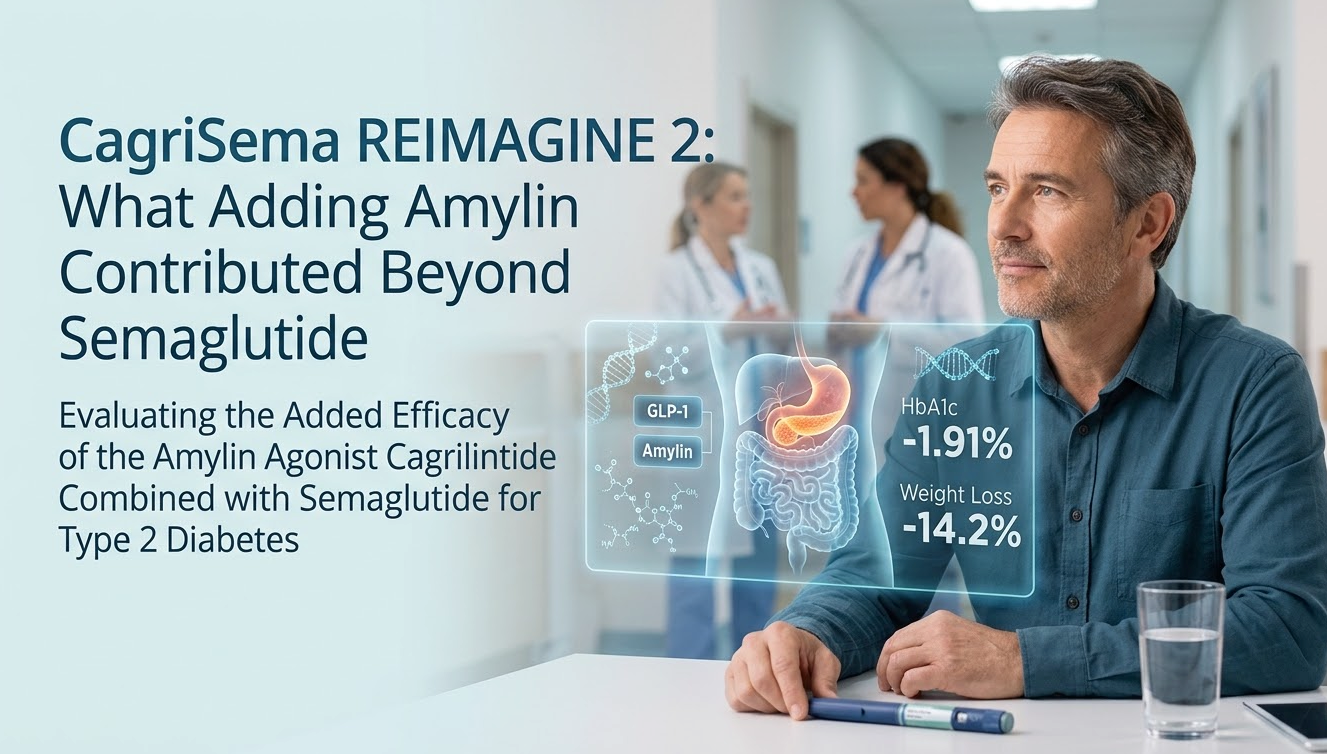
The 68-week Phase 3 REIMAGINE 2 clinical trial results provide the most rigorous active-comparator assessment to date of CagriSema in type 2 diabetes. By directly comparing the co-formulated amylin analogue cagrilintide and GLP-1 receptor agonist semaglutide against its individual monotherapy components and placebo across 2,713 adults, this study dissects the precise additive contribution of dual-hormone neuroendocrine co-targeting.
⚡ Quick Summary: CagriSema REIMAGINE 2 Trial Results
Quick Answer: In the 68-week Phase 3 REIMAGINE 2 trial evaluating 2,713 adults with type 2 diabetes on background metformin (± SGLT2i), once-weekly CagriSema (cagrilintide 2.4 mg + semaglutide 2.4 mg) demonstrated statistically significant superiority in weight reduction compared to semaglutide monotherapy. Under the on-treatment efficacy estimand, CagriSema produced a 14.2% mean body weight reduction versus 10.2% with semaglutide (and 12.9% vs. 9.2% under treatment-regimen estimands). While HbA1c reductions were robust across active arms (-1.91% points for CagriSema vs. -1.75% points for semaglutide), the added contribution of cagrilintide manifested predominantly as superior weight loss, accompanied by a modest increase in gastrointestinal adverse events (67.2% vs. 53.9%).
| Evaluation Arm (68 Weeks) | Mean Weight Loss (Efficacy / Regimen) | HbA1c Reduction (Efficacy) | GI Adverse Event Incidence |
|---|---|---|---|
| CagriSema (Dual Amylin/GLP-1) | -14.2% / -12.9% | -1.91% points | 67.2% (8.5% AE discontinuation) |
| Semaglutide 2.4 mg Monotherapy | -10.2% / -9.2% | -1.75% points | 53.9% (6.6% AE discontinuation) |
| Cagrilintide 2.4 mg Monotherapy | Intermediate weight loss | Modest glucose lowering | Mild-to-moderate amylin profile |
| Placebo Control Arm | Standard background control | Standard background control | Baseline lifestyle adverse event rate |
What Is the Compound? Component Contribution in Fixed-Dose Synergy
CagriSema is an investigational, fixed-dose co-formulation combining two distinct long-acting peptide therapies into a single weekly subcutaneous autoinjector: the selective amylin analogue cagrilintide (2.4 mg) and the established GLP-1 receptor agonist semaglutide (2.4 mg). In metabolic pharmacology, co-administering two active substances requires rigorous factorial verification to prove that the combination delivers genuine clinical synergy beyond its individual components.
The biological rationale for pairing cagrilintide with semaglutide operates through complementary neuroendocrine axes:
- Semaglutide (GLP-1 Receptor Agonist): Acts centrally on hypothalamic arcuate nuclei and autonomic brainstem tracts, driving glucose-dependent insulin secretion, suppressing pancreatic glucagon, slowing gastric emptying, and reducing appetite cues.
- Cagrilintide (Dual Amylin/Calcitonin Receptor Agonist): Mimics native amylin, a neuroendocrine hormone normally co-secreted with insulin by pancreatic beta cells. Cagrilintide binds calcitonin receptor core complexes (AMY1–3) in the area postrema and nucleus of the solitary tract (NTS) in the caudal hindbrain, stimulating physiological meal satiation and suppressing postprandial glucagon surges without inducing hypoglycemia.
- Precision Pharmaceutical Co-Formulation: CagriSema is a specialized co-crystallization designed to ensure identical pharmacokinetic stability and synchronized subcutaneous absorption. Clinical trial findings cannot be replicated by compounding separate products or manually combining independent research vials.
By engaging hypothalamic satiety (GLP-1) and hindbrain fullness (amylin) simultaneously, CagriSema coordinates energy intake reduction through two non-overlapping neural pathways.
How the Study Worked: REIMAGINE 2 Factorial Trial Architecture
The REIMAGINE 2 study was engineered specifically to satisfy regulatory factorial requirements by evaluating the combination against each constituent component in a shared, double-blind setting:
1. Large-Scale Representative Cohort
Enrolled 2,713 adults diagnosed with type 2 diabetes and inadequate glycemic control on a stable background regimen of metformin, with or without a sodium-glucose cotransporter-2 (SGLT2) inhibitor.
2. Four-Arm Factorial Comparison
Randomized participants into four concurrent arms: CagriSema, semaglutide monotherapy, cagrilintide monotherapy, or matching placebo, directly isolating the added contribution of each peptide.
3. 68-Week Exposure Window
Subjects underwent stepped dose titration followed by sustained maintenance over 68 weeks, providing a comprehensive assessment of long-term glycemic nadir stabilization and weight plateau dynamics.
4. Dual Estimand Statistical Model
Tracked primary glycemic and body weight outcomes under both the treatment-regimen estimand (intention-to-treat including dropouts) and the trial-product estimand (adherent on-treatment exposure).
Complete clinical protocol parameters and peer-reviewed disclosures are documented in the REIMAGINE 2 Primary Study Report (PubMed) and the associated Published Correction Record.
Results and Key Findings: Dissecting the Weight vs. Glucose Gradient
The 68-week data from REIMAGINE 2 provide a detailed look at how multi-receptor targeting impacts glycemic versus weight endpoints in type 2 diabetes:
- Superior Weight Reduction (-14.2% vs. -10.2%): Under the on-treatment efficacy estimand, CagriSema delivered a 14.2% mean body weight reduction, statistically superior to the 10.2% achieved by semaglutide monotherapy (p < 0.0001). Under the treatment-regimen estimand, weight loss stood at 12.9% versus 9.2%.
- Modest Incremental Glycemic Lowering (-1.91% vs. -1.75%): In HbA1c lowering, CagriSema achieved an absolute reduction of 1.91 percentage points compared to 1.75 percentage points with semaglutide. While statistically significant, this 0.16% point delta reveals that adding amylin agonism to an already potent GLP-1 backbone yields an incremental, rather than transformative, additional glucose-lowering effect.
- Dose-Dependent Factorial Validation: Cagrilintide monotherapy demonstrated independent weight-loss and glucose-lowering activity, confirming that both active substances contributed to the co-formulation's overall metabolic performance.
- Population-Specific Diabetes Realities: Consistent with trials like REDEFINE 2 and SYNCHRONIZE-2, these figures reflect outcomes in diabetic cohorts and should not be directly compared against non-diabetic obesity trials where higher percentage weight reductions are routinely recorded.
The Study in Plain English: Understanding Active-Comparator Metrics
Interpreting factorial active-comparator trials requires distinguishing between placebo contrasts and drug-versus-drug incremental differences:
| Trial Terminology | Clinical / Statistical Definition | Real-World Patient Meaning |
|---|---|---|
| Active-Comparator Trial | Testing a new therapy directly against an established, active commercial medicine | Judges CagriSema against semaglutide (Ozempic/Wegovy), proving what adding amylin adds beyond GLP-1 alone |
| Incremental Weight Benefit (+4.0%) | The net additional percentage weight lost beyond the active comparator (14.2% vs. 10.2%) | On a 100 kg baseline, a patient loses an extra 4 kg (~9 lbs) by taking the dual peptide instead of semaglutide |
| Glycemic Plateau Effect | The biological ceiling where further receptor stimulation yields diminishing HbA1c reductions | Because semaglutide already normalizes glucose effectively, adding amylin primarily drives extra fat loss |
| Factorial Design | Evaluating Drug A, Drug B, Combination (A+B), and Placebo concurrently in one study | The scientific gold standard required to prove that a combination drug is not just an unnecessary additive |
Key Insights: What Makes the REIMAGINE 2 Readout Critical?
The clinical contribution of REIMAGINE 2 provides vital clarity for endocrinologists evaluating dual-action therapies:
- Measure-by-Measure Analysis Is Essential: Adding a second biological pathway does not uniformly amplify every endpoint. In REIMAGINE 2, cagrilintide added substantial value to weight loss (+4.0% net on-treatment difference), but only modest value to glycemic reduction (-0.16% point net difference). Treatment decisions should align with individual patient priorities: for patients prioritizing maximal weight loss, the combination offers clear added utility.
- Active Comparisons Replace Speculation: Rather than relying on cross-trial comparisons between unrelated studies, REIMAGINE 2 tested the combination against semaglutide within the exact same patient population, under identical double-blind conditions.
- Quantifying the Tolerability Tradeoff: The additional weight loss achieved by CagriSema was accompanied by higher rates of gastrointestinal side effects (67.2% vs. 53.9%) and adverse-event dropouts (8.5% vs. 6.6%). Clinicians must weigh whether the extra 4% weight reduction justifies this treatment-experience tradeoff.
Tolerability & The Complete Safety Profile
Throughout the 68-week evaluation period, CagriSema exhibited an adverse-event profile consistent with dual incretin and amylin receptor agonism, highlighting clear differences between monotherapy and combination therapy:
- Gastrointestinal Event Profile: Treatment-emergent gastrointestinal adverse events were reported in 67.2% of patients receiving high-dose CagriSema, compared to 53.9% receiving semaglutide monotherapy. Events were predominantly mild to moderate, peaking during initial dose escalation.
- Discontinuation Rates (8.5% vs. 6.6%): Adverse-event-related discontinuations occurred in 8.5% of CagriSema-treated patients versus 6.6% in the semaglutide cohort, reflecting the expected tolerability burden of combining two neuroendocrine appetite modulators.
- Hypoglycemia Profile: Because both GLP-1-mediated insulin secretion and amylin-mediated glucagon suppression are strictly glucose-dependent, rates of clinically significant hypoglycemia remained low in this population receiving background metformin ± SGLT2 inhibitors.
For complete safety data disclosures, reference the REIMAGINE 2 Primary Trial Publication (PubMed) and the corporate Novo Nordisk Scientific Announcement.
Comparative Research Themes & Next-Generation Metabolic Pipelines
To contextualize CagriSema within the broader landscape of diabetes and obesity therapeutics, researchers compare multi-receptor mechanisms across active-comparator trials:
| Investigational / Approved Approach | Molecular Class & Architecture | Target Receptor Pathways | Comparative Finding in T2D |
|---|---|---|---|
| CagriSema (REIMAGINE 2) | Fixed-Dose Co-Formulation | Dual Agonist: Amylin (Cagrilintide) + GLP-1 (Semaglutide) | Superior weight loss vs. semaglutide (14.2% vs. 10.2%); incremental HbA1c drop |
| CagriSema (REIMAGINE 3) | Fixed-Dose Co-Formulation | Dual Agonist: Amylin + GLP-1 | -2.33% HbA1c drop & -12.0% weight loss as basal insulin add-on |
| Zenagamtide (Amycretin) | Unimolecular Peptide Co-Agonist | Dual Agonist: GLP-1 + Amylin/Calcitonin | Single-chain dual action; 89.1% HbA1c <7.0% & -14.6% weight loss in Phase 2 |
| Tirzepatide (SURPASS-2) | Dual Incretin Peptide | Dual Agonist: GIP + GLP-1 | Proven superiority vs. semaglutide 1.0 mg in both HbA1c and weight reduction |
For a detailed analysis of comparative amylin biology, explore our guide: Eloralintide vs Cagrilintide: Amylin Agonists Compared. To review add-on basal insulin data with CagriSema, read: CagriSema REIMAGINE 3 Results: Basal Insulin Add-On Trial Data.
What Patients and Clinicians Can Look Forward To
CagriSema remains an investigational combination therapy undergoing active global Phase 3 evaluation; it is not yet approved by the U.S. FDA or international health authorities. However, the completion of REIMAGINE 2 provides the definitive active-comparator evidence required by regulatory agencies to evaluate the specific contribution of each component.
For clinicians and patients, these findings clarify where CagriSema fits in future treatment algorithms. Rather than viewing CagriSema as a replacement for semaglutide across all diabetic patients, it emerges as an intensified therapeutic option for individuals who require substantial, double-digit weight reduction beyond what single-agent GLP-1 therapies provide, provided they can tolerate the slightly higher gastrointestinal burden.
Questions for the Next Stage of Research
While the 68-week REIMAGINE 2 findings establish clear active-comparator proof-of-concept, several vital clinical questions guide the transition into practice:
- Head-to-Head Comparisons Against Tirzepatide: How will CagriSema compare directly against dual GIP/GLP-1 receptor agonism (tirzepatide 15 mg) in direct randomized trials in type 2 diabetes?
- Long-Term Cardiovascular and Renal Outcomes: Will co-formulating amylin with semaglutide preserve or amplify the proven cardiovascular and renal protections established by semaglutide monotherapy in the SELECT and FLOW trials?
- Individualizing Patient Selection: Can baseline biomarkers or metabolic phenotypes identify which diabetic patients will achieve the largest incremental weight benefit from adding an amylin analogue?
Explore Our Research Tools
To assist laboratory scientists and clinicians in tracking peptide calculations, experimental schedules, and analytical observations, explore our specialized software suite:
- Calculate volume measurements and concentration parameters with the interactive Peptide Calculator.
- Structure research intervals, timing windows, and observation phases inside the Protocol Builder.
- Log laboratory markers, baseline patient metrics, and analytical notes with the Protocol Tracker Tool.
Scientific References & Primary Trial Documents
- REIMAGINE 2 Primary Study Report: CagriSema vs Semaglutide, Cagrilintide, and Placebo in Type 2 Diabetes (PubMed)
- Novo Nordisk: Phase 3 REIMAGINE 2 Trial in Type 2 Diabetes Successfully Completed (Primary Announcement)
- REIMAGINE 2 Published Correction Record (PubMed)
- Eloralintide vs Cagrilintide: Amylin Agonists Compared
Clinical Verdict: The 68-week Phase 3 REIMAGINE 2 clinical trial establishes that co-formulating the amylin analogue cagrilintide with the GLP-1 receptor agonist semaglutide delivers statistically superior weight loss compared to semaglutide monotherapy (14.2% vs. 10.2%) alongside robust glycemic control (-1.91% vs. -1.75% HbA1c reduction). By demonstrating that the primary added value of dual-hormone signaling manifests as enhanced weight reduction—accompanied by a manageable increase in gastrointestinal adverse events—REIMAGINE 2 provides an evidence-based foundation for personalized treatment selection in advanced metabolic disease.
← View all clinical research, trials & peptide analyses in our Blog Archive