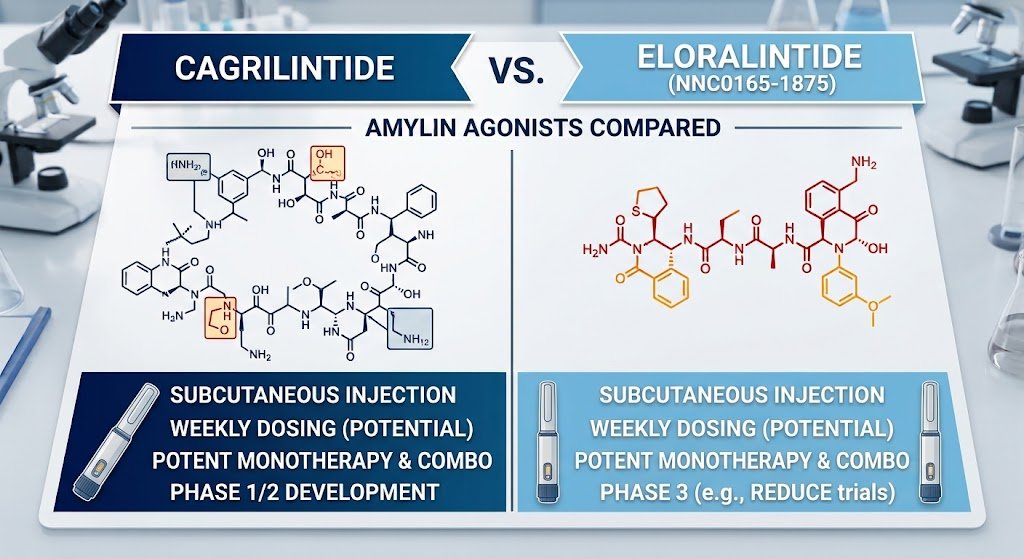
Eloralintide vs. Cagrilintide: Amylin Agonists Compared
Within metabolic endocrinology and peptide pharmacology, the investigation of energy homeostasis has expanded beyond single-hormone pathways. While glucagon-like peptide-1 (GLP-1) and dual incretin mimetics have redefined modern metabolic research, long-acting amylin receptor agonists represent an equally significant breakthrough. By mimicking the neuroendocrine actions of endogenous amylin, these synthetic analogues introduce non-incretin mechanisms to regulate satiety, slow nutrient transit, and optimize body composition.
Two primary investigative candidates lead this therapeutic class: Eloralintide and Cagrilintide. Both peptides are engineered to overcome the severe pharmacokinetic limitations of native amylin, yet each features distinct molecular modifications, receptor selectivity profiles, and research applications. This guide examines their molecular design, receptor signaling cascades, comparative metabolic benefits, and established laboratory handling parameters.
Quick Summary: Eloralintide vs. Cagrilintide at a Glance
Quick Answer: Both peptides are once-weekly synthetic amylin analogues, but they differ in receptor selectivity and clinical architecture. Cagrilintide (Novo Nordisk) exhibits broad dual amylin and calcitonin receptor agonism (DACRA) and is primarily studied in fixed co-formulation with Semaglutide (CagriSema). Eloralintide (Eli Lilly) is engineered as a selective, high-potency amylin receptor agonist that minimizes calcitonin cross-reactivity, demonstrating up to 20% weight loss as a standalone monotherapy in Phase 2 trials.
| Characteristic | Cagrilintide (Novo Nordisk) | Eloralintide (Eli Lilly) |
|---|---|---|
| Peptide Classification | Lipidated dual amylin/calcitonin receptor agonist (DACRA) | Selective, long-acting amylin receptor agonist |
| Half-Life Architecture | C18/C20 fatty diacid side chain (reversible albumin binding) | Stabilized peptide backbone with extended pharmacokinetics |
| Elimination Half-Life | Approximately 160 to 180 hours (~7 days) | Extended (~7 days), supporting once-weekly evaluation |
| Primary Receptor Targets | Broad affinity across AMY1–3 and Calcitonin receptors | High-potency, balanced activation selective for AMY subtypes |
| Investigative Strategy | Fixed-ratio co-formulation with Semaglutide (CagriSema) | Standalone monotherapy & multi-incretin synergy |
| Phase 2/3 Efficacy | ~22.7% loss in Phase 3 when paired with Semaglutide | ~20.0% loss as a monotherapy in 48-week Phase 2 trials |
What Are Long-Acting Amylin Agonists?
Amylin is a 37-amino-acid neuroendocrine peptide synthesized and co-secreted with insulin by pancreatic beta cells in a fixed ratio of roughly 1:100. Upon release in response to nutrient ingestion, native amylin coordinates postprandial glucose flux through three distinct mechanisms:
- Central Satiety Signaling: Binds to calcitonin-like receptor (CLR) complexes within the area postrema and the nucleus of the solitary tract (NTS) in the hindbrain, activating meal-termination pathways.
- Gastric Emptying Regulation: Slows gastric motility and the rate of chyme delivery to the small intestine, preventing rapid postprandial glucose spikes.
- Glucagon Suppression: Attenuates inappropriate post-meal hepatic glucagon secretion without impairing normal counter-regulatory hypoglycemia defenses.
Despite these critical regulatory functions, endogenous amylin is unsuitable for sustained experimental protocols due to an elimination half-life of less than 15 minutes, rapid renal clearance, and a high propensity to form cytotoxic beta-sheet amyloid fibrils in aqueous solution. Early synthetic analogues like pramlintide prevented amyloid formation via proline substitutions but still required three-times-daily dosing. Eloralintide and cagrilintide resolve both physical instability and enzymatic clearance, enabling consistent, once-weekly receptor occupancy.
The Core Comparison: Molecular Design & Selectivity
The fundamental distinction between these two next-generation candidates lies in their structural engineering, half-life extension strategies, and investigative targets:
1. Cagrilintide
Cagrilintide incorporates non-proteogenic amino acid substitutions and a C-terminal fatty diacid moiety attached via a hydrophilic spacer. Following subcutaneous administration, this lipid tail forms reversible, high-affinity non-covalent bonds with circulating serum albumin. This reversible albumin-binding depot shields the core peptide from neutral endopeptidase cleavage and glomerular filtration, providing an elimination half-life of approximately 7 days. Cagrilintide engages all three functional amylin receptor complexes (AMY1, AMY2, and AMY3), as well as human calcitonin receptors, eliciting continuous anorexigenic signaling. Explore its combination profiles in our dedicated What Is CagriSema? Guide.
2. Eloralintide (LY3841136)
Eloralintide represents a refined chemical architecture engineered for enhanced structural stability, prolonged systemic half-life, and potent receptor affinity. Rather than relying solely on the pharmacokinetic synergy of fixed incretin combinations, eloralintide was developed with optimized intrinsic activity across AMY subtypes. Its sequence reduces off-target calcitonin receptor divergence while maximizing post-receptor cyclic AMP generation, producing robust standalone metabolic remodeling and appetite suppression at nanomolar concentrations.
Key Benefits and Metabolic Mechanisms
Both compounds yield significant metabolic advantages over standard incretin-only regimens, driving distinct physiological outcomes in laboratory evaluations:
- Dual-Pathway Hindbrain Satiation: Unlike GLP-1 and GIP agonists, which engage GLP-1R and GIPR populations across the hypothalamus and vagal afferents, amylin agonists directly stimulate calcitonin receptor complexes in the area postrema. This recruits distinct, complementary neural circuits that induce profound meal-termination signaling and suppress hedonic food drive without additive hypothalamic receptor fatigue.
- Decoupled Glucose Homeostasis: Amylin agonists suppress postprandial glucagon secretion via islet paracrine communication rather than through direct insulinotropic stimulation. This makes both peptides uniquely effective in stabilizing glycemic variability and reducing insulin demand.
- Lean Mass Preservation: In preclinical obesity models, amylin-driven caloric reduction avoids the disproportionate loss of skeletal muscle frequently observed under aggressive single-agent incretin starvation. By maintaining homeostatic gastric transit and curbing hyperphagia without continuous nausea, these peptides foster a cleaner ratio of fat mass to lean tissue mass reduction.
- Circumvention of Incretin Tolerance: Sustained high-dose incretin receptor activation often leads to receptor internalization, beta-arrestin recruitment, and tachyphylaxis. Introducing an amylin agonist reactivates downstream metabolic efficiency through a separate, non-overlapping G-protein coupled cascade.
Mechanism of Action: Calcitonin & RAMP Signaling
Amylin receptors are not standalone proteins; they are heterodimeric receptor complexes composed of a core Calcitonin Receptor (CTR) partnered with one of three Receptor Activity-Modifying Proteins (RAMP1, RAMP2, or RAMP3):
- AMY1 Receptor: Formed by the CTR + RAMP1 heterodimer.
- AMY2 Receptor: Formed by the CTR + RAMP2 heterodimer.
- AMY3 Receptor: Formed by the CTR + RAMP3 heterodimer.
When cagrilintide or eloralintide binds to these functional heterodimers:
- Heterodimer Activation: The peptide docks into the transmembrane pocket of the CTR-RAMP complex, inducing a conformational shift that recruits stimulatory G-protein alpha subunits.
- Adenylyl Cyclase Stimulation: Activated G-protein alpha subunits stimulate membrane-bound adenylyl cyclase, converting cytosolic ATP into cyclic adenosine monophosphate (cAMP).
- PKA & Intracellular Cascade: Elevated intracellular cAMP activates Protein Kinase A (PKA) and exchange proteins directly activated by cAMP (EPAC), initiating downstream phosphorylation events.
- Noradrenergic Hindbrain Firing: In the dorsal vagal complex, this intracellular cascade activates noradrenergic neurons projecting to the lateral parabrachial nucleus, sending potent satiety and fullness signals through central metabolic control pathways.
- Gastrointestinal Transit Modulation: Concurrently, efferent vagal signals decelerate gastric motility and suppress postprandial glucagon release from pancreatic alpha cells.
Documented Laboratory Research & Comparative Protocols
Published preclinical models and clinical trial programs separate experimental parameters based on whether the compound is evaluated as an isolated agent or within a multi-pathway regimen:
| Protocol Parameter | Cagrilintide | Eloralintide |
|---|---|---|
| Research Target | Synergistic weight reduction, incretin combination kinetics | Monotherapy adiposity loss, selective AMY signaling dynamics |
| Administration Cadence | Once weekly (every 7 days) | Once weekly (every 7 days) |
| Administration Route | Subcutaneous (Sub-Q) into adipose tissue | Subcutaneous (Sub-Q) into adipose tissue |
| Titration Protocol | Gradual 4-week step-up increments to preserve GI tolerability | Dose-escalation design focused on selective receptor saturation |
| Investigative Pairings | Standardized alongside Semaglutide (CagriSema) | Standalone protocols, or paired with Tirzepatide / Retatrutide |
| Primary Endpoints | Body weight reduction, glycemic variability, gastric delay | Lean mass preservation, food intake reduction, AMY specificity |
| Key Biomarkers | Fasting glucose, HbA1c, fasting insulin, glucagon, total adiposity | Caloric consumption, body composition (fat vs. lean mass), cAMP markers |
Synergistic Research Pairings
Because amylin analogues operate independently of incretin pathways, laboratories frequently evaluate both peptides alongside complementary research agents to observe multi-receptor metabolic control, cellular recovery, and body composition pathways:
- Semaglutide: The benchmark GLP-1 pairing evaluated with cagrilintide (co-formulated as CagriSema). Co-administration yields non-linear, synergistic reductions in body mass and glycemic excursions that surpass the additive efficacy of single-pathway GLP-1 receptor activation. Explore detailed mechanistic data in our Semaglutide GLP-1 Research Guide.
- Tirzepatide: Investigators pair amylin analogues like eloralintide with dual GIP/GLP-1 agonists to evaluate multi-incretin convergence alongside hindbrain calcitonin receptor signaling. For a full breakdown of dual-agonist signaling cascades, see our guide to Tirzepatide Dual Incretin Mechanisms.
- Retatrutide: Research models exploring maximal thermogenesis, lipid oxidation, and hepatic fat clearance combine amylin agonism with GIP/GLP-1/Glucagon tri-agonists, balancing elevated energy expenditure with central satiety signaling. Review trial data and receptor actions in our Retatrutide Trial & Dosing Guide (or view Retatrutide research vials).
- Amycretin: Novo Nordisk's unimolecular co-agonist combining GLP-1 and amylin agonism in a single peptide chain. Compare unimolecular engineering with co-formulations in our Amycretin Research Guide.
- Comprehensive Metabolic Landscape: Compare the entire class of emerging candidates side-by-side in our Best GLP-1 for Weight Loss Guide.
- BPC-157: In models evaluating gastrointestinal motility, microvascular integrity, and mucosal adaptation, researchers observe whether co-administering tissue-protective pentadecapeptides modulates digestive tolerability during amylin dose titration. Review experimental parameters in our BPC-157 Mechanism & Research Guide.
- TB-500: Teams analyzing actin upregulation and structural cellular protection evaluate TB-500 (Thymosin Beta-4) to observe localized tissue remodeling alongside systemic metabolic adjustments.
- GHK-Cu: In metabolic protocols examining tissue remodeling, extracellular matrix integrity, and oxidative protection during rapid body composition changes, investigators reference GHK-Cu Copper Tripeptide Research.
Laboratory Handling, Reconstitution & Storage Standards
Maintaining the chemical and physical integrity of synthetic amylin analogues requires strict adherence to laboratory cold-chain procedures (detailed step-by-step in our Beginner's Guide to Peptides):
- Diluent Selection: Reconstitute lyophilized peptide vials using sterile, pharmaceutical-grade Pfizer Hospira Bacteriostatic Water containing 0.9% benzyl alcohol to prevent microbial growth across multi-dose research protocols. For cell-culture or specialized in-vitro assays where isotonicity without alcohol is required, utilize sterile 0.9% Sterile Bacteriostatic Saline.
- Reconstitution Technique: Direct the diluent stream gently against the internal glass wall of the vial using a sterile EasyTouch 31G Syringe rather than spraying directly onto the lyophilized powder cake. Amylin-class analogues are susceptible to physical shear stress; roll the vial gently between the palms until completely dissolved, avoiding vigorous agitating or shaking. Follow our instructions on how to reconstitute peptides and how much bacteriostatic water to add.
- Calculations & Protocol Tracking: Determine syringe unit tick marks using our free interactive Peptide Calculator and manage multi-week titration schedules within the Protocol Tracker Tool.
- Cold-Chain Maintenance: Store dry lyophilized vials at -20°C for long-term molecular stability. Once reconstituted into liquid solution, store the compound between 2°C and 8°C (36°F to 46°F), shielded from light and physical vibration inside a dedicated Peptide Vial Case or insulated Compact Travel Case. Solutions should be utilized within 28 to 30 days of reconstitution.
Both cagrilintide and eloralintide exemplify the evolution of peptide-based metabolic science. Whether evaluating cagrilintide for its documented synergy within combination regimens or examining eloralintide for its receptor selectivity and robust monotherapy potential, implementing precise titration schedules and maintaining stringent cold-chain handling will ensure reproducible, high-integrity experimental outcomes.
← View all peptide guides, research & protocols in our Blog Archive