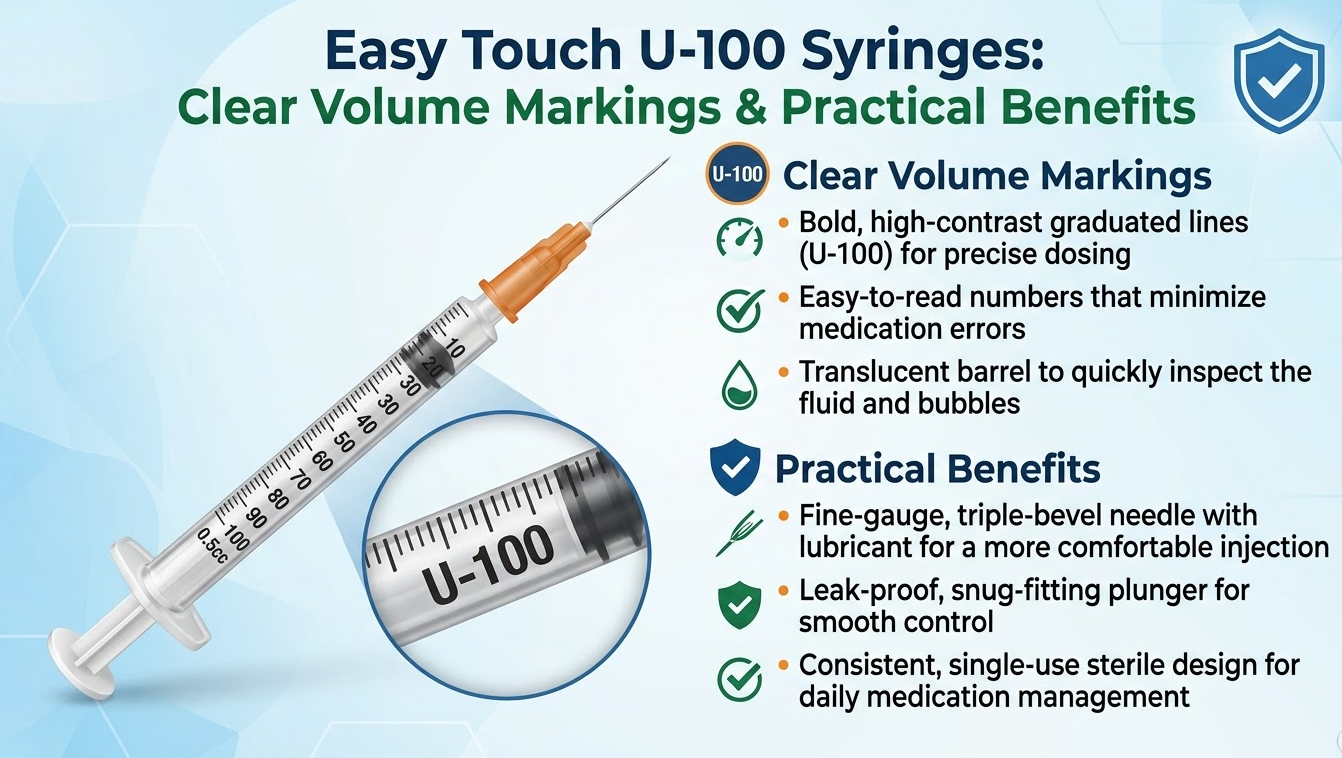
The single most common arithmetic blunder in peptide research is confusing syringe unit markings with active compound milligrams. A U-100 syringe measures physical volume, not compound strength. Precision equipment like the Easy Touch 31 Gauge U-100 Insulin Syringes pairs high-contrast unit hash marks with a 0.5 mL barrel to make micro-volume calculations clear, reproducible, and error-free.
⚡ Quick Summary: U-100 Syringe Units to mL Conversion
Quick Answer: On any standard U-100 syringe, 100 units equal exactly 1.0 mL (or 1.0 cc). Therefore, each individual unit mark represents exactly 0.01 mL of liquid volume. A 50-unit syringe barrel holds a maximum volume of 0.5 mL. Syringe units indicate liquid volume only—the mass of peptide (mg or mcg) delivered per unit depends entirely on your reconstitution concentration.
| U-100 Syringe Units | Liquid Volume (mL / cc) | Standard Barrel Proportion | Example Active Mass (at 5 mg/mL) |
|---|---|---|---|
| 5 Units | 0.05 mL | 1/10th of a 50-unit barrel | 250 mcg (0.25 mg) |
| 10 Units | 0.10 mL | 1/5th of a 50-unit barrel | 500 mcg (0.50 mg) |
| 25 Units | 0.25 mL | 1/2 of a 50-unit barrel | 1,250 mcg (1.25 mg) |
| 50 Units (Full Barrel) | 0.50 mL | Full capacity of 0.5 mL syringe | 2,500 mcg (2.50 mg) |
| 100 Units | 1.00 mL | Standard 1.0 mL capacity | 5,000 mcg (5.00 mg) |
The Triple Variable Rule: Volume vs. Concentration vs. Mass
When documenting laboratory protocols, never write "administered 10 units" without stating compound concentration. A measurement record requires three distinct parameters:
1. Liquid Volume (mL or Units)
The physical space the solvent occupies. On a U-100 barrel, 1 unit is strictly 0.01 mL of liquid, regardless of what chemical is dissolved inside.
2. Concentration (mg/mL)
How many milligrams of lyophilized peptide cake were dissolved into your diluent (e.g., 10 mg dissolved in 2.0 mL BAC water = 5 mg/mL).
3. Active Delivered Mass (mg or mcg)
The actual chemical dose: Volume (mL) × Concentration (mg/mL). Ten units (0.1 mL) of a 5 mg/mL solution delivers exactly 0.5 mg (500 mcg).
Double-check your volume math before drawing from any vial using our free interactive Peptide Calculator to avoid arithmetic slips.
Precision Micro-Dosing with Zero Septum Drag
Protect rubber stoppers and eliminate draw friction with surgical-grade 31G, 8 mm needles. High-contrast markings ensure accurate visual calibration on every pull.
Shop Easy Touch 31G U-100 Syringes →Why 0.5 mL (50-Unit) Barrels Beat 1.0 mL Barrels for Peptides
While 1.0 mL (100-unit) syringes are common, researchers working with concentrated peptide solutions strongly prefer 0.5 mL (50-unit) barrels like the Easy Touch 31G 10-Pack:
- Wider Hash-Mark Spacing: Because the 0.5 mL barrel has a narrower bore, the unit graduation lines are spaced farther apart along the barrel, reducing visual parallax error when measuring micro-doses (like 5 or 8 units).
- Ultra-Fine 31 Gauge Profile: The razor-sharp 31G needle glides through vial septums without tearing or coring the rubber, preserving container closure integrity across multi-week cycles.
- Short 8 mm Needle Length: The 8 mm (5/16") depth ensures consistent subcutaneous deposition without striking deeper intramuscular tissue. For an exhaustive gauge comparison, read our Peptide Needle Gauge & Length Guide.
Syringes vs. Reusable Injection Pens: When to Upgrade
While U-100 syringes provide an essential baseline for manual lab draws, managing recurring daily protocols with disposable syringes introduces daily friction. Comparing standard syringe workflows to modern cartridge systems reveals clear operational advantages:
- Zero Fluid Trapping: Traditional syringe hubs trap tiny amounts of fluid inside the needle collar ("dead space"). Reusable systems like the V3 Reusable Injection Pen pair directly with 3mL Glass Cartridges to eliminate dead-space loss entirely.
- Tactile Click Precision: Instead of squinting at printed hash marks on a clear syringe barrel, the V3 pen uses audibly indexed clicks that mechanically advance the plunger by exact micrometer fractions.
- Septum Longevity: Puncturing a single vial 30+ times with disposable needles degrades the rubber seal. With an injection pen, the cartridge is filled once and capped with fresh micro-pen needles for every cycle.
Organizing Your Disposables & Vials in the Lab
A tidy prep station prevents accidental needle contamination and protects delicate glass inventory:
- Sterile Consumable Separation: Keep packaged Easy Touch syringes and alcohol swabs isolated from wet cold packs and loose glassware inside the Compact Peptide Travel Case. Its modular SnapCore divider protects fragile containers while keeping dry goods sterile.
- Indexed Fridge Housing: Secure your mixed peptide vials upright in cold storage using the Compact 4-Slot Case or the high-capacity 10-Slot Peptide Vial Case to stop vibration damage.
- Proper Diluent Pairing: Reconstitute lyophilized cakes using certified Bacteriostatic Water or choose isotonic Sodium Chloride Saline Bacteriostatic Water 0.9% for sting-prone peptides like MOTS-c. Learn exact diluent ratios in How Much Bacteriostatic Water to Add.
- Protocol Scheduling: Map your syringe unit conversions and tracking schedules with the Protocol Builder and maintain daily records in the Protocol Tracker Tool.
Frequently Asked Questions
Are 50 units and 0.5 cc the exact same capacity on this syringe?
Yes. One cubic centimeter (cc) is identical to one milliliter (mL). On any standard U-100 insulin syringe, 50 units equals exactly 0.5 cc (0.5 mL).
Can I reuse an Easy Touch insulin syringe if I swab the needle with alcohol?
No. Insulin syringes are strictly single-use instruments. Wiping a needle with alcohol strips its medical-grade silicone lubricant and dulls the micro-beveled tip, causing tissue trauma and risking bacterial contamination. Always dispose of used syringes in a certified sharps container.
How do I convert syringe units if my peptide vial was mixed with 1 mL vs. 2 mL of water?
Changing the diluent volume changes the concentration (mg/mL). If a 10 mg vial is mixed with 1.0 mL of water, each unit (0.01 mL) contains 100 mcg. If mixed with 2.0 mL of water, the solution is half as concentrated, so each unit contains 50 mcg. Use our Peptide Calculator to verify your specific inputs.
Related Reading & Protocol References
- Peptide Needle Gauge & Length: 30G vs 31G & 8mm vs 12.7mm
- How Much Bacteriostatic Water to Add: Understanding Concentration vs. Dose
Accurate peptide delivery relies on mastering the relationship between volume, concentration, and mass. Stocking your bench with high-clarity Easy Touch 31G U-100 Syringes ensures crisp graduation readability, smooth plunger glide, and effortless micro-volume precision for every protocol.
← View all peptide guides, research & protocols in our Blog Archive