★★★★★
Hard to find reliable BAC water that isn't sketchy or overpriced. Stopper is thick and self-seals cleanly even after multiple draws.
Kenji S.Verified BuyerStandard Labs sells research peptides exclusively to qualified researchers and laboratories for in vitro and laboratory use. Please confirm before continuing.
By proceeding you affirm the statements above are true. Products are not for human or veterinary use, not for use in diagnostic procedures, and have not been evaluated by the U.S. Food and Drug Administration.
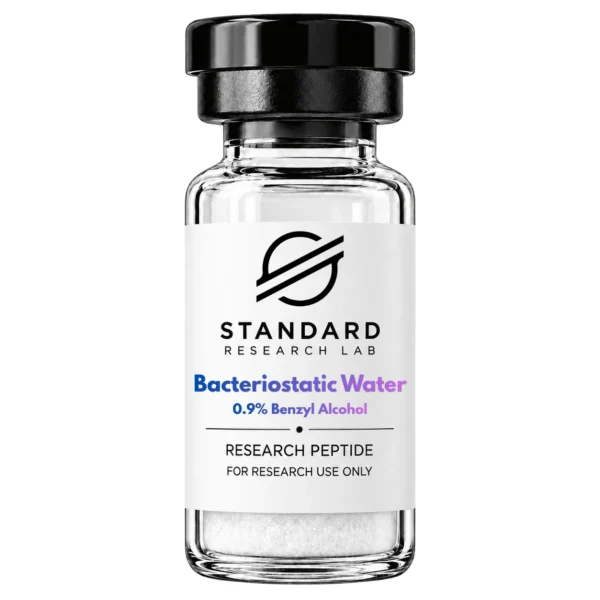
Protect peptide solutions from bacterial contamination and extend reconstituted vial shelf life with Bacteriostatic Water. Formulated with sterile non-pyrogenic water containing 0.9% benzyl alcohol (9 mg/mL), it inhibits microbial proliferation for safe multi-draw protocols.
Bacteriostatic Water (BAC water) is the sterile diluent used to reconstitute lyophilized research peptides and laboratory compounds. It is sterile, non-pyrogenic water preserved with 0.9% (9 mg/mL) benzyl alcohol, which inhibits bacterial growth and allows repeated multi-dose draws from a single vial across a 28-day window once opened. These compact 3 mL and 10 mL vials are sized for a single protocol — enough diluent to finish your work inside that window, without a half-used 30 mL bottle sitting on the bench afterwards.
Multi-dose diluent carries a 28-day beyond-use date from the first puncture, regardless of how much is left inside. A 30 mL bottle used for one compound at 1 mL per reconstitution will still be three-quarters full when that window closes. Buying the volume you will actually finish means you are not paying for diluent that gets discarded — and it removes the temptation to stretch an opened vial past its labelled window. If you want the detail on why that window exists, read How Long Is BAC Water Good For? 28-Day Rule vs. Reality.
At typical reconstitution volumes of 1 mL to 2 mL per peptide vial, a 10 mL vial covers roughly five to eight vials. If you reconstitute at 3 mL per vial, expect three. Use the Peptide Calculator if you want the exact figure for your chosen concentration.
Yes, comfortably. Most 5 mg and 10 mg peptide vials are reconstituted with 1 mL to 3 mL, so a single 3 mL vial is sized for one or two reconstitutions. It is the practical choice if you are reconstituting a single compound and expect to finish it quickly.
Only the volume of diluent — the formulation is identical, 0.9% benzyl alcohol in sterile water. Choose by how much you will use inside 28 days of first puncture: 3 mL for a single compound, 10 mL for one or two compounds over several weeks, or the 30 mL Pfizer Hospira vial for a multi-compound bench.
The vial carries a 28-day beyond-use date from the first puncture of the stopper. Unopened, it is valid through the manufacturer expiry date printed on the label. Store at controlled room temperature (20°C to 25°C) or refrigerated, protected from freezing and direct light.
The volume you add sets the concentration (mg/mL), not the dose. Most researchers use 1 mL to 3 mL per vial depending on peptide mass. For exact syringe units, see How Much Bacteriostatic Water to Add or use the Peptide Calculator.
Directly from Standard Labs. Orders dispatch from British Columbia within one business day (orders placed before 2pm EST are targeted for same-day dispatch) with tracking, and most Canadian cities arrive in 2 to 4 business days. No customs, no import fees.
When available, we publish the supplier-provided Certificate of Analysis for the production lot we received. Each vial carries a Standard Labs batch code linked to our internal inventory records, which may differ from the lot number on the certificate. We’re also expanding independent third-party testing.
Hard to find reliable BAC water that isn't sketchy or overpriced. Stopper is thick and self-seals cleanly even after multiple draws.
Kenji S.Verified BuyerCrystal clear quality. Dissolved my vials in under 5 minutes without any cloudiness. Checkout was super smooth, paid with Interac e-Transfer and had my confirmation within minutes. Great customer experience.
Harpreet D.Verified BuyerHonestly so glad you guys carry the 3ml format instead of just big bottles. Perfect amount to mix single 5mg vials without feeling like I'm throwing out half an expired bottle after 28 days. Order landed in Vancouver in 2 days flat, will definitely reorder on my next cycle.
Zayn K.Verified BuyerGrabbed the 3ml for a quick BPC run so I wouldn't have leftover water expiring in the fridge. Product inside was completely intact, vacuum pulled fine, and reconstituted clear. Deducting a stars because the Canada Post box arrived pretty beat up and the inner packaging was squished, luckily the glass didn't crack. Good quality water, just hope packing gets a little more bubble wrap next time.
Navid K.Verified BuyerWater itself is sterile and works fine, dissolved my vials clean with no burning or issues. Only giving 3 stars because the 3ml ampoules were sold out when I ordered, so I had to buy the 10ml bottle which is mostly going to waste since I'm only running one small cycle.
Samira N.Verified BuyerYour email will not be published. Reviews may need approval before appearing.
PEPTIDE LAB SUPPLIES
PEPTIDE LAB SUPPLIES
PEPTIDE LAB SUPPLIES
PEPTIDE LAB SUPPLIES

A Canadian-owned, B.C. based supplier of research peptides. Building blocks for breakthroughs.