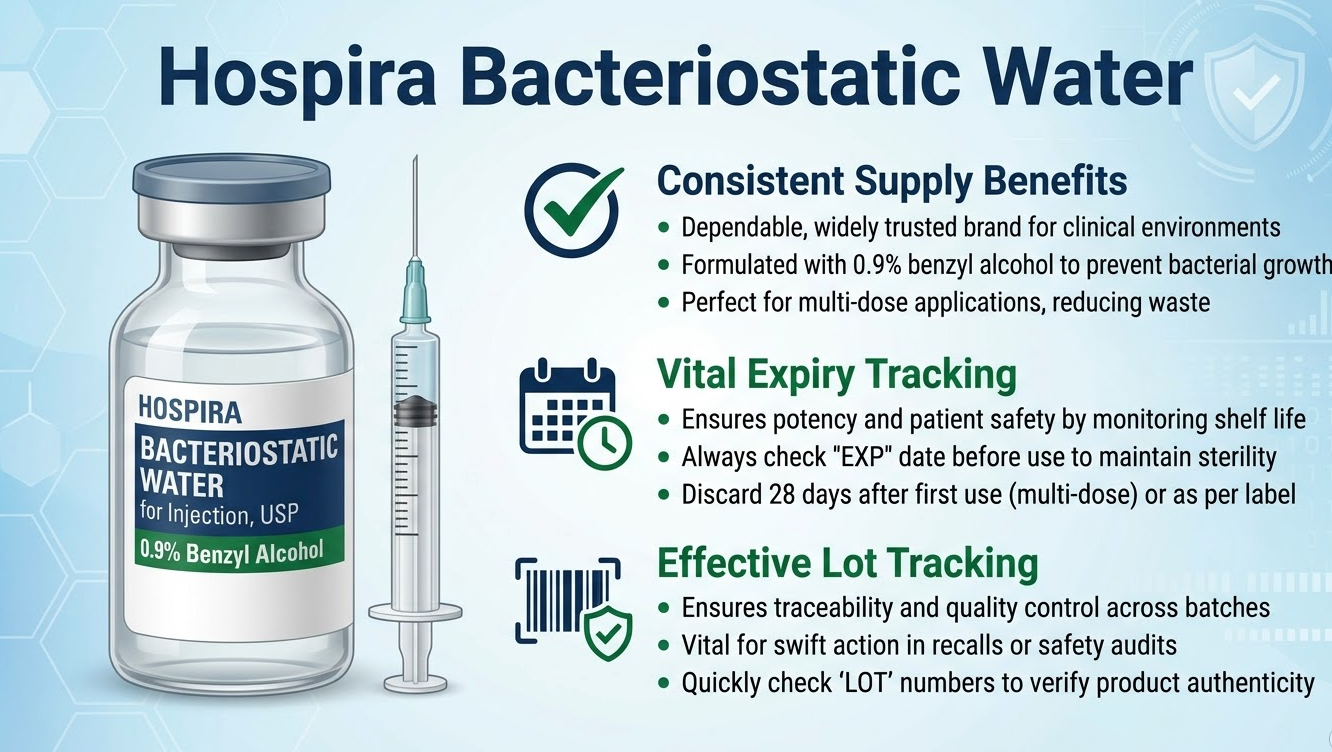
A persistent myth in peptide reconstitution is that a punctured vial of bacteriostatic water magically turns unusable on day 29. While institutional hospital guidelines mandate strict 28-day discard cycles, the underlying chemistry tells a very different story. Genuine Bacteriostatic Water 30 mL Pfizer Hospira retains potent antimicrobial protection for 60 to 90 days in private research settings when handled with proper aseptic technique.
⚡ Quick Answer: Hospira BAC Water Expiry After Opening
How long is Hospira bacteriostatic water good for once opened?
- Clinical / Hospital Setting: 28 days maximum (mandated by CDC & USP <797> multi-patient liability protocols).
- Private Home / Research Setting: 60 to 90+ days, provided strict aseptic technique is followed (fresh sterile needle every draw, 15-second alcohol swab on the septum, clean dry storage).
- Unopened Factory Vial: Valid through the stamped manufacturer expiration date on the bottle (typically 18–24 months from manufacture).
The Critical Dating Split: Factory Shelf Life vs. First-Puncture Window
In standard laboratory management, diluent inventory is governed by two independent timelines: the unopened factory expiration date and the Beyond-Use Date (BUD) established upon first puncture. Confusing these two dates introduces either unnecessary fluid waste or silent contamination risks across weeks of protocol reconstitution.
| Operational Setting | Environment & Access Habits | Realistic Usable Lifespan |
|---|---|---|
| Hospital / Multi-User Ward | Dozens of handlers, shared medication carts, high ambient pathogen risk. | Strict 28-day discard mandated by liability protocols. |
| Private / Home Researcher | Single user, controlled sterile workspace, fresh single-use needles every draw. | 60 to 90+ days without loss of preservative efficacy. |
| Unopened Factory Vial | Intact hermetic seal, inert headspace, zero microbial exposure. | Valid through the printed manufacturer expiry date (often 18–24 months). |
The Preservative Chemistry: Why 0.9% Benzyl Alcohol Lasts
Authentic Pfizer Hospira bacteriostatic water contains 0.9% (9 mg/mL) benzyl alcohol. Benzyl alcohol does not degrade on an arbitrary calendar timer. It creates a chemically hostile environment that disrupts bacterial cell membranes and permanently prevents microbial replication:
1. Chemical Longevity
Benzyl alcohol remains chemically stable at room temperature and under refrigeration for months, continuing to suppress bacterial growth well beyond day 28.
2. Self-Healing Chlorobutyl Septum
Hospira's thick pharmaceutical-grade rubber stopper reseals cleanly when pierced with fine needles, locking ambient atmospheric contaminants out.
3. Zero Dilution Degradation
Unlike reconstituted peptide molecules that can hydrolyze over time, the solvent itself is purely purified water and preservative—it does not break down on its own.
Stock the Industry Baseline in Multi-Dose Diluents
Eliminate contamination worries with authentic, laboratory-grade diluents. Genuine Pfizer Hospira 30 mL provides the volume and preservative longevity needed for extended multi-month cycles.
Shop Hospira Bacteriostatic Water 30 mL →How to Safely Maintain a 30 mL Vial for 60+ Days
To comfortably run an opened Hospira 30 mL vial across 60 days or more without risking contamination, follow these strict sterile handling protocols:
- Aggressive Friction Swabbing: Wipe the rubber septum with a 70% isopropyl alcohol prep pad for 15 seconds, and allow it to air-dry completely before every single puncture.
- Use Fine-Gauge Needles: Avoid large-bore transfer needles (like 18G–22G) that carve holes into the stopper. Drawing with fine-gauge hardware—such as Easy Touch 31G U-100 Syringes—maintains the self-healing integrity of the rubber septum across dozens of entries.
- Never Inject Ambient Air: Equalizing vacuum by pumping unfiltered room air into the vial introduces airborne dust and fungal spores that test the preservative. Draw your volume slowly against natural resistance instead.
- Keep It Out of Direct Light: Store the vial in a cool, dark cabinet or storage case at controlled room temperature (20°C to 25°C). For a deeper breakdown on storage conditions, read: Do You Need to Refrigerate BAC Water? The Surprising Truth.
For a detailed analysis of how preservative kinetics perform in the real world vs. clinical guidelines, explore our full review: How Long Is BAC Water Good For? 28-Day Rule vs. Reality.
Pairing Your Supply with Advanced Delivery & Storage
A high-volume 30 mL supply vial powers multiple reconstitution cycles. Protecting both your source diluent and your mixed compound inventory ensures experimental continuity:
- Reusable Injection Pens: Instead of drawing daily doses with syringes from fragile glass vials, transfer reconstituted compounds into 3mL Injection Pen Glass Cartridges and use the V3 Reusable Injection Pen for click-dialed accuracy, zero dead-space loss, and durable metal protection.
- Dedicated Fridge & Bench Housing: Keep your reconstituted 3 mL vials organized, upright, and shielded from light with the Compact 4-Slot Case or the high-capacity 10-Slot Peptide Vial Case.
- Field & Travel Protection: Keep active pens, backup cartridges, and sterile needle tips secured in transit inside the Compact Peptide Travel Case.
- Alternative Diluents: Reconstituting sensitive peptides like MOTS-c that require physiological osmolarity? Consider Sodium Chloride Saline Bacteriostatic Water 0.9% to eliminate injection burning.
Arithmetic & Dilution Tracking
Accurate mixing records guarantee reproducible research across multi-week cycles:
- Math Verification: Calculate target concentrations (mg/mL) from your 30 mL supply effortlessly using the Peptide Calculator.
- Protocol Schedules: Log lot numbers, puncture dates, and compound volumes with the Protocol Builder and maintain ongoing logs in the Protocol Tracker Tool.
Frequently Asked Questions
Why does the packaging say to discard after 28 days?
Pharmaceutical manufacturers label multi-dose vials according to FDA and USP guidelines written for hospital environments. Discarding at 28 days protects medical institutions from legal liability in non-sterile clinical wards, even though the chemical preservative remains active far longer.
Can I use Hospira bacteriostatic water if it has been open for 60 to 90 days?
Yes, provided you have maintained strict aseptic technique (single-use sterile needles, alcohol swabbing before every draw) and the liquid remains 100% crystal clear. If you ever notice cloudiness, floating specks, or discoloration, discard the vial immediately regardless of age.
Should I store an opened Hospira vial in the fridge or at room temperature?
Pfizer Hospira officially specifies storage at controlled room temperature (20°C to 25°C / 68°F to 77°F). While some researchers keep it in the fridge, room temperature storage is completely stable and prevents condensation from collecting around the crimp seal.
References & Regulatory Guidelines
- Bacteriostatic Water for Injection, USP — FDA DailyMed Official Hospira / Pfizer Monograph
- CDC Safe Injection Practices & Multi-Dose Vial Clinical Guidance
Don't throw away perfectly good diluent because of clinical hospital rules. By practicing proper sterile hygiene, your Bacteriostatic Water 30 mL Pfizer Hospira supply will safely support your peptide reconstitutions for 60+ days of consistent, reliable research.
← View all peptide guides, research & protocols in our Blog Archive