Do You Need to Refrigerate BAC Water? The Surprising Truth
If you have ever wondered: do you need to refrigerate BAC water after unboxing or breaching it, the definitive answer is no. In fact, storing your standalone diluent bottle in the refrigerator is completely unnecessary and can even complicate your reconstitution workflow. While virtually all reconstituted peptide solutions require strict refrigeration, pure bacteriostatic diluent does not follow the same rules.
This common misconception stems from conflating the storage requirements of sensitive peptide chains with the solvent used to dissolve them. Below, we break down why the question of whether do you need to refrigerate BAC water is answered with a clear negative, how benzyl alcohol functions at room temperature, and where you should actually store your vials.
Quick Summary: Do You Need to Refrigerate BAC Water at a Glance?
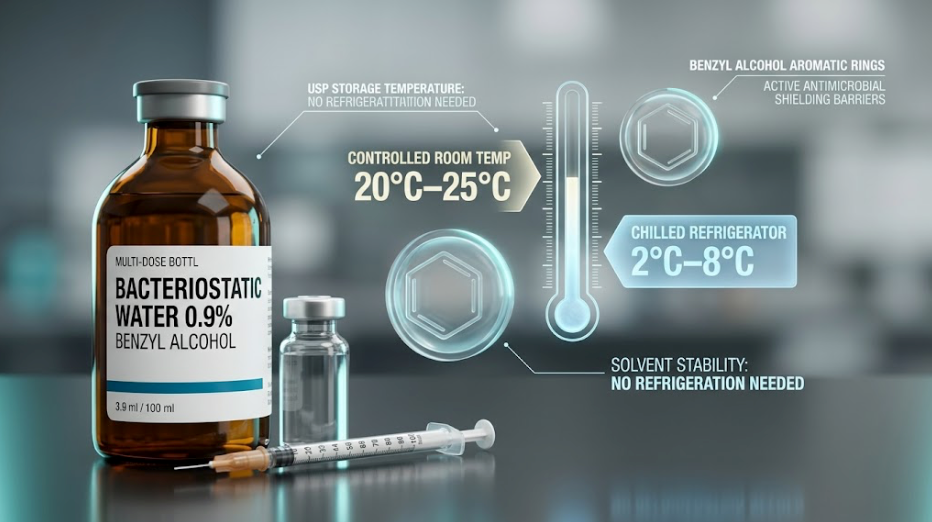
Quick Answer: No, you do not need to refrigerate bacteriostatic water. Standalone diluent containing 0.9% benzyl alcohol is chemically stable at controlled room temperature (20°C to 25°C). Storing it in the refrigerator is unnecessary and creates thermal shock when mixing with room-temperature reagents, though the 28-day post-puncture disposal window still applies.
| Storage Strategy | Storage Temperature | Scientific Impact on Handling |
|---|---|---|
| Controlled Room Temp (Recommended) | 20°C to 25°C (68°F to 77°F) | Optimal dissolution speed; zero condensation shock; fully validated benzyl alcohol efficacy. |
| Refrigerated (Unnecessary) | 2°C to 8°C (36°F to 46°F) | Chilled liquid slows lyophilized powder dissolution; cold glass pulls atmospheric moisture upon room exposure. |
| Frozen / Sub-Zero (Avoid) | ≤ 0°C (32°F) | Expands and cracks glass vials; risks phase separation of benzyl alcohol from the aqueous solvent. |
| Excess Heat & Sunlight (Avoid) | > 30°C (86°F) / Direct UV | Accelerates evaporation through coring tracks and promotes thermal degradation of the rubber septum. |
The Big Confusion: Peptides vs. The Diluent
The assumption that bacteriostatic water belongs in the fridge usually arises from mixing up two completely different biological matrices:
- Reconstituted Peptides (Must Be Refrigerated): Once you dissolve delicate amino acid chains like BPC-157, TB-500, or GHK-Cu Copper Tripeptide in liquid, they become vulnerable to thermal degradation, deamidation, and unfolding. Therefore, the mixed vial must live at 2°C to 8°C (36°F to 46°F).
- Pure Bacteriostatic Water (Room Temperature Stable): Standalone diluent contains no proteins, amino acids, or living biological material. It consists exclusively of highly purified, sterile water and 0.9% benzyl alcohol ($9\text{ mg/mL}$). It has nothing inside it that can spoil from mild ambient warmth.
What Do the Official Pharmaceutical Guidelines Say?
You do not have to guess what conditions are ideal for your solvent. The manufacturer insert and the United States Pharmacopeia (USP) monographs specify exact parameters.
Official medical guidelines for pharmaceutical-grade Bacteriostatic Water state that it should be stored at Controlled Room Temperature: 20°C to 25°C (68°F to 77°F), with temporary excursions permitted between 15°C and 30°C (59°F to 86°F). Crucially, this room-temperature directive applies to both unopened bottles and vials that have already experienced their initial needle puncture.
As documented in literature from the National Center for Biotechnology Information (NCBI) on sterile pharmaceutical excipients, antimicrobial preservatives are specifically tested and validated to maintain full microbiological efficacy at standard room temperature.
Why Benzyl Alcohol Does Not Need the Cold
Refrigeration is designed to slow down bacterial replication by lowering thermal kinetic energy. However, bacteriostatic water does not rely on low temperatures to stop bacteria—it relies on active chemistry:
- Membrane Disruption: Benzyl alcohol is a hydrophobic aromatic compound. It naturally embeds itself into the lipid bilayer of microbial cell walls, compromising membrane permeability and halting cell division.
- Optimal Fluid Dynamics: At controlled room temperature, benzyl alcohol remains perfectly dispersed throughout the water molecules, maintaining uniform contact across the entire container volume.
- Zero Preservative Loss: Benzyl alcohol does not degrade, evaporate, or expire simply by resting in a 22°C (72°F) room. Its chemical potency remains completely steady whether the liquid is cold or temperate.
The Hidden Downsides of Storing BAC Water in the Fridge
Putting standalone bacteriostatic water in the refrigerator is not just unnecessary; it can actually introduce subtle points of friction to your bench routine:
The primary issue with chilled diluent is solvation speed. Lyophilized powders dissolve much faster in room-temperature liquid than in cold fluid. When you inject chilled diluent directly into a dry puck, the slower dissolution rate often tempts researchers to shake or swirl the vial aggressively, introducing unwanted shear stress and foam.
Furthermore, taking cold glass out of the refrigerator causes ambient humidity to condense on the exterior walls and rubber septum. This moisture can drag airborne contaminants across the needle track if the stopper is not re-sanitized and dried properly prior to puncture. Learn proper reconstitution mechanics in our How to Reconstitute Peptides Guide and review timelines in How Long Is BAC Water Good For?.
Best Practices: How and Where to Store Your BAC Water
To ensure your diluent remains pristine throughout its 28-day breached lifecycle (verified with the Protocol Tracker Tool), follow these simple storage principles:
- Choose a Dark, Cool Cabinet: Keep your vial inside a climate-controlled room (a closet, desk drawer, or cupboard) away from direct sunlight, heating radiators, or steam-heavy bathrooms.
- Use a Protective Enclosure: Store your bottle upright inside a specialized Peptide Vial Case or insulated Compact Travel Case to shield the stopper from dust, debris, and physical impacts.
- Strictly Follow the 28-Day Clock: While refrigeration is unnecessary, the 28-day disposal rule still applies. Write the date of first puncture on the label and discard the bottle after 4 weeks to avoid cumulative bioburden.
- Maintain Aseptic Entry: Always wipe the rubber septum with an alcohol prep swab before drawing fluid into an EasyTouch 31G Syringe. Calculate required volumes with the Peptide Calculator.
So, do you need to refrigerate BAC water? Absolutely not. Save your refrigerator space for your fragile, reconstituted peptide vials. Keep your bacteriostatic water in a cool, dry cabinet at controlled room temperature, where its benzyl alcohol preservative does its job best, and enjoy faster, cleaner dissolutions every time you reconstitute.
← View all peptide guides, research & protocols in our Blog Archive