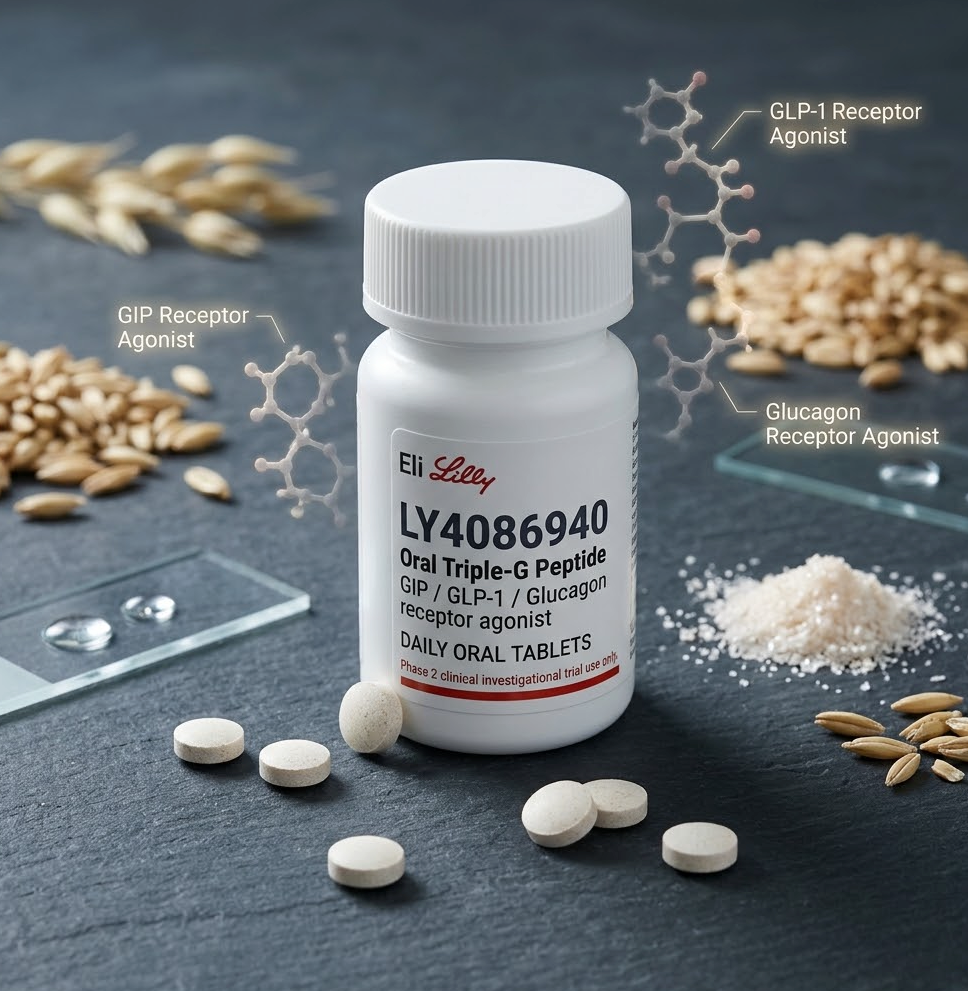
Eli Lilly is advancing a new investigational oral triple-receptor agonist known as LY4086940, or Oral Triple-G. Designed to activate GLP-1, GIP, and glucagon receptors, the compound represents an emerging direction in metabolic research: combining triple-hormone receptor activity with oral administration. While injectable Retatrutide has attracted significant scientific attention, LY4086940 raises a new question: can a triple agonist achieve meaningful metabolic effects without injections?
What Is Oral Triple-G (LY4086940)?
Quick Answer: LY4086940 (Oral Triple-G) is an investigational oral triple-receptor agonist developed by Eli Lilly. It targets three metabolic hormone receptors: GLP-1, GIP, and glucagon. Unlike injectable retatrutide, LY4086940 is designed for oral administration. The compound is being studied for obesity and metabolic regulation, but its clinical efficacy and long-term safety have not yet been established.
| Research Attribute | LY4086940 (Oral Triple-G) |
|---|---|
| Compound Name | LY4086940 |
| Common Name | Oral Triple-G |
| Developer | Eli Lilly and Company |
| Drug Classification | Triple-receptor agonist (GGG) |
| Target Receptors | GLP-1, GIP, and glucagon |
| Administration Route | Oral |
| Research Focus | Obesity, weight management, and metabolic regulation |
| Clinical Trial | NCT06945419 |
| Regulatory Status | Investigational; not FDA-approved |
Understanding LY4086940 and Its Research Applications
LY4086940 is an investigational oral triple-receptor agonist developed by Eli Lilly and Company.
The compound is designed to target three hormone receptors involved in metabolic regulation:
- GLP-1: Associated with appetite regulation, glucose-dependent insulin secretion, and delayed gastric emptying.
- GIP: Involved in insulin secretion, nutrient metabolism, and metabolic signaling.
- Glucagon: Participates in glucose regulation, hepatic energy metabolism, and energy expenditure.
Together, these three pathways represent a growing area of research into multi-receptor therapies for obesity and metabolic disease.
Unlike retatrutide, which is being developed as an injectable triple agonist, LY4086940 is administered orally.
This distinction makes the compound especially relevant to research investigating whether multi-receptor peptide therapies can be delivered without injections.
The Triple-Agonist Mechanism: GLP-1, GIP & Glucagon
Metabolic drug research has evolved from single-receptor agonists such as Semaglutide to dual-receptor compounds such as Tirzepatide and investigational triple-receptor agonists.
LY4086940 builds on this multi-pathway approach.
1. GLP-1 Receptor Agonism
GLP-1 is an incretin hormone involved in the body's response to nutrient intake. GLP-1 receptor activation promotes glucose-dependent insulin secretion, influences appetite signaling, and slows gastric emptying.
These effects have made GLP-1 receptor agonism a major area of obesity and diabetes research.
2. GIP Receptor Agonism
GIP is another incretin hormone that participates in glucose-dependent insulin secretion and nutrient metabolism.
Combining GIP and GLP-1 receptor activity has become an important research strategy for investigating complementary metabolic effects.
3. Glucagon Receptor Agonism
Glucagon is traditionally associated with increasing blood glucose through hepatic glucose production.
However, glucagon receptor signaling is also being investigated for its effects on energy expenditure, lipid metabolism, and hepatic fatty acid oxidation.
Triple agonists seek to combine these pathways in a single compound, potentially producing a broader metabolic response than single-receptor activation.
Whether LY4086940 achieves superior clinical outcomes through this mechanism remains an open research question.
Why Oral Triple-G Is an Important Development
One of the most significant challenges in peptide drug development is oral bioavailability.
Many peptides are vulnerable to enzymatic degradation in the digestive tract and have difficulty crossing the intestinal barrier into systemic circulation.
For this reason, numerous peptide-based metabolic therapies have historically relied on injectable administration.
LY4086940 is particularly interesting because its development explores oral delivery of a triple-receptor agonist.
Key Research Challenges
- Gastrointestinal stability: Maintaining compound integrity during exposure to digestive conditions.
- Oral absorption: Achieving sufficient systemic exposure following administration.
- Bioavailability consistency: Understanding variability between participants.
- Receptor engagement: Maintaining the intended GLP-1, GIP, and glucagon activity.
- Clinical tolerability: Evaluating adverse events associated with oral triple agonism.
Oral peptide delivery is already an established area of pharmaceutical research, including the development of oral semaglutide.
However, successful oral delivery of one peptide does not guarantee comparable results for another. Molecular structure, formulation technology, pharmacokinetics, and receptor activity can all influence clinical performance.
LY4086940 vs. Retatrutide: Key Differences
LY4086940 and Retatrutide (LY3437943) share the same three receptor targets, but they are separate investigational compounds.
| Research Characteristic | LY4086940 (Oral Triple-G) | Retatrutide |
|---|---|---|
| Developer | Eli Lilly | Eli Lilly |
| Receptor Class | Triple agonist | Triple agonist |
| GLP-1 Activity | Yes | Yes |
| GIP Activity | Yes | Yes |
| Glucagon Activity | Yes | Yes |
| Administration | Oral | Subcutaneous injection |
| Primary Research Area | Obesity and metabolic regulation | Obesity and metabolic regulation |
| Human Efficacy Evidence | Not yet established publicly | Published clinical efficacy findings |
| Clinical Development | Early-stage clinical development | Advanced clinical development |
Is LY4086940 Simply Oral Retatrutide?
No. Although both compounds target GLP-1, GIP, and glucagon receptors, LY4086940 should not be described as retatrutide in pill form.
They are distinct molecules that may differ in receptor potency, pharmacokinetic behavior, exposure, tolerability, and clinical efficacy.
Direct comparative research would be necessary to establish whether one compound provides advantages over the other.
LY4086940 Clinical Trials and Research Development
Eli Lilly has registered clinical research investigating LY4086940 in human participants.
Phase 1 Clinical Trial: NCT06945419
The Phase 1 study registered as NCT06945419 investigates LY4086940 in healthy participants and individuals with overweight or obesity, including participants with or without type 2 diabetes.
The study evaluates several important research endpoints:
- Safety and tolerability
- Single- and multiple-ascending-dose administration
- Pharmacokinetic characteristics
- Systemic exposure following oral administration
- Adverse events and treatment tolerability
The trial listing describes an enrollment target of approximately 219 participants and a study period beginning in April 2025.
These early-stage studies are essential for understanding how an investigational compound behaves in humans.
However, successful completion of enrollment or initial clinical testing does not establish therapeutic efficacy.
Official study record: ClinicalTrials.gov – NCT06945419
Phase 2: Evaluating Body-Weight Outcomes
Subsequent clinical development has been reported for LY4086940, including a Phase 2 study identified as NCT07890376.
The reported study design focuses on investigating oral LY4086940 against placebo in adults with obesity or overweight without type 2 diabetes.
Research objectives include evaluating body-weight change, tolerability, and outcomes associated with different investigational dose groups.
The reported primary body-weight assessment is at 32 weeks, with additional follow-up through 48 weeks.
These details should be confirmed against the current trial registry because clinical trial schedules and protocols can change.
Clinical development reference: NCT07890376 Trial Record
Potential Research Advantages of Oral Triple-G
1. Non-Injectable Administration
Oral administration may offer an alternative to injectable metabolic therapies if future studies demonstrate sufficient efficacy and acceptable tolerability.
Convenience and treatment preference are relevant considerations, although oral administration does not automatically guarantee better adherence.
2. Multi-Receptor Metabolic Signaling
Triple agonism provides a framework for investigating coordinated effects on appetite, insulin secretion, glucose regulation, and energy metabolism.
The interaction between these pathways remains an active area of pharmaceutical research.
3. Oral Peptide Formulation Research
LY4086940 may provide additional insight into the feasibility of developing orally administered multi-receptor peptide therapies.
Such research could contribute to advances in peptide stability, gastrointestinal absorption, and drug-delivery technology.
4. Expanded Metabolic Research Approaches
The development of both oral and injectable triple agonists creates opportunities to investigate how administration route and molecular design affect pharmacokinetics, safety, and metabolic outcomes.
LY4086940 Safety and Potential Side Effects
The complete clinical safety profile of LY4086940 has not yet been established.
Other incretin-based therapies have been associated with gastrointestinal adverse events such as nausea, vomiting, diarrhea, and constipation.
However, these observations should not be interpreted as a confirmed adverse-event profile for LY4086940.
Additional areas of investigation include:
- Gastrointestinal tolerability
- Heart rate and cardiovascular parameters
- Glucose regulation
- Effects associated with glucagon receptor activation
- Long-term safety and treatment discontinuation rates
Clinical trial results will be necessary to determine the compound's actual safety and tolerability characteristics.
Is Oral Triple-G (LY4086940) Available?
As of October 2026, LY4086940 remains an investigational compound and is not an approved treatment for obesity or type 2 diabetes.
No approved consumer formulation, established therapeutic dosing regimen, or comprehensive long-term safety profile is available.
Its future clinical development will depend on results from controlled human studies and regulatory evaluation.
The Future of Oral Triple-Receptor Agonists
The emergence of LY4086940 illustrates an important direction in metabolic drug discovery: combining multi-receptor pharmacology with alternative delivery technologies.
While Retatrutide represents the injectable triple-agonist approach, LY4086940 investigates whether similar receptor pathways can be targeted through oral administration.
The most important unanswered questions concern bioavailability, receptor engagement, clinical efficacy, and long-term tolerability.
Future trial results will determine whether oral triple agonism becomes a clinically viable approach.
Frequently Asked Questions
What is LY4086940?
LY4086940 is an investigational oral triple-receptor agonist developed by Eli Lilly. It targets GLP-1, GIP, and glucagon receptors involved in metabolic regulation.
Is Oral Triple-G the same as retatrutide?
No. LY4086940 and retatrutide are separate investigational compounds. They share three receptor targets but differ in molecular identity and administration route.
Is LY4086940 taken orally?
Yes. LY4086940 is being investigated as an orally administered triple-receptor agonist, unlike injectable retatrutide.
Does LY4086940 cause weight loss?
LY4086940 is being investigated for weight management. Its compound-specific clinical weight-loss efficacy has not yet been established through publicly available results.
Is LY4086940 FDA-approved?
No. LY4086940 remains investigational and has not received FDA approval for treating obesity or diabetes.
What receptors does LY4086940 target?
LY4086940 is designed to activate GLP-1, GIP, and glucagon receptors, which participate in appetite regulation, glucose metabolism, and energy balance.
What is the difference between oral and injectable triple agonists?
The primary distinction is the route of administration. Oral compounds must overcome gastrointestinal stability and absorption challenges, while injectable compounds bypass the gastrointestinal absorption process. Differences in molecular structure and formulation may also influence pharmacokinetics and clinical outcomes.
Research Sources and References
- Eli Lilly and Company. LY4086940 Clinical Trial Program. View Lilly Clinical Trial.
- ClinicalTrials.gov. NCT06945419: LY4086940 Phase 1 Study. View Official Study Record.
- ClinicalTrials.gov. NCT07890376: Reported LY4086940 Phase 2 Study. View Study Record.
- On The Pen. Retatrutide Isn't Even Here Yet. Lilly Is Already Testing an Oral Triple Agonist. Read Research Commentary.
Research Summary: LY4086940 (Oral Triple-G) is an investigational Eli Lilly compound targeting GLP-1, GIP, and glucagon receptors through oral administration. Its development represents an emerging direction in metabolic research, combining triple-receptor agonism with the challenges of oral peptide delivery. Clinical efficacy and long-term safety remain to be established.
Free resource
New to peptide research?
The free 51-page guide covers 12 compound profiles, reconstitution math, COA reading and storage — without the hype.
Get the free guide →Or start with the 2-page checklist