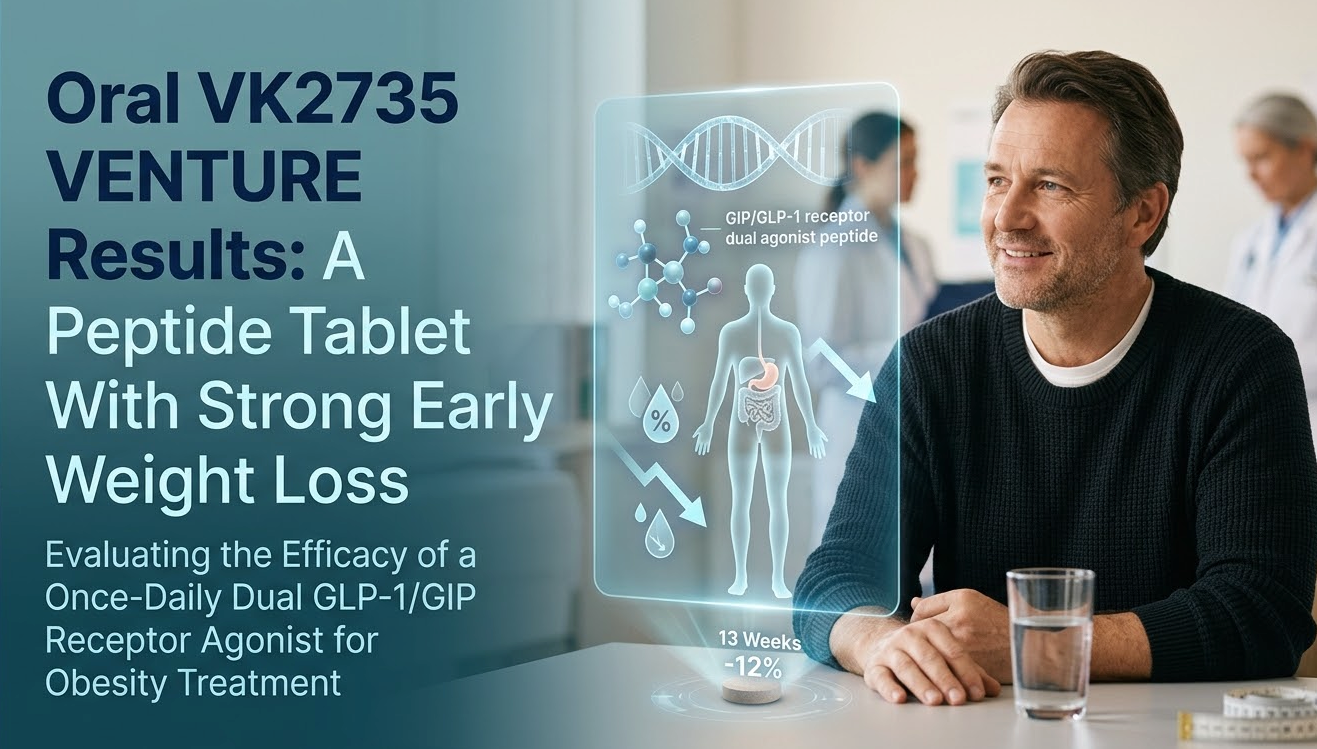
The top-line Phase 2 VENTURE-Oral clinical trial results add an important benchmark to the evaluation of oral VK2735. By assessing a once-daily tablet formulation of a dual GIP and GLP-1 receptor agonist over 13 weeks, these data demonstrate how purposeful oral peptide engineering can drive double-digit weight reduction in non-diabetic obesity, while clarifying the tolerability tradeoffs that dictate real-world treatment adherence.
⚡ Quick Summary: VK2735 VENTURE-Oral Trial Results
Quick Answer: In the 13-week Phase 2 VENTURE-Oral trial evaluating adults with obesity or overweight, once-daily oral VK2735 delivered a statistically significant, dose-dependent mean body weight reduction of up to 12.2% (10.9% placebo-adjusted) at the highest dose level, compared to 1.3% for placebo. As a dual GIP/GLP-1 receptor-activating tablet, oral VK2735 demonstrated rapid kinetic onset with weight loss detectable by week 1. However, high-dose efficacy was accompanied by an overall discontinuation rate of 38% in the highest-dose arm, emphasizing the necessity of refined, slower dose-titration protocols in Phase 3 trials.
| Evaluation Arm (13 Weeks) | Mean Body Weight Change | Placebo-Adjusted Difference | Adverse Event Discontinuation |
|---|---|---|---|
| Oral VK2735 Highest Dose | -12.2% (-12.1 kg) | -10.9% (p < 0.0001) | 38% all-cause dropout in top tier |
| Oral VK2735 Intermediate Doses | -7.0% to -11.1% | -5.7% to -9.8% (p < 0.0001) | Manageable dose-dependent dropout curve |
| Placebo Control Arm | -1.3% (-1.3 kg) | Standardized trial baseline | 13% AE-related dropout (18% overall) |
| Categorical ≥10% Responders | Up to 80% of patients | 5% on placebo (p < 0.0001) | High proportion of double-digit responders |
What Is the Compound? Mechanism of Dual GIP/GLP-1 Oral Peptide Engineering
VK2735 is an investigational synthetic peptide designed to simultaneously co-activate the glucose-dependent insulinotropic polypeptide receptor (GIPR) and the glucagon-like peptide-1 receptor (GLP-1R). While commercial agents like tirzepatide have established the clinical power of dual GIP/GLP-1 agonism via weekly subcutaneous autoinjectors, oral administration of large therapeutic peptides has historically been hindered by the harsh proteolytic environment of the gastrointestinal tract.
The tablet evaluated in VENTURE-Oral is a purpose-engineered solid oral dosage form. It utilizes specialized absorption-enhancing excipients that temporarily stabilize the peptide against gastric degradation, permitting passive mucosal uptake into portal circulation. The dual mechanism functions through complementary physiological pathways:
- GLP-1 Receptor Satiety: Stimulates central anorexigenic signaling within the hypothalamic arcuate nucleus and hindbrain, blunting appetite, delaying gastric transit, and eliminating food cravings.
- GIP Receptor Adipocyte Modulation: Enhances lipid buffering capacity in subcutaneous adipose tissue, improves peripheral insulin sensitivity, and counteracts the nauseating visceral signals often triggered by high-potency GLP-1 monotherapy.
Crucially, oral peptide formulations are chemically and biophysically distinct from injectable solutions. Swallowing liquid peptide intended for subcutaneous injection results in immediate enzymatic digestion with zero bioavailability; oral efficacy is strictly dependent on the proprietary excipient co-formulation tested in this trial.
How the Study Worked: VENTURE-Oral Trial Architecture
The VENTURE-Oral study was structured as a randomized, double-blind, placebo-controlled Phase 2 dose-finding trial designed to evaluate the safety, tolerability, pharmacokinetics, and weight-loss trajectory of daily tablet administration:
1. Study Population & Enrollment
Enrolled 240 to 280 adults presenting with obesity (BMI ≥30 kg/m²) or overweight (BMI ≥27 kg/m² with weight-related comorbidities), strictly excluding patients with type 2 diabetes.
2. Rapid 13-Week Dose Exploration
Evaluated six escalating daily oral dose cohorts (ranging from 15 mg to 120 mg) against matching placebo over a 13-week treatment period to define the optimal therapeutic index.
3. Primary Weight-Loss Endpoint
The prespecified primary outcome tracked the percentage change in body weight from baseline to Week 13 across all randomized cohorts, alongside categorical responder rates (≥5% and ≥10% loss).
4. Tolerability & Persistence Profiling
Secondary metrics closely monitored gastrointestinal adverse event kinetics, weekly nausea/vomiting incidence, and premature treatment discontinuation across all active dose cohorts.
Complete clinical protocol parameters and top-line announcements are documented in the Viking Therapeutics Primary Study Release.
Results and Key Findings: High-Magnitude Early Loss & Dose-Response Dynamics
The 13-week data from VENTURE-Oral demonstrated rapid kinetic onset of weight reduction across escalating tablet strengths:
- Double-Digit Weight Loss (-12.2%): Patients in the highest-dose cohort achieved a mean weight reduction of 12.2% (12.1 kg / 26.6 lbs) from baseline, compared to 1.3% (1.3 kg / 2.9 lbs) on placebo (p < 0.0001). The placebo-adjusted net weight loss stood at 10.9%.
- Dose-Dependent Gradients: Progressive dose escalation yielded clear biological gradients: intermediate cohorts achieved mean reductions ranging from 7.0% (30 mg) to 11.1% (90 mg), proving that oral absorption was reliable and dose-proportional.
- Categorical Responders (≥10% Loss): In the top-tier cohort, 80% of patients achieved a ≥10% body weight reduction within 13 weeks, compared to just 5% in the placebo group (p < 0.0001).
- Absence of Weight Plateau: Weight trajectories across all active dose cohorts exhibited a continuous, downward slope through Week 13, suggesting that longer exposure in future Phase 3 trials could unlock deeper weight reduction if patients remain on therapy.
The Study in Plain English: Understanding Oral Peptide Tradeoffs
Interpreting early-phase obesity trials requires understanding the balance between rapid weight-loss headlines and treatment persistence:
| Trial Metric | Clinical Definition | Real-World Patient Meaning |
|---|---|---|
| 13-Week Weight Trajectory | Short-term kinetic rate of weight reduction during early dose titration | Shows how quickly the drug starts working; does not predict where weight will stabilize after a year |
| Placebo-Adjusted Loss | Net weight loss calculated after subtracting weight lost by the placebo group | Isolates the exact pharmacological effect of the tablet from natural lifestyle or diet adjustments |
| All-Cause Discontinuation | The percentage of patients who stop taking the trial medication for any reason | Reflects real-world tolerability; a drug that causes rapid weight loss is ineffective if patients cannot stay on it |
| Oral Peptide Bioavailability | The percentage of an swallowed intact peptide that successfully crosses into the bloodstream | Requires strict daily adherence: swallowing the tablet with water, followed by fasting to ensure absorption |
Key Insights: What Makes the VENTURE-Oral Results Critical?
The findings from VENTURE-Oral carry major strategic implications for the competitive pipeline of oral obesity medications:
- Overcoming the Bioavailability Barrier: Skeptics long asserted that dual GIP/GLP-1 peptides were too large to achieve competitive systemic exposure via oral tablets. Achieving 12.2% weight loss in 13 weeks matches or exceeds the early weight loss seen with high-dose subcutaneous injections, proving the viability of Viking's oral delivery platform.
- The Discontinuation Hurdle: The most significant clinical takeaway is the tolerability tradeoff: 38% of patients in the highest-dose arm discontinued treatment early. While 98% of gastrointestinal adverse events were graded as mild or moderate, rapid titration into high doses overwhelmed gastric comfort for a substantial minority of participants.
- The Path Toward Refined Titration: Phase 2 trials exist precisely to identify tolerability ceilings. The data indicate that future Phase 3 trials must utilize smaller incremental dose steps and longer titration intervals (e.g., 4-to-6-week steps rather than rapid escalation) to preserve the compound's deep weight-loss potency while keeping discontinuations manageable.
Tolerability & The Complete Safety Profile
The safety and adverse-event spectrum in VENTURE-Oral mirrored the established class effects of dual incretin therapies, while highlighting the sensitivity of oral dosing:
- Gastrointestinal Event Profile: Nausea and vomiting were the most frequently observed treatment-emergent adverse events (TEAEs). Nausea occurred in 58% of VK2735-treated participants versus 48% with placebo; 98% to 99% of GI-specific events were categorized as mild or moderate.
- Transient Kinetic Pattern: Gastrointestinal symptoms were concentrated during the initial weeks of therapy. Across combined active arms, weekly rates of nausea or vomiting dropped below 5% after the third week of treatment.
- Discontinuation Rates: Overall adverse-event-related discontinuation was 20% with VK2735 versus 13% with placebo. In the highest-dose cohort, all-cause discontinuation reached 38%, underscoring the need for gentler titration schedules in subsequent registrational studies.
For complete safety disclosures and presentation tables, reference the Viking Therapeutics Primary Trial Announcement.
Comparative Research Themes & Next-Generation Incretin Pipelines
To contextualize oral VK2735 within the broader landscape of obesity pharmacotherapy, researchers compare oral incretin tablets against weekly injectables:
| Investigational / Approved Approach | Hormone Receptor Targets | Delivery Route & Frequency | Clinical Differentiator |
|---|---|---|---|
| Oral VK2735 (VENTURE-Oral) | Dual Agonist: GIP + GLP-1 | Daily Oral Tablet | Rapid onset (12.2% loss at 13 wks); requires optimized titration |
| Oral Semaglutide (OASIS 4) | Single GLP-1 Receptor Agonist | Daily Oral Tablet (SNAC co-formulation) | Proven 64-wk weight loss (13.6%–16.6%); U.S. approved Wegovy pill |
| Subcutaneous VK2735 (VENTURE) | Dual Agonist: GIP + GLP-1 | Weekly Subcutaneous Injection | Deep weight loss (~15% at 13 wks); advancing to Phase 3 (VANQUISH) |
| Tirzepatide (Zepbound) | Dual Agonist: GIP + GLP-1 | Weekly Subcutaneous Injection | Established global standard in dual-incretin weight management |
For an in-depth review of dual-incretin biology, explore our guide: What Is Tirzepatide? Dual-Incretin Mechanisms. To examine approved oral incretin formulations, read our report: Oral Semaglutide OASIS 4 Results: 25 mg Weight Loss Trial.
What Patients and Clinicians Can Look Forward To
VK2735 remains an investigational compound that is not yet approved by the U.S. FDA or international health authorities. However, the completion of the Phase 2 VENTURE-Oral trial confirms that Viking Therapeutics has successfully developed an oral tablet formulation capable of driving substantial weight loss.
For patients who experience severe needle aversion, an effective once-daily dual GIP/GLP-1 tablet represents a highly desirable alternative to weekly autoinjectors. As Viking refines its dose-titration protocols for Phase 3 evaluation, the goal is to preserve this double-digit efficacy while improving real-world treatment persistence.
Questions for the Next Stage of Research
While the 13-week VENTURE-Oral findings provide strong proof-of-concept, several vital clinical questions guide the transition into registrational studies:
- Long-Term Durability (52–68 Weeks): Will the steep downward weight trajectory continue over a full year, and what final percentage weight loss will oral VK2735 achieve upon reaching a steady-state plateau?
- Titration Optimization: Can extending dose-escalation intervals from 2–3 weeks to 4–6 weeks reduce the 38% high-dose discontinuation rate to levels comparable to weekly injectables?
- Fasting and Food-Effect Requirements: What are the precise morning fasting and water-intake constraints required to ensure consistent gastrointestinal absorption of the oral tablet?
Explore Our Research Tools
To assist laboratory scientists and clinicians in tracking peptide calculations, experimental schedules, and analytical observations, explore our specialized software suite:
- Calculate volume measurements and concentration parameters with the interactive Peptide Calculator.
- Structure research intervals, timing windows, and observation phases inside the Protocol Builder.
- Log laboratory markers, baseline patient metrics, and analytical notes with the Protocol Tracker Tool.
Scientific References & Primary Trial Documents
- Viking Therapeutics: Positive Top-Line Results from Phase 2 VENTURE-Oral Dosing Trial of VK2735 Tablet Formulation in Patients with Obesity (Primary Report)
- What Is Tirzepatide? Dual-Incretin Mechanisms
- Oral Semaglutide OASIS 4 Results: 25 mg Weight Loss Trial
Clinical Verdict: The Phase 2 VENTURE-Oral clinical trial confirms that a once-daily tablet formulation of VK2735 achieves statistically significant, dose-dependent weight loss of up to 12.2% in just 13 weeks in patients with obesity. While demonstrating that dual GIP/GLP-1 oral peptide delivery can rival injectable weight-loss potency, the 38% high-dose discontinuation rate highlights the necessity of slower, symptom-guided dose titration as this promising oral therapy advances into Phase 3 trials.
← View all clinical research, trials & peptide analyses in our Blog Archive