
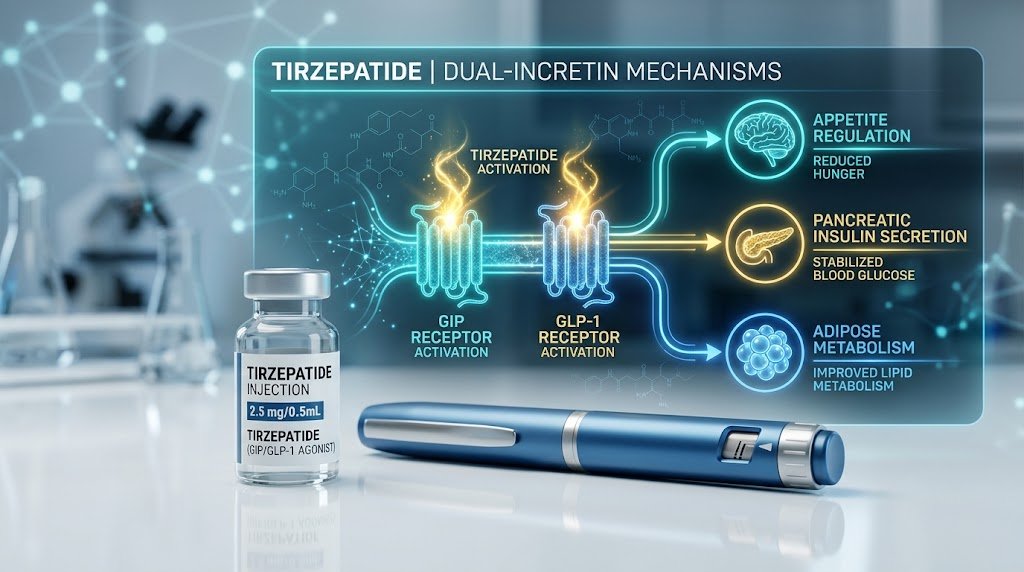
What Is Tirzepatide? Dual-Incretin Mechanisms & Research
For years, metabolic medicine focused almost entirely on single-target glucagon-like peptide-1 (GLP-1) receptor agonists. While single incretins delivered meaningful results, researchers consistently hit dose-escalation ceilings driven by gastrointestinal intolerance and metabolic adaptation.
Tirzepatide changed this paradigm fundamentally by demonstrating the power of dual-receptor co-agonism. By engaging both glucose-dependent insulinotropic polypeptide (GIP) and GLP-1 receptors simultaneously, Tirzepatide triggers synergistic metabolic pathways that curb appetite, improve insulin sensitivity, and accelerate adipose reduction far beyond single-target alternatives.
Quick Summary: What Is Tirzepatide at a Glance?
Quick Answer: Tirzepatide is a synthetic 39-amino-acid peptide that acts as a dual GIP and GLP-1 receptor agonist. By combining GIP-mediated insulin sensitization and white adipose tissue lipid buffering with GLP-1-mediated central appetite suppression and delayed gastric transit, it delivers superior glycemic stabilization and up to ~22% body weight reduction in landmark clinical trials.
| Parameter | GIP Receptor (GIPR) Component | GLP-1 Receptor (GLP-1R) Component |
|---|---|---|
| Receptor Selectivity | Imbalanced high-potency agonism (matches native GIP affinity) | Biased partial agonism (~5× lower affinity than native GLP-1) |
| Primary Biological Action | Adipose blood flow regulation, lipid clearance, nausea buffering | Hypothalamic satiety signaling, delayed gastric emptying, food noise control |
| Metabolic Impact | Enhances subcutaneous fat storage flexibility over visceral ectopic fat | Suppresses caloric intake and stimulates glucose-dependent insulin secretion |
| Trial Milestones | Documented 20.9% to 22.5% mean mass reduction at 15 mg weekly in SURMOUNT-1 | |
Molecular Structure & Pharmacokinetics
Tirzepatide is an engineered 39-amino-acid peptide based on the native GIP sequence, modified with synthetic amino acids and lipid side chains:
- C20 Fatty Diacid Chain: A specialized C20 diacid moiety attached at lysine residue 20 via a hydrophilic linker. This fatty acid enables reversible albumin binding in blood plasma.
- Elimination Half-Life: Albumin conjugation extends its elimination half-life to approximately 5 days (~120 hours), permitting a steady once-weekly subcutaneous dosing cadence.
- Peptide Resistance: Incorporates alpha-aminoisobutyric acid (Aib) residues at positions 2 and 13 to block rapid enzymatic degradation by dipeptidyl peptidase-4 (DPP-4).
Mechanisms of Action: The Dual-Incretin Advantage
Tirzepatide’s clinical efficacy comes from non-overlapping physiological synergy between its two receptor targets:
1. GIP Receptor Agonism (Sensitization & Adipose Buffering)
Historically, GIP was considered a fattening hormone because it promotes lipid uptake into fat cells. However, research revealed that tonic GIP receptor activation actually restores healthy white adipose tissue buffering capacity. It improves insulin sensitivity in peripheral tissues, promotes lipid uptake into protective subcutaneous depots rather than damaging visceral organs, and buffers against the acute nausea typically triggered by high-dose GLP-1 receptor activation.
2. GLP-1 Receptor Agonism (Appetite Control & Glycemic Regulation)
Tirzepatide activates GLP-1 receptors in the hypothalamic arcuate nucleus and hindbrain area postrema. This central signaling silences compulsive food noise, accelerates fullness cues, and reduces daily caloric intake. Peripherally, it slows gastric motility and triggers glucose-dependent insulin release from pancreatic beta cells while suppressing excessive post-meal glucagon.
3. Preferential Adipose Breakdown & Lean Tissue Sparing
By facilitating lipid turnover while reducing systemic hyperinsulinemia, dual incretin therapy promotes selective fat oxidation. Clinical DEXA evaluations demonstrate that fat mass accounts for the vast majority of total weight lost, helping preserve metabolically active skeletal muscle mass.
Clinical Trial Evidence: The SURMOUNT & SURPASS Highlights
Tirzepatide has been extensively documented in large-scale Phase 3 clinical trials:
1. SURMOUNT-1 (Obesity & Chronic Weight Management)
In a landmark 72-week Phase 3 trial of 2,539 adults with obesity or overweight without diabetes, Tirzepatide demonstrated dose-dependent reductions in average body mass:
- 5 mg weekly: 15.0% average weight loss
- 10 mg weekly: 19.5% average weight loss
- 15 mg weekly: 20.9% average weight loss (with up to 40% of patients achieving ≥25% weight loss)
2. Glycemic Superiority in SURPASS Trials
Across head-to-head SURPASS trials in type 2 diabetes cohorts, Tirzepatide consistently achieved greater reductions in HbA1c (often exceeding -2.3% to -2.6%) compared to selective GLP-1 monotherapies, insulin glargine, and oral agents.
3. Expanded Indications: Sleep Apnea & Metabolic Health
Beyond glycemic control, dual incretin therapy has gained FDA approval for treating moderate-to-severe obstructive sleep apnea (OSA) in adults with obesity, reflecting profound reductions in pharyngeal adipose tissue and nighttime airway collapsibility.
Documented Research Titration & Dosing Protocols
Clinical protocols enforce gradual, 4-week step-up increments to allow gastrointestinal receptor habituation. Investigators commonly calculate vial math using our free Peptide Reconstitution Calculator and track schedule intervals inside the Protocol Tracker Tool.
| Protocol Phase | Subcutaneous Dose (Once Weekly) | Evaluation Interval | Primary Research Focus |
|---|---|---|---|
| Initiation Phase | 2.5 mg once weekly | Weeks 1–4 | Gastric habituation, tolerability baseline (non-therapeutic dose) |
| Escalation Step 1 | 5.0 mg once weekly | Weeks 5–8 | First active metabolic dose; early appetite and glycemic control |
| Escalation Step 2 | 7.5 mg once weekly | Weeks 9–12 | Sustained adiposity reduction and enhanced GIP adipose buffering |
| Escalation Step 3 | 10.0 mg once weekly | Weeks 13–16 | Higher therapeutic efficacy; significant lipid and HbA1c optimization |
| Escalation Step 4 | 12.5 mg once weekly | Weeks 17–20 | Advanced titration step for non-plateauing models |
| Maximum Ceiling | 15.0 mg once weekly | Weeks 21+ | Maximum evaluated trial ceiling for profound weight management |
Microdosing vs. Maximum Dose Escalation
While standard commercial protocols push patients toward maximum 15 mg rungs, clinical and community researchers frequently adopt flexible strategies:
- Symptom-Gated Maintenance: Instead of advancing automatically every 4 weeks on a calendar, protocols hold patients at 5.0 mg or 7.5 mg as long as appetite suppression and glycemic metrics remain steady.
- Targeted Microdosing: Normal-BMI individuals and autoimmune researchers frequently evaluate fractional micro-doses (1.0 mg to 2.5 mg weekly), aiming to capture systemic anti-inflammatory benefits without triggering unintended weight loss. Learn more in our guide on GLP-1 microdosing schedules.
Recommended Laboratory Screening & Safety Checks
Investigators evaluating Tirzepatide in experimental research monitor specific metabolic markers:
- Metabolic & Glycemic Panels: Baseline fasting glucose, HbA1c, and fasting insulin to assess incretin response.
- Lipid & Liver Enzymes: Comprehensive lipid panel, ALT, AST, and GGT to track hepatic steatosis improvement.
- Renal & Hydration Markers: BUN, creatinine, and eGFR. Incretin therapies blunt thirst cues, making adequate hydration (2.5–3.0 L/day plus electrolytes) essential to avoid dehydration-related renal strain.
- Oral Contraceptive Interaction: Delayed gastric emptying can transiently reduce absorption of oral contraceptive pills. Studies advise using backup barrier methods for 4 weeks after initiation and after each dose escalation.
Synergistic Research Pairings & Incretin Benchmarks
In multi-pathway metabolic research, Tirzepatide is frequently compared against emerging multi-receptor analogues and tissue repair compounds:
- Retatrutide (Triple Agonist): Compared against the triple GIP/GLP-1/Glucagon agonism of Retatrutide, which adds thermogenic hepatic lipid burn to dual incretin therapy. Review our comprehensive Retatrutide Guide (or source Retatrutide research vials).
- Cagrilintide & Amylin Agonists: Evaluated alongside long-acting amylin analogues to study non-incretin neuroendocrine satiety circuits. Read our Cagrilintide Guide.
- MOTS-c: Paired with MOTS-c to examine cellular mitochondrial biogenesis alongside systemic incretin-driven fat oxidation.
- 5-Amino-1MQ: Investigated alongside 5-Amino-1MQ to evaluate intracellular NNMT enzyme inhibition combined with systemic GLP-1/GIP signaling.
- BPC-157: Investigators monitor mucosal integrity by pairing incretins with BPC-157 to analyze gut barrier preservation during rapid metabolic shifts.
- Wolverine Blend: Teams cross-reference metabolic profiles with the Wolverine Blend Guide (or Wolverine Blend vials) during concurrent tissue recovery models.
Laboratory Handling, Reconstitution & Storage Standards
To preserve the chemical stability of this 39-amino-acid peptide during research evaluations, protocols enforce standard laboratory cold-chain rules (detailed in our Beginner's Guide to Peptides):
- Diluent Selection: Reconstitute lyophilized Tirzepatide using sterile, pharmaceutical-grade Pfizer Hospira Bacteriostatic Water containing 0.9% benzyl alcohol to prevent microbial contamination throughout multi-dose testing schedules. Alternatively, select 0.9% Sterile Bacteriostatic Saline for isotonic protocols.
- Reconstitution Protocol: Use a sterile EasyTouch 31G Syringe to dispense diluent gently down the interior glass wall of the vial. Never spray liquid directly onto the lyophilized cake. Avoid shaking; roll the vial slowly between your hands until the liquid is clear and uniform.
- Temperature Control: Store dry lyophilized powder at -20°C for long-term molecular stability. Maintain reconstituted liquid solutions between 2°C and 8°C (36°F to 46°F) inside a secure, light-shielded Peptide Vial Case or insulated Compact Travel Case to protect against mechanical vibration and light degradation. Use within 28 days.
Tirzepatide represents a defining milestone in metabolic pharmacology. By validating the dual-incretin hypothesis, it proved that engaging complementary endocrine pathways generates superior fat loss, glycemic control, and adipose tissue remodeling compared to single-receptor agonists. Maintaining disciplined titration schedules, tracking hydration markers, and adhering to strict laboratory handling standards ensures reliable, high-integrity experimental outcomes.
← View all peptide guides, research & protocols in our Blog Archive


21 comments