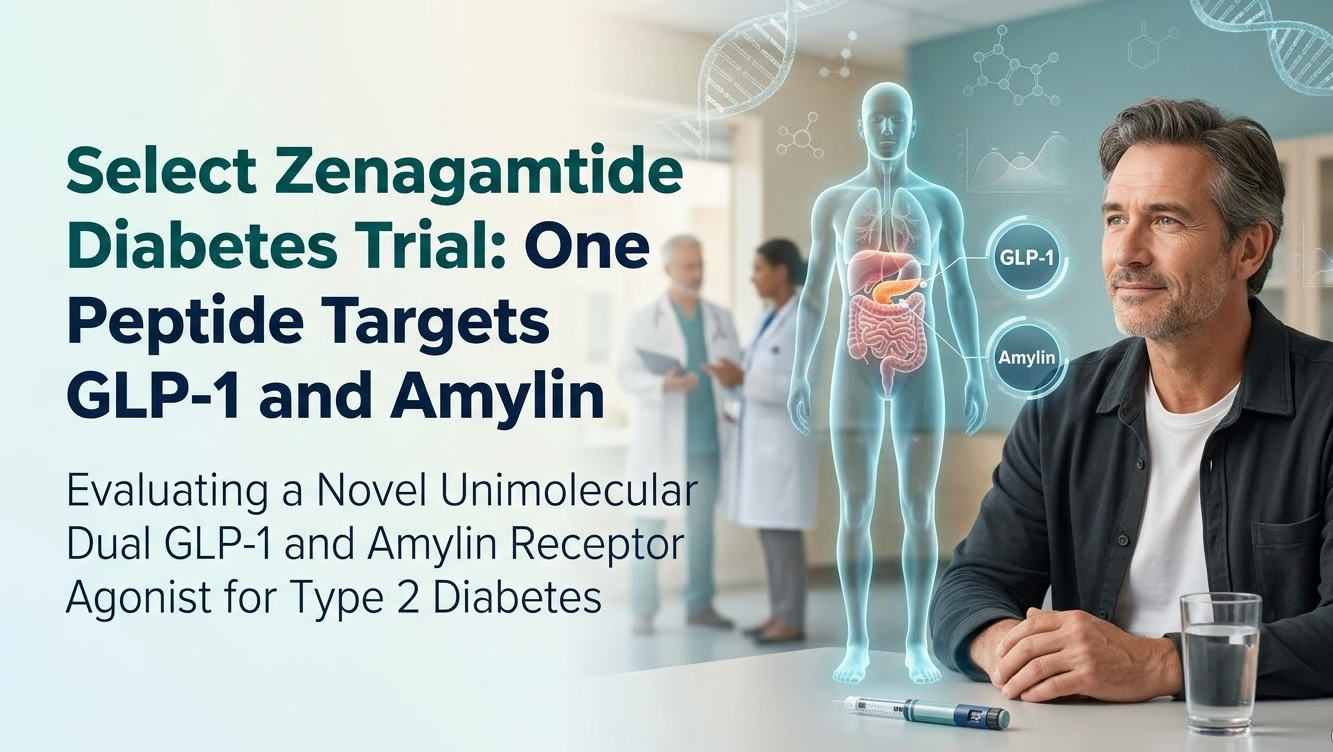
The 36-week Phase 2 clinical readout for Zenagamtide (formerly Amycretin / NNC0487-0111) marks a critical milestone in metabolic endocrinology. By evaluating once-weekly subcutaneous administration of a single unimolecular peptide co-targeting the GLP-1 and amylin receptors in adults with type 2 diabetes, these data provide definitive proof-of-concept that dual neuroendocrine pathway activation delivers potent glycemic normalization alongside double-digit weight reduction.
⚡ Quick Summary: Zenagamtide Type 2 Diabetes Phase 2 Results
Quick Answer: In the 36-week Phase 2 dose-finding trial evaluating 262 adults with type 2 diabetes on background metformin ± SGLT2 inhibitors, once-weekly subcutaneous zenagamtide (amycretin) met its primary glycemic endpoint across all tested doses. At the highest evaluated dose, up to 89.1% of patients achieved an HbA1c <7.0%, accompanied by an estimated 14.6% mean body weight reduction. By combining GLP-1-driven glucose-dependent insulinotropic action with amylin-mediated glucagon suppression and hindbrain satiety in a single molecule, zenagamtide overcomes the blunted weight-loss response characteristic of diabetic populations while restoring glycemic control.
| Evaluation Arm (36 Weeks) | Primary Glycemic Status | HbA1c <7.0% Target Clearance | Mean Body Weight Loss |
|---|---|---|---|
| Zenagamtide Top Dose (SubQ) | Primary endpoint met across doses | Up to 89.1% of cohort | -14.6% (dose-dependent) |
| Zenagamtide Intermediate Tiers | Statistically significant vs. placebo | High-tier glycemic normalization | Progressive, dose-ordered loss |
| Placebo Control Arm | Baseline glycemic control maintained | Standard background control rate | Negligible change on metformin ± SGLT2i |
| Safety & Tolerability Signal | Class-consistent gastrointestinal AEs | Low hypoglycemia incidence | Supports progression into Phase 3 |
What Is the Compound? Unimolecular Dual GLP-1 and Amylin Co-Agonism
Zenagamtide (originally developed under the investigational moniker amycretin and code-named NNC0487-0111) is an engineered synthetic peptide designed to act as a unimolecular co-agonist at both the glucagon-like peptide-1 receptor (GLP-1R) and human amylin/calcitonin receptors (AMY1–3). Unlike multi-agent regimens that require co-packaging or co-administering two distinct peptide chains (such as CagriSema, which combines cagrilintide and semaglutide), zenagamtide incorporates both biological pharmacophores into a single, cohesive molecular sequence.
The molecular engineering behind zenagamtide coordinates glucose and energy homeostasis through two synergistic pathways:
- Incretin Glucoregulatory Axis (GLP-1R): Stimulates glucose-dependent insulin secretion from pancreatic beta cells, delays gastric emptying to blunt postprandial glucose spikes, and acts centrally on the hypothalamic arcuate nucleus to suppress hunger and reduce food cravings.
- Neuroendocrine Satiation Axis (Amylin/Calcitonin Receptors): Activates calcitonin core complexes coupled with receptor activity-modifying proteins (RAMPs) in the area postrema and nucleus of the solitary tract (NTS) in the hindbrain. This mimics endogenous amylin's natural meal-terminating fullness signal while potently suppressing inappropriate postprandial glucagon secretion from pancreatic alpha cells.
- Balanced Unimolecular Pharmacokinetics: By utilizing a single peptide backbone with an integrated fatty-acid protraction moiety, zenagamtide ensures that target tissues experience perfectly synchronized, equimolar exposure to both hormonal signals, avoiding the divergent clearance kinetics that can complicate multi-peptide combinations.
The transition from the code name amycretin to the official generic stem zenagamtide reflects standard International Nonproprietary Name (INN) adoption, with earlier preclinical and Phase 1 trial disclosures directly informing its clinical profile.
How the Study Worked: Phase 2 Type 2 Diabetes Architecture
The Phase 2 study was designed as a randomized, double-blind, placebo-controlled, dose-finding trial to characterize the dose-response relationship, glycemic efficacy, and weight-loss kinetics of subcutaneous zenagamtide in a real-world diabetic population:
1. Clinically Representative Population
Enrolled 262 adults diagnosed with inadequately controlled type 2 diabetes who were maintained on a stable background regimen of metformin, with or without a sodium-glucose cotransporter-2 (SGLT2) inhibitor.
2. Staged 36-Week Evaluation
Subjects underwent gradual dose titration followed by sustained maintenance across multiple subcutaneous dose tiers for up to 36 weeks, evaluating glycemic nadir stabilization and weight trajectory over an extended duration.
3. Primary Glycemic Hurdle
The prespecified primary endpoint assessed changes in glycated hemoglobin (HbA1c) from baseline to week 36 across escalating dose cohorts compared to matching placebo, establishing the therapeutic window.
4. Categorical Metabolic Thresholds
Secondary outcomes tracked the proportion of participants achieving the American Diabetes Association target of HbA1c <7.0%, total percentage body weight reduction, and the incidence of gastrointestinal adverse events.
Complete clinical methodology and primary corporate releases are documented in the Novo Nordisk Phase 2 Type 2 Diabetes Primary Trial Report.
Results and Key Findings: Glycemic Normalization and Double-Digit Weight Loss
The 36-week data confirmed that unimolecular GLP-1 and amylin co-agonism delivers robust glycemic control alongside high-magnitude weight reduction in a population historically resistant to weight loss:
- Primary Endpoint Achievement: Subcutaneous zenagamtide met its primary endpoint with high statistical significance across all tested dose tiers, driving substantial, dose-dependent reductions in HbA1c at 36 weeks compared to placebo.
- Target Glycemic Clearance (Up to 89.1% <7.0%): In the top-dose cohort, up to 89.1% of patients achieved an HbA1c below 7.0%, demonstrating that the vast majority of treated individuals attained clinical glycemic normalization on top of baseline oral therapy.
- Double-Digit Weight Loss (-14.6%): Despite the metabolic resistance typical of type 2 diabetes—where concurrent hyperinsulinemia and background medications blunt lipolysis—the highest reported subcutaneous dose produced an estimated 14.6% mean body weight reduction at 36 weeks.
- Differentiating Targets from Absolute Drops: Clinical reporting must carefully distinguish between target-achievement rates (the 89.1% share of patients crossing the clinical threshold of <7.0%) and the mean numerical drop in HbA1c percentage points, ensuring accurate communication of therapeutic benefit.
The Study in Plain English: Understanding Diabetes Trial Metrics
Interpreting clinical trials in type 2 diabetes requires understanding how laboratory blood-sugar percentages interact with proportional body-weight changes:
| Trial Terminology | Clinical Definition | Real-World Patient Meaning |
|---|---|---|
| HbA1c <7.0% Target Achievement | The percentage of patients who lower their 3-month average blood glucose marker below 7% | Indicates successful disease control; reaching <7% significantly lowers long-term kidney, eye, and nerve damage |
| 14.6% Mean Weight Loss in T2D | Proportional body weight lost from starting baseline (e.g., losing ~32 lbs from a 220 lb starting weight) | Major metabolic fat loss that directly relieves hepatic steatosis, improves insulin sensitivity, and lowers cardiovascular strain |
| Unimolecular Peptide | A single manufactured peptide designed to hit two distinct biological targets at the same time | One injection delivers both insulin-sensitizing GLP-1 action and fullness-signaling amylin action |
| Background Metformin ± SGLT2i | Standard oral diabetes medications taken continuously alongside the experimental trial drug | Proves that adding zenagamtide provides powerful extra glucose and weight benefits on top of existing standard-of-care pills |
Key Insights: What Makes the Zenagamtide Diabetes Data Critical?
The clinical contribution of the Phase 2 zenagamtide diabetes program provides essential insights into the next wave of metabolic pharmacology:
- Overcoming the "Diabetes Weight-Loss Penalty": In historical trials of single-agent GLP-1 receptor agonists (such as semaglutide in SUSTAIN) and dual GIP/GLP-1 co-agonists (such as tirzepatide in SURPASS), patients with type 2 diabetes consistently lose approximately 30% to 50% less weight than patients without diabetes. Achieving a 14.6% weight loss in a diabetic cohort within 36 weeks confirms that adding amylin-mediated hindbrain fullness significantly counteracts this metabolic resistance.
- Dual-Action Glycemic Synergy: By simultaneously enhancing glucose-dependent insulin secretion (via GLP-1) and shutting down inappropriate post-meal glucagon secretion (via amylin), zenagamtide attacks both arms of pancreatic islet dysfunction. This complementary action explains why nearly 90% of treated patients crossed the stringent HbA1c <7.0% threshold.
- Streamlined Manufacturing Pipeline: Unlike two-peptide combinations (such as CagriSema) that require synthesizing, purifying, and co-formulating two separate drug substances, zenagamtide's single-chain architecture simplifies large-scale commercial manufacturing, easing future production capacity constraints.
Tolerability & The Complete Safety Profile
Throughout the 36-week dose-finding evaluation, zenagamtide exhibited a safety and adverse-event spectrum characteristic of incretin- and amylin-based therapies:
- Gastrointestinal Event Profile: Mild-to-moderate nausea, vomiting, and diarrhea were the most frequently observed treatment-emergent adverse events (TEAEs). Consistent with incretin class dynamics, these symptoms peaked during dose titration and declined during maintenance.
- Hypoglycemia Profile: Because GLP-1 stimulates insulin release in a strictly glucose-dependent manner and amylin suppresses glucagon without blocking physiological counter-regulation during fasting, rates of clinically significant hypoglycemia remained low in patients receiving background metformin and SGLT2 inhibitors.
- Dose Exploration Guidance: The Phase 2 data provided the pharmacokinetic and tolerability parameters needed to refine titration intervals, identifying optimal maintenance doses that maximize glycemic control while minimizing gastrointestinal dropouts for registrational trials.
For complete safety data disclosures and presentation materials, reference the Novo Nordisk Primary Corporate Release.
Comparative Research Themes & Next-Generation Metabolic Pipelines
To contextualize zenagamtide within the broader landscape of diabetes and obesity therapeutics, researchers compare single-, dual-, and multi-target mechanisms:
| Investigational / Approved Approach | Molecular Class & Architecture | Receptor Pathways | T2D Clinical Profile |
|---|---|---|---|
| Zenagamtide (Amycretin) | Unimolecular Peptide Co-Agonist | Dual Agonist: GLP-1 + Amylin/Calcitonin | Up to 89.1% HbA1c <7.0%; -14.6% weight loss in Phase 2 |
| CagriSema Program | Two-Drug Fixed-Dose Combination | Dual Agonist: Semaglutide + Cagrilintide | Potent glycemic lowering & synergistic satiety in Phase 3 |
| Survodutide (SYNCHRONIZE-2) | Dual Agonist Peptide (GCGR/GLP-1R) | Glucagon + GLP-1 Receptor Agonist | -1.21% HbA1c drop & -13.1% weight loss in T2D at 76 wks |
| Tirzepatide (Mounjaro / SURPASS) | Dual Incretin Peptide (GIPR/GLP-1R) | GIP + GLP-1 Receptor Agonist | Established benchmark; HbA1c drops >2% & weight loss ~15% |
For an in-depth review of unimolecular amylin/GLP-1 biology, explore our guide: Amycretin Beginner's Guide: Novo's GLP-1 + Amylin Dual Agonist. To evaluate dual-hormone glucagon co-agonism in diabetes, read: Survodutide SYNCHRONIZE-2 Results: Phase 3 Trial Data.
What Patients and Clinicians Can Look Forward To
Zenagamtide remains an investigational agent undergoing active clinical evaluation; it is not yet approved by the U.S. FDA or international health authorities. However, the successful completion of this Phase 2 type 2 diabetes trial, alongside its 22% weight-loss readout in non-diabetic obesity, solidifies zenagamtide as a premier clinical asset in Novo Nordisk's pipeline.
For clinicians and patients managing type 2 diabetes, the prospect of a single once-weekly peptide that delivers near-90% glycemic normalization alongside the weight-loss magnitude of multi-drug combinations represents an encouraging therapeutic advance. Furthermore, parallel ongoing trials evaluating an oral tablet formulation of zenagamtide indicate that this unimolecular mechanism may eventually become available as a needle-free daily pill.
Questions for the Next Stage of Research
While the 36-week Phase 2 diabetes findings provide robust proof-of-concept, several vital clinical questions guide the transition into registrational Phase 3 trials:
- Long-Term Durability (52–76 Weeks): Will the 89.1% target glycemic achievement and 14.6% weight reduction be sustained through 1 to 2 years of continuous treatment in global Phase 3 cohorts?
- Comparison to Active Dual Incretins: How will zenagamtide perform in direct head-to-head randomized trials against tirzepatide (Mounjaro) and CagriSema in patients with type 2 diabetes?
- Cardiovascular and Renal Outcomes: Beyond glucose and weight, will unimolecular GLP-1/amylin co-agonism demonstrate proven reductions in major adverse cardiovascular events (MACE) and slow the progression of diabetic kidney disease?
Explore Our Research Tools
To assist laboratory scientists and clinicians in tracking peptide calculations, experimental schedules, and analytical observations, explore our specialized software suite:
- Calculate volume measurements and concentration parameters with the interactive Peptide Calculator.
- Structure research intervals, timing windows, and observation phases inside the Protocol Builder.
- Log laboratory markers, baseline patient metrics, and analytical notes with the Protocol Tracker Tool.
Scientific References & Primary Trial Documents
- Novo Nordisk: Phase 2 Trial of Zenagamtide (Amycretin) in Type 2 Diabetes Successfully Completed (Primary News Release)
- Amycretin Beginner's Guide: Novo's GLP-1 + Amylin Dual Agonist
- Survodutide SYNCHRONIZE-2 Results: Phase 3 Trial Data
Clinical Verdict: The Phase 2 zenagamtide type 2 diabetes trial confirms that unimolecular co-agonism of the GLP-1 and amylin receptors achieves powerful metabolic control, enabling up to 89.1% of patients to reach an HbA1c <7.0% while delivering a 14.6% mean body weight reduction at 36 weeks. By demonstrating that a single peptide chain can co-target insulin secretion, glucagon suppression, and hindbrain fullness in a diabetic population, zenagamtide establishes a compelling, evidence-based foundation for late-stage registrational development.
← View all clinical research, trials & peptide analyses in our Blog Archive