Amycretin Guide: Novo Nordisk GLP-1 & Amylin Dual Agonist
Within obesity medicine and metabolic endocrinology, the paradigm has shifted decisively from single-pathway incretin mimetics toward multi-receptor agonists. While combination strategies like CagriSema co-administer two separate molecules—a GLP-1 analogue (semaglutide) and an amylin analogue (cagrilintide)—pharmacologists have pursued a more streamlined objective: an engineered single molecule capable of simultaneously activating both receptor targets.
Amycretin (investigational code by Novo Nordisk) represents this next evolutionary leap: a novel unimolecular co-agonist engineered to stimulate both the glucagon-like peptide-1 (GLP-1) receptor and the calcitonin/amylin receptor complexes. Evaluated in both oral tablet and subcutaneous injectable formulations, amycretin has demonstrated unprecedented early weight-loss kinetics in Phase 1 clinical trials. This guide breaks down amycretin’s molecular structure, dual receptor mechanisms, clinical trial evidence, and laboratory handling standards.
Quick Summary: What Is Amycretin at a Glance?
Quick Answer: Amycretin is a synthetic, long-acting unimolecular peptide co-agonist developed by Novo Nordisk. Unlike multi-peptide combinations, amycretin contains dual binding affinities for both the GLP-1 receptor and calcitonin/amylin (AMYR) complexes within a single peptide chain. In Phase 1 trials, it achieved an average weight loss of 13.1% in just 12 weeks for the oral tablet formulation and up to 16% in subcutaneous cohorts.
| Parameter | Amycretin (Unimolecular Co-Agonist) | CagriSema (Fixed-Dose Co-Formulation) |
|---|---|---|
| Molecular Format | Single engineered peptide chain (dual ligand) | Two separate peptides (Semaglutide + Cagrilintide) |
| Receptor Targets | GLP-1R + AMY1–3 / Calcitonin receptors | GLP-1R + AMY1–3 / Calcitonin receptors |
| Delivery Formats | Oral tablet (SNAC carrier) & Once-weekly Sub-Q | Once-weekly Subcutaneous injection |
| Phase 1 Mass Reduction | 13.1% at 12 weeks (Oral) | ~16% (Sub-Q) | ~20.4% to 22.7% (Phase 3 REDEFINE, 68 weeks) |
| Manufacturing Profile | Single synthetic sequence and unified stability profile | Dual synthesis and paired compatibility profiling |
What Is Amycretin?
Amycretin is a synthetic, long-acting unimolecular peptide developed by Novo Nordisk that acts as a dual agonist at both the GLP-1 receptor (GLP-1R) and amylin receptors (AMY1, AMY2, and AMY3). Unlike dual incretins such as tirzepatide (which targets GLP-1 and GIP), amycretin merges incretin biology with neuroendocrine calcitonin-family signaling within a single peptide chain.
Rather than combining two distinct chemical entities in one syringe or tablet, amycretin's single backbone is synthesized with tailored amino acid substitutions and lipid side chains that allow it to fold and dock precisely into both receptor binding pockets. This design achieves:
- Unimolecular Dual Agonism: Balanced pharmacological activation of two distinct appetite- and glucose-regulating endocrine systems without formulation incompatibilities.
- Dual Delivery Formats: Formulated both as an oral tablet utilizing SNAC (sodium N-(8-[2-hydroxybenzoyl]amino)caprylate) permeation technology and as a once-weekly subcutaneous injectable.
- Extended Pharmacokinetics: Lipidation engineered for high-affinity, reversible binding to circulating serum albumin, shielding the molecule from rapid renal filtration and enzymatic breakdown.
- Complementary Neuronal Targeting: Simultaneous engagement of hypothalamic energy circuits and hindbrain meal-termination centers.
Amycretin vs. CagriSema: Co-Agonist vs. Co-Formulation
Researchers often confuse amycretin with CagriSema due to their shared biological targets. However, their structural formulation and clinical delivery represent fundamentally different engineering philosophies:
| Parameter | CagriSema | Amycretin |
|---|---|---|
| Molecular Format | Co-formulation of two distinct peptides | Unimolecular single peptide chain (co-agonist) |
| Active Compounds | Semaglutide (GLP-1) + Cagrilintide (Amylin) | Single engineered peptide (dual GLP-1R / AMY agonist) |
| Receptor Targets | GLP-1R + AMY1–3 / Calcitonin receptors | GLP-1R + AMY1–3 / Calcitonin receptors |
| Investigational Routes | Subcutaneous injection (fixed-dose combination) | Subcutaneous injection (weekly) & Oral tablet (daily) |
| Receptor Engagement Ratio | Fixed 1:1 milligram dose ratio (e.g., 2.4 mg / 2.4 mg) | Intrinsic affinity ratio dictated by single-molecule design |
| Manufacturing Complexity | Dual synthesis and paired stability profiling | Single synthetic sequence and unified stability profile |
Dual Mechanism of Action: Synergy in Satiety and Metabolism
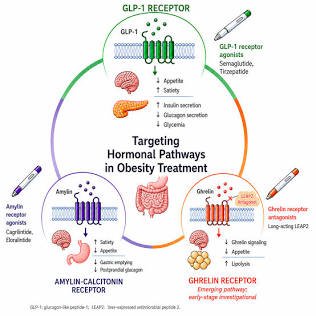
Amycretin’s therapeutic power stems from the physiological synergy between GLP-1 and amylin signaling. While both hormones suppress caloric intake and reduce postprandial blood glucose, they operate through complementary, non-overlapping pathways:
- Dual G-Protein Coupling: Amycretin binds simultaneously to the classical GLP-1 receptor and calcitonin receptor heterodimers (CTR partnered with RAMP1, RAMP2, or RAMP3). Both receptor families couple to stimulatory G-protein alpha subunits, driving intracellular cyclic AMP (cAMP) and Protein Kinase A (PKA) generation.
- Complementary Central Neurocircuitry:
- GLP-1 Arm: Primarily targets the hypothalamic arcuate nucleus, stimulating anorexigenic POMC/CART neurons while suppressing hunger-driving NPY/AgRP neurons to lower homeostatic appetite setpoints.
- Amylin Arm: Directly accesses the area postrema and the nucleus of the solitary tract (NTS) in the caudal hindbrain, activating noradrenergic projections to the lateral parabrachial nucleus to accelerate meal-termination and fullness signaling.
- Non-Overlapping Gastric Deceleration: Both pathways synergistically slow gastric emptying, preventing rapid nutrient influx into the duodenum and substantially flattening postprandial glucose excursions.
- Dual-Action Glycemic Stabilization: While the GLP-1 component drives glucose-dependent insulin secretion from pancreatic beta cells, the amylin component suppresses inappropriate postprandial glucagon release from alpha cells. Together, they lower blood glucose with minimal risk of hypoglycemia.
Early Clinical Trial Results: Phase 1 Breakthroughs
Phase 1 clinical trial data presented by Novo Nordisk highlighted striking efficacy across both oral and subcutaneous delivery platforms, positioning amycretin among the most rapid weight-loss candidates evaluated to date:
1. Oral Amycretin Trial Data
In a Phase 1, double-blind, randomized, placebo-controlled trial evaluating oral amycretin in participants with overweight or obesity:
- Mean Weight Loss: Participants receiving oral amycretin reached an average body weight reduction of 13.1% at just 12 weeks, compared to 1.1% in the placebo cohort.
- Rapid Trajectory: The rate of mass reduction outpaced early trial benchmarks established by oral semaglutide, with continuous downward trajectory and no plateau observed at the 12-week mark.
2. Subcutaneous Injectable Trial Data
In parallel Phase 1 trials assessing the weekly subcutaneous formulation of amycretin:
- Interim Weight Reductions: Early data demonstrated continuous weight loss reaching up to approximately 16% over 12 to 16 weeks of exposure, depending on the dose-escalation cohort.
- Biomarker Improvements: Clinically meaningful improvements were recorded in waist circumference, fasting blood glucose, and circulating lipid fractions.
3. Tolerability and Gastrointestinal Profile
The safety profile of amycretin aligns with known incretin and amylin pharmacology:
- Adverse Events: Mild-to-moderate gastrointestinal symptoms (nausea, vomiting, diarrhea, and constipation) represented the most frequent side effects, predominantly clustered during upward dose titration.
- Adaptation: Consistent with other amylin mimetics, gastrointestinal events were largely transient and diminished as receptor tolerance stabilized across maintenance periods.
Documented Dosing Protocols & Titration Concepts
Because amycretin activates both GLP-1 and calcitonin/RAMP complexes, experimental and clinical designs emphasize gradual dose escalation to safeguard gastrointestinal tolerability:
| Protocol Parameter | Oral Formulation | Subcutaneous Formulation |
|---|---|---|
| Administration Route | Oral tablet (formulated with SNAC) | Subcutaneous (Sub-Q) injection |
| Frequency | Once daily | Once weekly (every 7 days) |
| Administration Timing | Fasted morning state with a sip of water; wait 30 min before food | Independent of food intake, at any time of day |
| Dose Escalation Cadence | Stepwise increases every 2 to 4 weeks | Stepwise 4-week increments |
| Primary Monitored Endpoints | Adiposity reduction, caloric intake, GI adverse events | Body composition, fat vs. lean mass, glycemic control |
Synergistic Research Pairings & Incretin Benchmarks
In metabolic research and comparative endocrinology, amycretin is regularly cross-referenced against next-generation multi-incretin analogues and regenerative compounds:
- Semaglutide: Serves as the historical GLP-1 benchmark. Amycretin adds direct amylin receptor activation to the GLP-1 backbone, dramatically accelerating the rate of weight loss compared to mono-GLP-1 therapies. Review the foundations of GLP-1 signaling in our Semaglutide Research Guide.
- CagriSema: The fixed-dose predecessor co-administering cagrilintide and semaglutide. Read complete Phase 3 REDEFINE trial endpoints in our dedicated What Is CagriSema? Guide.
- Tirzepatide: Whereas tirzepatide pairs GLP-1 with GIP receptor agonism, amycretin explores the GLP-1 plus amylin axis, offering an alternative dual mechanism for subjects encountering incretin resistance. Explore the differences in our Tirzepatide Dual Incretin Guide.
- Retatrutide: Investigators benchmark amycretin's neuroendocrine satiety pathways against the metabolic rate acceleration of triple GIP/GLP-1/Glucagon agonists. Read comprehensive trial findings in our Retatrutide Dosing & Trial Evidence Guide (or view Retatrutide research vials).
- Comparative Metabolic Landscape: Compare the entire class of emerging candidates side-by-side in our Best GLP-1 for Weight Loss Guide.
- BPC-157: In preclinical investigations into gastrointestinal motility and mucosal barrier stability, research models evaluate whether co-administering cytoprotective pentadecapeptides supports mucosal adaptation during potent GLP-1/amylin titration. See our BPC-157 Mechanism & Research Protocols.
- TB-500: Teams studying cellular structural integrity and actin regulation evaluate TB-500 (Thymosin Beta-4) alongside rapid adiposity reduction models.
- GHK-Cu: In protocols analyzing connective tissue health, dermal elasticity, and collagen synthesis during rapid weight loss, scientists explore the tripeptide detailed in our GHK-Cu Copper Tripeptide Overview.
Laboratory Handling, Reconstitution & Storage Standards
Maintaining the structural stability of unimolecular dual agonists requires adherence to established peptide laboratory standards (detailed step-by-step in our Beginner's Guide to Peptides):
- Diluent Selection: For injectable research formats, reconstitute lyophilized peptide vials with pharmaceutical-grade Pfizer Hospira Bacteriostatic Water containing 0.9% benzyl alcohol to prevent bacterial contamination across multi-dose schedules. For specific in-vitro or cell-culture assays requiring isotonic conditions without benzyl alcohol, use sterile 0.9% Sterile Bacteriostatic Saline.
- Reconstitution Protocol: Direct the diluent stream smoothly down the inside glass wall of the vial using a sterile EasyTouch 31G Syringe. Avoid agitating or vigorously shaking the solution; swirl the vial gently in a circular motion until the lyophilized cake is fully dissolved to prevent peptide shearing. Follow our step-by-step instructions on how to reconstitute peptides and how much bacteriostatic water to add.
- Mathematical Accuracy: Calculate exact syringe tick marks and volume distributions with our free online Peptide Calculator and manage multi-week test intervals inside the Protocol Tracker Tool.
- Cold-Chain Maintenance: Store lyophilized vials at -20°C for long-term peptide preservation. Once reconstituted, solutions should be kept refrigerated at 2°C to 8°C (36°F to 46°F), shielded from light and mechanical vibration inside a protective Peptide Vial Case or insulated Compact Travel Case, and utilized within 28 to 30 days.
Amycretin demonstrates the power of molecular engineering in combining two complementary hormone pathways into a single therapeutic candidate. Delivering over 13% weight loss in just 12 weeks in oral Phase 1 trials and even higher reductions in subcutaneous models, amycretin represents a pivotal milestone in the future of multi-target metabolic medicine.
← View all peptide guides, research & protocols in our Blog Archive