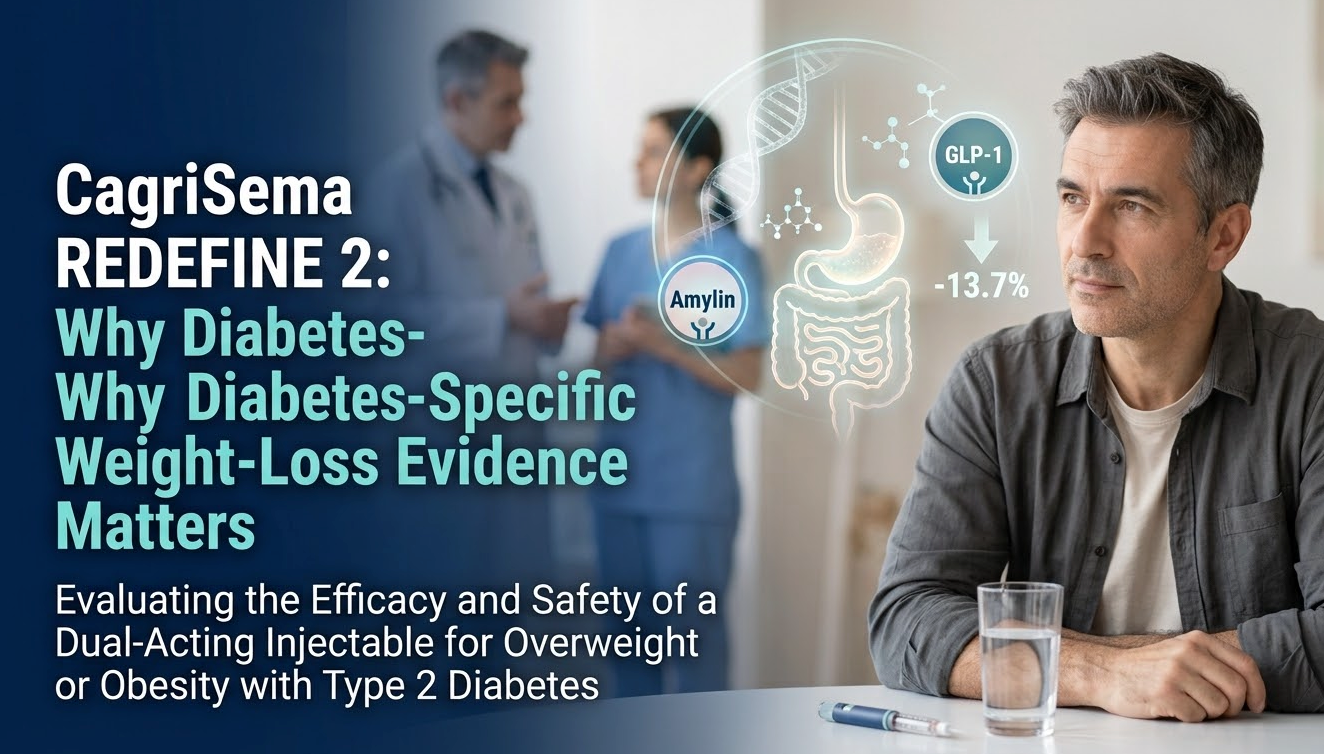
The 68-week Phase 3 REDEFINE 2 clinical trial results provide critical evidence on the metabolic performance of CagriSema. By evaluating the co-formulation of the amylin analogue cagrilintide with the GLP-1 receptor agonist semaglutide specifically in adults with type 2 diabetes, the study demonstrates how dual-hormone signaling counteracts the physiological resistance that historically impairs weight loss in diabetic populations.
⚡ Quick Summary: CagriSema REDEFINE 2 Trial Results
Quick Answer: In the 68-week Phase 3 REDEFINE 2 clinical trial enrolling 1,206 adults with type 2 diabetes and overweight or obesity, once-weekly CagriSema (cagrilintide 2.4 mg + semaglutide 2.4 mg) achieved statistically significant, double-digit weight reduction alongside robust glycemic control. Under the treatment-policy estimand (evaluating all randomized participants regardless of adherence), CagriSema delivered a 13.7% mean body weight reduction compared to 3.4% for placebo. Under the trial-product estimand (adherent exposure), weight loss reached 15.7% (versus 3.1% for placebo), establishing that combining amylin and GLP-1 receptor mechanisms overcomes the blunted weight-loss response characteristic of type 2 diabetes.
| Statistical Estimand (68 Weeks) | CagriSema Arm | Placebo Control Arm | Estimated Treatment Difference (ETD) |
|---|---|---|---|
| Treatment-Policy Estimand (ITT) | -13.7% | -3.4% | -10.3% (p < 0.0001) |
| Trial-Product Estimand (Adherent) | -15.7% | -3.1% | -12.6% (p < 0.0001) |
| Trial Population Profile | 1,206 Adults with T2D (BMI ≥27) | 1,206 Adults with T2D (BMI ≥27) | Evaluated across 68 weeks with lifestyle support |
| Gastrointestinal Safety Signal | Class-consistent nausea/vomiting | Lower GI adverse events | Predictable profile; no new systemic toxicity |
What Is the Compound? Dual Amylin and GLP-1 Receptor Biology
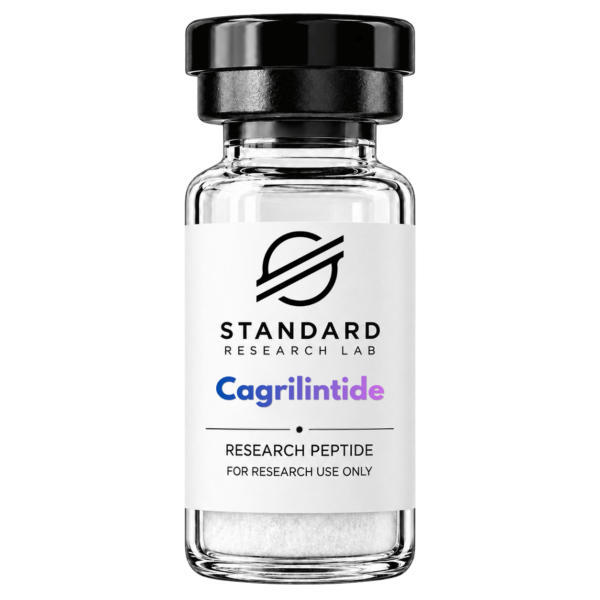
CagriSema is an investigational, fixed-dose co-formulation combining two distinct long-acting peptide therapies into a single weekly subcutaneous autoinjector: the selective amylin analogue cagrilintide (2.4 mg) and the established GLP-1 receptor agonist semaglutide (2.4 mg). Developed by Novo Nordisk, the combination leverages synergistic neuroendocrine signaling pathways governing metabolic homeostatic control:
- Semaglutide (GLP-1 Receptor Agonist): Acts primarily on the hypothalamic arcuate nucleus and autonomic brainstem centers, stimulating glucose-dependent pancreatic insulin release, suppressing inappropriate glucagon secretion, slowing gastric transit, and blunting appetite cravings.
- Cagrilintide (Dual Amylin/Calcitonin Receptor Agonist): Mimics endogenous amylin, a neuroendocrine hormone co-secreted with insulin by pancreatic beta cells. Cagrilintide binds calcitonin receptor core complexes (AMY1–3) within the area postrema and nucleus of the solitary tract (NTS) in the caudal hindbrain, driving homeostatic meal satiation and suppressing postprandial glucagon surges without inducing hypoglycemia.
- Formulated Synergy vs. Manual Mixing: CagriSema is a precision pharmaceutical co-crystallization optimized for chemical stability, liquid compatibility, and synchronized subcutaneous absorption. Clinical trial results cannot be replicated by manually combining separate compounded products or mixing incompatible research vials.
By engaging both the hypothalamus (GLP-1) and the hindbrain (amylin) simultaneously, CagriSema targets complementary satiety and metabolic networks to maximize energy deficit without exceeding the tolerability threshold of either single pathway.
How the Study Worked: REDEFINE 2 Trial Architecture
The REDEFINE 2 study was engineered as a prospective, randomized, double-blind, placebo-controlled Phase 3 trial to assess the efficacy, durability, and safety of CagriSema specifically in patients managing type 2 diabetes:
1. Diabetes-Specific Study Cohort
Randomized 1,206 adults diagnosed with type 2 diabetes and a baseline BMI ≥27 kg/m², maintained on background metformin or diet-and-exercise management, isolating diabetes-specific metabolic outcomes.
2. Prolonged 68-Week Treatment Duration
Subjects underwent stepped dose titration across both peptide components followed by sustained maintenance over 68 weeks, providing a full annual assessment of weight-loss plateau dynamics.
3. Dual Estimand Statistical Model
Evaluated outcomes using the treatment-policy estimand (intention-to-treat including treatment dropouts) alongside the trial-product estimand (evaluating on-treatment biological potency in fully adherent subjects).
4. Standardized Behavioral Lifestyle Co-Intervention
Both the active CagriSema arm and the placebo control arm received identical, standardized nutritional counseling (a 500 kcal/day deficit) and physical activity recommendations throughout the trial.
Detailed trial protocol parameters and peer-reviewed primary findings are documented in the REDEFINE 2 Primary Study Report (PubMed).
Results and Key Findings: Overcoming the Diabetes Weight-Loss Deficit
Achieving double-digit percentage weight reduction in patients with type 2 diabetes represents a major clinical milestone, as metabolic adaptations and hyperinsulinemia consistently reduce responsiveness to caloric restriction. The REDEFINE 2 data demonstrated high-magnitude therapeutic efficacy across both primary statistical frameworks:
- The Treatment-Policy Estimand (-13.7%): In the primary intention-to-treat analysis—which accounts for all randomized participants regardless of whether they adhered to dosing, discontinued early, or initiated rescue therapies—CagriSema produced a 13.7% mean body weight reduction, compared to 3.4% in the placebo group (p < 0.0001).
- The Trial-Product Estimand (-15.7%): Under the on-treatment efficacy model—evaluating participants who remained adherent without treatment disruption—CagriSema delivered a 15.7% mean weight loss compared to 3.1% on placebo (p < 0.0001).
- Population-Specific Context: Crucially, these figures reflect outcomes in type 2 diabetes. They must not be conflated with the parallel REDEFINE 1 trial in non-diabetic obesity, where incretin and amylin therapies routinely generate higher baseline percentage weight reductions due to the absence of insulin-mediated anabolic resistance.
- Comparative Incretin Context: In the SURPASS-2 trial, tirzepatide 15 mg achieved an average weight loss of approximately 13.1% in type 2 diabetes over 40 weeks, while semaglutide 1.0 mg produced ~6.7%. CagriSema's 13.7% to 15.7% reduction places it in the upper echelon of weight-loss interventions in diabetic cohorts.
The Study in Plain English: Interpreting Trial Estimands & Diabetes Metrics
Interpreting clinical trials in diabetes and obesity pharmacotherapy requires understanding the distinction between statistical reporting models and biomarker units:
| Trial Terminology | Clinical / Statistical Definition | Real-World Patient Meaning |
|---|---|---|
| Treatment-Policy Estimand | Evaluates every randomized patient regardless of whether they stopped medication early | Reflects expected real-world clinical effectiveness, factoring in dropouts, missed doses, and non-compliance |
| Trial-Product Estimand | Evaluates weight reduction strictly while participants remain actively compliant on therapy | Reflects the full physiological potency achieved by patients who tolerate and take the medication consistently |
| HbA1c Percentage Points vs. Weight % | HbA1c reflects absolute drop in glycation (e.g., 8.0% to 7.0%), while weight is proportional loss | Clarifies that an 8% A1c dropping by 1 point becomes 7%, whereas a 13.7% weight loss shed 13.7 kg from 100 kg |
| Amylin / GLP-1 Fixed-Dose Synergy | Two distinct neuroendocrine hormones formulated together to hit hindbrain and hypothalamic targets | Attacks appetite from two different brain centers simultaneously, maximizing fullness with balanced side effects |
Key Insights: What Makes the REDEFINE 2 Readout Critical?
The clinical contribution of REDEFINE 2 provides vital direction for endocrinologists and researchers navigating multi-hormone metabolic therapies:
- Ending the Extrapolation Fallacy: Pharmaceutical marketing frequently highlights the largest weight-loss headline from a non-diabetic study (such as REDEFINE 1 or STEP 1) and assumes diabetic patients will achieve the same outcome. REDEFINE 2 provides matched, rigorous evidence confirming what patients with type 2 diabetes can realistically expect.
- Overcoming the "Diabetes Weight-Loss Penalty": Across historical clinical trials, patients with type 2 diabetes lose 30% to 50% less weight than non-diabetic cohorts on identical doses of GLP-1 monotherapy. Delivering up to 15.7% weight loss in this population confirms that adding the amylin pathway directly counters this anabolic resistance.
- Separating Active Synergy from Lifestyle Placebo: Factoring in the 3.4% weight loss in the placebo arm emphasizes the importance of placebo-adjusted calculations (-10.3% net ETD). The true clinical value lies in what the medication adds beyond structured lifestyle and dietary support.
Tolerability & The Complete Safety Profile
Throughout the 68-week evaluation period, CagriSema exhibited a safety and adverse-event spectrum characteristic of combined incretin and amylin receptor agonism:
- Gastrointestinal Event Profile: Mild-to-moderate nausea, vomiting, diarrhea, and constipation were the most frequently reported treatment-emergent adverse events (TEAEs). These symptoms peaked during the initial dose-titration phase and subsided as patients stabilized on maintenance doses.
- Discontinuation and Treatment Persistence: Adverse-event discontinuations were consistent with expectations for high-dose incretin-class regimens in diabetes; specific cohort-level safety tables should be reviewed directly within the primary publication.
- Hypoglycemia Profile: Because both GLP-1-mediated insulin secretion and amylin-mediated glucagon suppression are glucose-dependent, the risk of severe hypoglycemia remained low in patients on background metformin without concurrent sulfonylureas or exogenous insulin.
For complete safety disclosures and trial tables, reference the REDEFINE 2 Primary Trial Publication (PubMed).
Comparative Research Themes & Next-Generation Metabolic Pipelines
To contextualize CagriSema within the broader landscape of diabetes and obesity pharmacotherapy, researchers compare multi-pathway peptide mechanisms:
| Investigational / Approved Approach | Molecular Class & Architecture | Target Receptor Pathways | Clinical Differentiator in T2D |
|---|---|---|---|
| CagriSema (REDEFINE 2) | Fixed-Dose Co-Formulation | Dual Agonist: Amylin (Cagrilintide) + GLP-1 (Semaglutide) | -13.7% to -15.7% weight loss in T2D at 68 wks |
| Zenagamtide (Amycretin) | Unimolecular Peptide Co-Agonist | Dual Agonist: GLP-1 + Amylin/Calcitonin | Single-chain dual action; -14.6% weight loss in T2D Phase 2 |
| Survodutide (SYNCHRONIZE-2) | Dual Agonist Peptide | Glucagon + GLP-1 Receptor Agonist | -13.1% weight loss & -1.21% HbA1c drop via hepatic thermogenesis |
| Tirzepatide (Mounjaro / SURPASS) | Dual Incretin Peptide | GIP + GLP-1 Receptor Agonist | Established global benchmark; >2% HbA1c reduction |
For a detailed analysis of comparative amylin biology, explore our guide: Eloralintide vs Cagrilintide: Amylin Agonists Compared. To review single-molecule dual incretin biology, read: Zenagamtide Phase 2 T2D Results: Dual GLP-1/Amylin Trial Data.
What Patients and Clinicians Can Look Forward To
CagriSema remains an investigational combination therapy undergoing active global Phase 3 trials and regulatory reviews; it is not yet approved by the U.S. FDA or international health authorities. However, the successful completion of REDEFINE 2, alongside its parallel obesity registration program in REDEFINE 1, establishes CagriSema as a leading candidate among next-generation metabolic therapies.
For clinicians and patients managing type 2 diabetes, CagriSema represents a potential therapeutic advance. If approved, it will offer a dual-mechanism option capable of delivering the double-digit weight reduction historically seen only in non-diabetic populations, while providing comprehensive glycemic control in a single weekly injection.
Questions for the Next Stage of Research
While the 68-week REDEFINE 2 data establish robust proof-of-concept, several vital clinical questions guide the transition into clinical practice:
- Head-to-Head Comparisons Against Tirzepatide: How will CagriSema compare directly against high-dose dual GIP/GLP-1 therapy (tirzepatide 15 mg) in dedicated head-to-head randomized trials in type 2 diabetes?
- Long-Term Cardiovascular and Renal Outcomes: Will co-formulating amylin with semaglutide preserve or amplify the proven cardiovascular and nephroprotective benefits established by semaglutide monotherapy in the SELECT and FLOW trials?
- Metabolic Durability Beyond Year 1: Will the 13.7% to 15.7% weight reduction be sustained through years 2, 3, and 5 of continuous weekly administration without late metabolic plateauing?
Explore Our Research Tools
To assist laboratory scientists and clinicians in tracking peptide calculations, experimental schedules, and analytical observations, explore our specialized software suite:
- Calculate volume measurements and concentration parameters with the interactive Peptide Calculator.
- Structure research intervals, timing windows, and observation phases inside the Protocol Builder.
- Log laboratory markers, baseline patient metrics, and analytical notes with the Protocol Tracker Tool.
Scientific References & Primary Trial Documents
- REDEFINE 2 Primary Study Report: Efficacy and Safety of CagriSema in Adults with Type 2 Diabetes and Overweight or Obesity (PubMed)
- Eloralintide vs Cagrilintide: Amylin Agonists Compared
- Zenagamtide Phase 2 T2D Results: Dual GLP-1/Amylin Trial Data
Clinical Verdict: The 68-week Phase 3 REDEFINE 2 clinical trial establishes that co-formulating the amylin analogue cagrilintide with the GLP-1 receptor agonist semaglutide achieves statistically superior, double-digit weight loss in type 2 diabetes, delivering a 13.7% treatment-policy reduction and up to 15.7% on-treatment efficacy. By demonstrating that dual-hormone signaling overcomes the metabolic resistance characteristic of diabetic populations, CagriSema confirms that combining amylin and incretin pathways represents an effective, evidence-based strategy for comprehensive metabolic disease management.
← View all clinical research, trials & peptide analyses in our Blog Archive