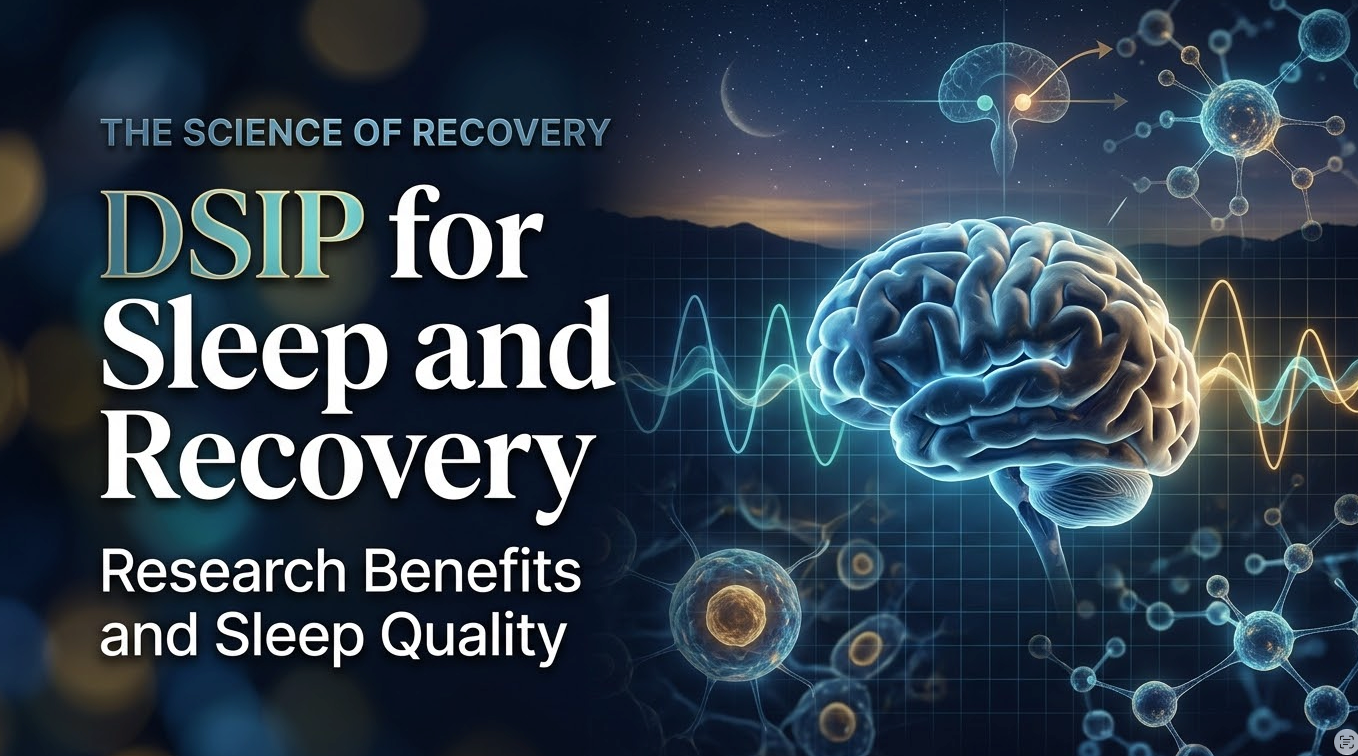
Standard pharmacological sleep aids—such as benzodiazepines and Z-drugs—rely on heavy, non-selective GABA-A receptor sedation. While they knock subjects unconscious, they severely disrupt natural sleep architecture by suppressing deep slow-wave sleep and REM phases, leaving individuals feeling unrefreshed. In contrast, DSIP (Delta Sleep-Inducing Peptide) represents an endogenous regulatory approach. Emerging from Swiss rabbit hemodialysate research, modern DSIP sleep research examines how this nonapeptide synchronizes thalamocortical oscillations, induces natural delta-wave rhythms, modulates stress-induced cortisol, and influences clinical insomnia parameters.
⚡ Quick Summary: DSIP Sleep Research & Delta-Wave Induction
Quick Answer: DSIP (Delta Sleep-Inducing Peptide) is a naturally occurring nine-amino-acid neuropeptide (Trp-Ala-Gly-Gly-Asp-Ala-Ser-Gly-Glu) (~848.8 Da) first isolated from the cerebral venous blood of sleeping rabbits. In neurophysiological research, DSIP acts as a neuromodulator rather than a direct sedative: it crosses the blood-brain barrier to promote low-frequency EEG delta rhythm (0.5–4 Hz), reduce sleep latency, and improve sleep continuity without suppressing REM sleep. Furthermore, DSIP downregulates corticotropin-releasing hormone (CRH) to suppress stress-induced cortisol while modulating endogenous LH and growth hormone release.
| Sleep Architecture Metric | Conventional Hypnotics (Z-Drugs) | DSIP Neuropeptide Impact | Neurobiological Significance |
|---|---|---|---|
| Slow-Wave Sleep (SWS / Delta) | Severely suppressed or fragmented | Synchronizes and prolongs delta waves | Restores deep physical tissue repair and glymphatic clearance |
| REM Sleep Cycles | Blunted; causes REM rebound nightmares | Preserved in natural physiological balance | Maintains emotional memory consolidation and neuroplasticity |
| Next-Day Sedative Hangover | High residual grogginess and motor deficits | Zero hangover; acts as a circadian regulator | Clears rapidly without receptor-downregulation grogginess |
| HPA Axis / Cortisol Modulation | Indirect; does not regulate central CRH | Suppresses stress-induced cortisol release | Prevents 3:00 AM nocturnal awakenings driven by adrenaline spikes |
The Delta Rhythm: How DSIP Modulates the Sleeping Brain
Unlike hypnotic compounds that force generalized neuronal hyperpolarization, DSIP functions as a physiological coordinator of circadian rhythmicity and autonomic homeostasis. It coordinates restorative rest across three key neurological pathways:
1. Thalamocortical Delta Synchronization
DSIP promotes slow-wave, synchronized delta-wave firing (0.5 to 4 Hz) between the thalamus and cerebral cortex, guiding the brain into Stage 3 Non-REM slow-wave sleep naturally.
2. HPA Axis Attenuation (Anti-Stress)
By dampening pituitary ACTH and hypothalamic CRH output, DSIP blunts nighttime cortisol surges, preventing stress-induced nocturnal awakenings and early-morning restlessness.
3. Modulation of Monoamines & LH
DSIP normalizes serotonergic and dopaminergic metabolism in the brainstem, helping maintain physiological luteinizing hormone (LH) and somatotroph growth hormone (GH) secretion during deep sleep.
Advance Sleep Architecture & Recovery Protocols
Investigate the premier endogenous neuropeptide for slow-wave sleep and circadian research. Inspect certified analytical purity, HPLC reports, and mass spectrometry for research-grade DSIP.
Shop Research DSIP (10 mg) →The Clinical Evidence: What Insomnia Studies Actually Found
The scientific literature surrounding DSIP is characterized by a fascinating split between physiological EEG measurements and subjective insomnia questionnaires:
- Early Efficacy Discoveries: In pioneering clinical investigations (Schneider-Helmert et al., 1981 / PubMed), synthetic DSIP administered to subjects with severe chronic insomnia demonstrated a statistically significant reduction in sleep onset latency, an increase in total sleep time, and an increase in high-amplitude slow-wave sleep.
- The Controlled Polysomnography Reality Check: A subsequent rigorous, double-blind, placebo-controlled laboratory trial in 16 chronic insomniacs (Monti et al., 1992 / PubMed) reported that while DSIP induced objective, modest increases in sleep efficiency and reductions in nighttime wake episodes, subjective sleep ratings did not show dramatic improvement. The authors noted that DSIP is not a sledgehammer knockout drug like flurazepam, but rather an endogenous sleep modulator.
- Circadian Adaptation & Shift Work: Additional military and aerospace trials highlighted DSIP’s remarkable ability to facilitate daytime naps and normalize altered circadian sleep-wake cycles during acute jet lag or rotating shift work without degrading cognitive performance upon waking.
Sleep Efficiency vs. Sleep Latency: Reading the Data
Evaluating DSIP research requires distinguishing between different dimensions of sleep pathology:
| Sleep Parameter | Clinical Endpoint Definition | DSIP Experimental Finding |
|---|---|---|
| Sleep Onset Latency (SOL) | Time required to transition from full wakefulness to Stage 1/2 sleep | Modest-to-significant reduction; subjects fall asleep faster under calm conditions |
| Sleep Efficiency (SE) | Percentage of total time in bed spent in confirmed physiological sleep | Measurable increase; reduces prolonged wake-after-sleep-onset (WASO) episodes |
| Slow-Wave Activity (SWA) | Power density and amplitude of low-frequency EEG delta waves | Upregulated; promotes deeper, more restorative non-REM sleep cycles |
| Subjective Sleep Quality | Self-reported morning ratings of restfulness and satisfaction | Variable; subjective improvement often requires consistent multi-night entrainment |
For an exhaustive breakdown of how cognitive neuropeptides interact with circadian architecture, explore our comprehensive guide: Nootropic Peptides for Cognitive Research: 2026 Guide.
Synergistic Research Pairings: The Rest & Repair Network
Because nighttime recovery involves both central nervous system calming and endocrine growth hormone release, investigators frequently design multi-peptide protocols:
- The Calm-Sleep Tandem (DSIP + Selank): High daytime sympathetic tone and hyperarousal often prevent sleep induction. Pairing DSIP with Selank provides daytime GABAergic anxiolysis and enkephalin preservation, ensuring the nervous system is primed for nighttime slow-wave entry. Read: Selank & GABA: Non-Sedating Anxiolysis & Focus.
- Nocturnal GH Amplification (CJC-1295 / Ipamorelin): Because peak physiological growth hormone release occurs during deep slow-wave delta sleep, pairing DSIP with CJC-1295 (No DAC) + Ipamorelin maximizes natural nocturnal pituitary pulses. Review our blend analysis: CJC-1295 No DAC + Ipamorelin Evidence.
- Cortical Neuroprotection (Pinealon): For research evaluating sleep deprivation and brain resilience, pair DSIP with Pinealon to protect cortical neurons from oxidative damage: Pinealon & Brain Ageing: The EDR Peptide Explained.
Standardized 2.0 mL Reconstitution Math for Research Vials
DSIP is typically supplied in lyophilized cakes containing 5 mg, 10 mg, or 20 mg of pure peptide. Because it is a nonapeptide with high water solubility, it dissolves rapidly in sterile diluent. Reconstituting with 2.0 mL of certified Pfizer Hospira Bacteriostatic Water yields the following standardized concentrations:
Concentration Formula: Mass (mg) ÷ Solvent Volume (mL) = Concentration (mg/mL). For example, adding 2.0 mL of BAC water to a 10 mg vial yields an active concentration of 5 mg/mL (500 mcg per 0.1 mL / 10 units on a U-100 syringe).
| Vial Material Amount | Diluent Added (BAC Water) | Final Concentration | Dose per 10 Units (0.1 mL) |
|---|---|---|---|
| 5 mg Vial | 2.0 mL | 2.5 mg/mL (2,500 mcg/mL) | 250 mcg (0.25 mg) |
| 10 mg Vial | 2.0 mL | 5.0 mg/mL (5,000 mcg/mL) | 500 mcg (0.50 mg) |
| 20 mg Vial | 2.0 mL | 10.0 mg/mL (10,000 mcg/mL) | 1,000 mcg (1.00 mg) |
Double-check your volume math, unit hash marks, and target mcg concentrations with our free interactive Peptide Calculator.
Hardware Selection: Delivering Precision Sleep Doses
Nighttime neuropeptide protocols require hardware that ensures reliable micro-dosing and preserves delicate amino acid bonds:
- Reusable Injection Pens: Avoid syringe graduation errors and stopper coring in dim lighting by loading your reconstituted DSIP into 3mL Injection Pen Glass Cartridges and pairing with the V3 Reusable Injection Pen. The mechanical lead-screw delivers audibly calibrated, repeatable micro-volumes with zero needle-hub fluid loss.
- Precision Manual Syringes: If manual draws are preferred, draw with surgical-grade Easy Touch 31G U-100 Syringes with 0.5 mL barrels. The ultra-fine 31-gauge needle glides cleanly through septums without tearing or coring rubber stoppers.
- Secure Lab Storage: Reconstituted DSIP degrades under warm temperatures and ambient light. Store your active vials upright inside the Compact 4-Slot Case or the high-capacity 10-Slot Peptide Vial Case. For mobile protocols, carry supplies inside the insulated Compact Peptide Travel Case.
Protocol Builder & Tracking Tools
Document every parameter of your sleep and recovery research to maintain reproducible experimental records:
- Protocol Structuring: Plan pre-bed administration timing (typically 30 to 60 minutes before sleep), dosage escalation ramps (typically 100 mcg to 500 mcg), and solvent volumes inside the Protocol Builder.
- Daily Logging: Record subjective sleep scores, wearable sleep tracker metrics (deep sleep vs. REM percentages), and beyond-use dates inside the Protocol Tracker Tool.
Frequently Asked Questions
Does DSIP knock a subject unconscious like a sleeping pill?
No. DSIP is not a hypnotic sedative. It does not force unconsciousness through massive GABAergic inhibition. Instead, it functions as an endogenous neuromodulator that lowers central hyperarousal, facilitates natural delta-wave EEG synchronization, and permits the brain to transition into physiological sleep when conditions are favorable.
Can DSIP cause dependency, tolerance, or withdrawal insomnia?
Clinical and animal studies indicate that DSIP does not cause pharmacological addiction, receptor downregulation, or rebound insomnia upon cessation. Because it acts within normal physiological regulatory networks, subjects maintain natural sleep-wake rhythms without withdrawal symptoms.
What is the ideal administration window for DSIP in research protocols?
In published laboratory protocols, DSIP is typically administered subcutaneously or intranasally approximately 30 to 60 minutes prior to the intended sleep window, allowing sufficient time for central translocation and thalamocortical slow-wave priming.
Related Reading & Scientific References
- Nootropic Peptides for Cognitive Research: 2026 Guide
- Selank & GABA: Non-Sedating Anxiolysis & Focus
- CJC-1295 No DAC + Ipamorelin Evidence
- Schneider-Helmert et al. (1981): Effects of DSIP in Insomnia Patients (PubMed)
- Monti et al. (1992): Double-Blind Evaluation of DSIP in Chronic Insomnia (PubMed)
By moving beyond blunt sedative sledgehammers to orchestrate authentic, synchronized slow-wave sleep, DSIP establishes a unique research model in neuro-recovery. Promoting delta-wave EEG architecture while suppressing nocturnal cortisol spikes allows investigators to explore deep restorative sleep, circadian entrainment, and cellular rejuvenation without disrupting natural sleep-stage equilibrium.
← View all peptide guides, research & protocols in our Blog Archive