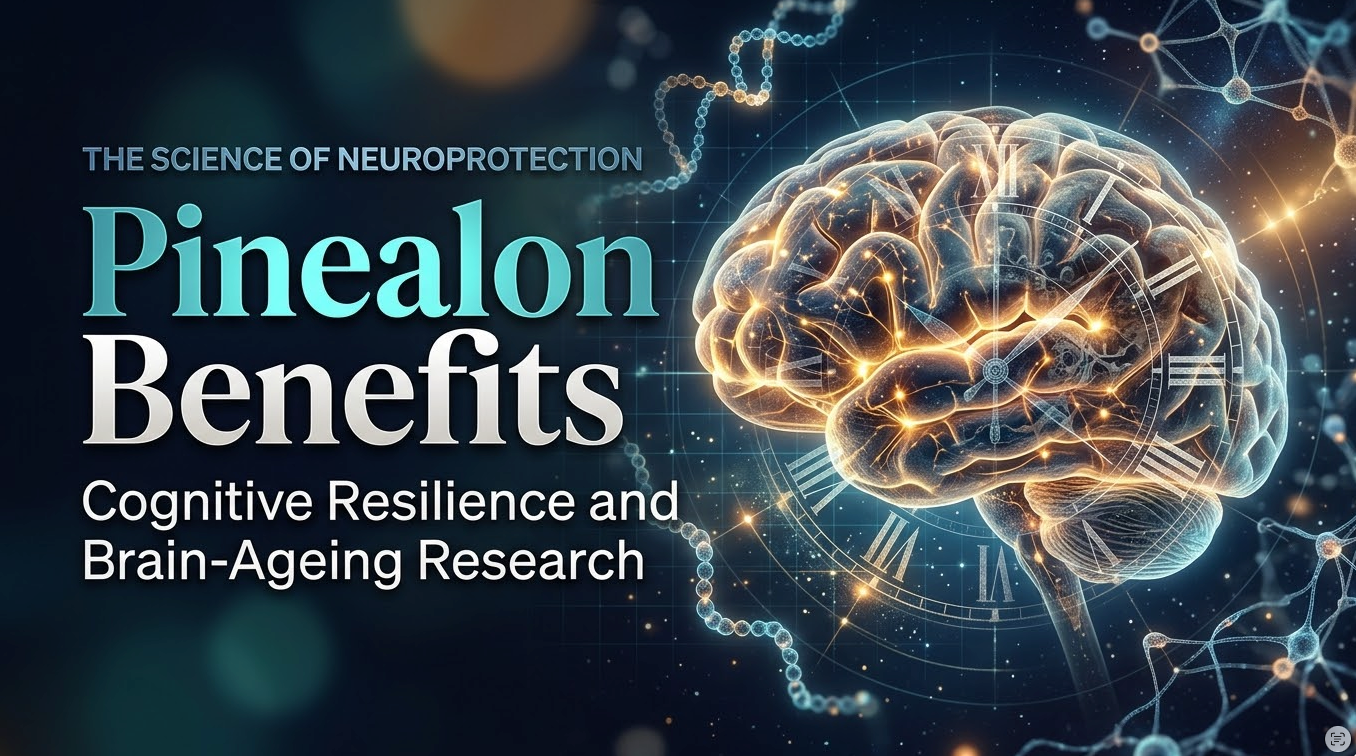
Brain aging is not merely a loss of neurotransmitters; it is driven by chronic oxidative stress, mitochondrial uncoupling, accumulated DNA damage, and apoptotic neuronal dropout. While common nootropics rely on psychostimulation to force dopamine or acetylcholine release—frequently causing neural fatigue and receptor burnout—cellular geroscience takes a structural approach. At the forefront of neuro-restorative science is Pinealon. Investigating Pinealon brain ageing literature reveals how this synthetic tripeptide—Glu-Asp-Arg (EDR)—crosses the blood-brain barrier to modulate gene expression, suppress reactive oxygen species (ROS), activate anti-apoptotic signaling cascades, and defend aging cerebral cortex neurons.
⚡ Quick Summary: Pinealon Brain Ageing & The EDR Tripeptide
Quick Answer: Pinealon is a synthetic peptide bioregulator composed of the tripeptide sequence Glu-Asp-Arg (EDR) (~388.4 Da). Developed within the Khavinson bioregulator framework to target central nervous system tissues, Pinealon directly penetrates neuronal membranes and nuclear envelopes. In preclinical models of brain aging, hypoxia, and neurotoxicity, EDR suppresses intracellular reactive oxygen species (ROS), prevents caspase-3-mediated apoptosis, stimulates neurite outgrowth via ERK1/2 phosphorylation, and preserves cognitive memory retention under severe physiological and metabolic stressors.
| Neuroprotective Marker | Biological Role in Brain Ageing | Pinealon (EDR) Molecular Effect | Observed Research Finding |
|---|---|---|---|
| Oxidative Stress & Free Radicals | Drives lipid peroxidation and mitochondrial DNA damage | Suppresses intracellular ROS and lipid peroxidation products | Protects cerebellar and cortical neurons from peroxide death |
| Caspase-3 Apoptotic Pathway | Executes programmed cell death in stressed brain tissue | Downregulates pro-apoptotic Bax while stabilizing Bcl-2 | Significantly decreases apoptosis in hypoxic brain tissue |
| ERK1/2 Signaling Cascade | Regulates synaptic plasticity, survival, and neurite branching | Increases phosphorylation of extracellular signal-regulated kinase | Stimulates dendritic arborization and synaptic repair |
| Cognitive Retention Under Stress | Memory consolidation vulnerable to excitotoxicity and age | Normalizes synaptic transmission in damaged cerebral cortex | Preserves conditioned reflex memory in animal stress models |
The Epigenetic Neuro-Shield: How the EDR Sequence Operates
Unlike large neurotrophins or monoclonal antibodies that are blocked by cerebral capillary endothelial walls, Pinealon has an ultra-low molecular mass (~388.4 Da). This allows it to freely cross the blood-brain barrier (BBB) and execute targeted cellular remodeling:
1. Free Penetration of the Blood-Brain Barrier
Because EDR is a short tripeptide under 500 Da, it penetrates brain parenchyma rapidly after systemic or intranasal delivery, reaching therapeutic concentrations in cortical and cerebellar tissue without carrier disruption.
2. Direct Chromatin & DNA Binding
Pinealon enters neuronal nuclei, binding to the major and minor grooves of DNA to modulate the expression of genes governing cellular survival, antioxidant defense enzymes, and structural neurofilament assembly.
3. Preservation of Synaptic Density
In aging brain tissue where synaptic pruning outpaces synaptogenesis, EDR stabilizes post-synaptic densities and promotes neurite growth, preserving functional neuronal connectivity across neural networks.
Advance Neuroprotection & Brain Longevity Research
Investigate the premier peptide bioregulator for cortical resilience and cellular stress resistance. Review verified analytical testing, HPLC purity reports, and mass spectrometry for research-grade Pinealon.
Shop Research Pinealon (EDR) →Preclinical Evidence: Prenatal Hypoxia & Oxidative Resilience
The definitive preclinical validation of Pinealon’s neuroprotective mechanisms is documented in peer-reviewed gerontological and neurochemical literature (Primary Research Record / PMC):
- Resistance to Severe Oxidative Stress: In isolated cerebellar granule cell cultures exposed to lethal concentrations of hydrogen peroxide (H2O2), pre-incubation with EDR tripeptide dramatically increased cell survival, preventing free radical-induced membrane rupture and preserving mitochondrial membrane potential.
- Reversing Developmental & Hypoxic Damage: In rat offspring subjected to prenatal hyperhomocysteinemia—a severe metabolic stressor that causes structural brain damage and memory deficits—treatment with Pinealon restored conditioned reflex memory, improved exploratory behavior, and normalized cortical neuronal density.
- Cerebrovascular & Stroke Protection: In models of acute focal cerebral ischemia (stroke), EDR reduced the total volume of necrotic brain tissue, dampened inflammatory microglial activation, and accelerated functional neurological recovery compared to untreated controls.
- Non-Stimulant Nootropic Profile: Unlike stimulant compounds that elevate resting heart rate and induce post-dose depletion, Pinealon’s cognitive enhancement stems purely from cellular stress resilience—protecting neurons so they can maintain sustained baseline function.
The Russian Nootropic Triad: Pinealon vs. Semax vs. Selank
Modern cognitive neuroscience frequently explores Pinealon alongside two other renowned Russian neuropeptides. Understanding their functional differences ensures precise experimental design:
| Neuropeptide | Peptide Class & Sequence Length | Primary Cellular Mechanism | Optimal Cognitive / Research Profile |
|---|---|---|---|
| Pinealon | Tripeptide Bioregulator (EDR, ~388 Da) | Epigenetic DNA binding, ROS suppression, anti-apoptotic signaling | Structural neuroprotection, brain aging, stroke recovery, oxidative resilience |
| Semax | ACTH(4-10) Heptapeptide (~813 Da) | Rapid hippocampal BDNF/TrkB upregulation & dopaminergic turnover | High-intensity focus, working memory consolidation, acute cognitive output |
| Selank | Tuftsin-Derived Heptapeptide (~751 Da) | Allosteric GABA gene modulation & enkephalinase inhibition | Non-sedating anxiolysis, stress mitigation, emotional stabilization |
For an exhaustive breakdown of how Semax stimulates hippocampal neurogenesis, read: Semax & BDNF Research: Neurogenesis, TrkB & Memory Pathways. To explore non-sedating emotional composure, see Selank & GABA: Non-Sedating Anxiolysis & Focus.
Synergistic Research Pairings: The Brain Longevity Stack
Because comprehensive brain aging involves vascular, mitochondrial, and epigenetic decay, investigators frequently combine Pinealon with complementary neuro-restorative agents:
- The Comprehensive Russian Triad (Pinealon + Semax + Selank): While Pinealon provides baseline cytoprotection and prevents neuronal apoptosis, Semax drives BDNF for neuroplasticity and Selank prevents stress-induced cortisol from damaging the hippocampus. Explore protocols in our Semax and Selank Stack Guide.
- Mitochondrial Fueling (MOTS-c): Neurons consume over 20% of the body's total ATP. Pair Pinealon with MOTS-c to activate AMPK and optimize mitochondrial glucose utilization during high cognitive demands: What Is MOTS-c? Mitochondrial Signaling & Dosing Evidence.
- Full Bioregulator Framework: To understand how short peptide bioregulators interact with chromatin across multiple organ systems, explore our foundational monograph: What Are Bioregulators? The Science of Khavinson Peptides.
Standardized 2.0 mL Reconstitution Math for Research Vials
Pinealon is typically supplied in lyophilized cakes containing 10 mg, 20 mg, or 50 mg. Because it is an ultra-small tripeptide, it dissolves instantaneously in sterile diluent. Reconstituting with 2.0 mL of certified Pfizer Hospira Bacteriostatic Water yields the following standardized concentrations:
Concentration Formula: Mass (mg) ÷ Solvent Volume (mL) = Concentration (mg/mL). For example, adding 2.0 mL of diluent to a 20 mg vial yields an active concentration of 10 mg/mL (1,000 mcg per 0.1 mL / 10 units on a U-100 syringe).
| Vial Material Amount | Diluent Added (BAC Water) | Final Concentration | Dose per 10 Units (0.1 mL) |
|---|---|---|---|
| 10 mg Vial | 2.0 mL | 5.0 mg/mL (5,000 mcg/mL) | 500 mcg (0.50 mg) |
| 20 mg Vial | 2.0 mL | 10.0 mg/mL (10,000 mcg/mL) | 1,000 mcg (1.00 mg) |
| 50 mg Vial | 2.0 mL | 25.0 mg/mL (25,000 mcg/mL) | 2,500 mcg (2.50 mg) |
Formulation Note for Intranasal Spray Compounding: Because Pinealon is an ultra-low-molecular-weight tripeptide (~388.4 Da), it is an ideal candidate for non-invasive intranasal spray administration. When compounding a 10 mL metered spray bottle, dissolve the peptide cake in 1.0 mL BAC water first, then dilute into 9.0 mL sterile saline to provide a comfortable isotonic base delivering 100–300 mcg per 0.1 mL metered pump. Learn exact nasal compounding math in Peptide Nasal Sprays: Bypassing the BBB & Dalton Guide.
Confirm custom volume ratios, unit graduations, and target mcg concentrations with our free interactive Peptide Calculator.
Hardware Selection: Delivering Precision Neuro-Doses
Bioregulator research cycles rely on consistent, short-course administration schedules. Upgrading your lab delivery hardware protects fragile compound bonds and ensures absolute volumetric repeatability:
- Reusable Injection Pens: Avoid syringe graduation errors and stopper coring by loading your reconstituted Pinealon solution into 3mL Injection Pen Glass Cartridges and pairing with the V3 Reusable Injection Pen. The mechanical lead-screw delivers audibly calibrated, repeatable micro-volumes with zero needle-hub fluid loss.
- Precision Manual Syringes: If manual draws are preferred, draw with surgical-grade Easy Touch 31G U-100 Syringes with 0.5 mL barrels. The ultra-fine 31-gauge needle glides cleanly through septums without tearing or coring rubber stoppers.
- Secure Lab Storage: Reconstituted peptides are sensitive to ambient warmth and vibrational shock. Store your active vials upright inside the Compact 4-Slot Case or the high-capacity 10-Slot Peptide Vial Case. For mobile protocols, carry supplies inside the insulated Compact Peptide Travel Case.
Protocol Builder & Tracking Tools
Document every parameter of your neuroprotection and brain longevity research to maintain reproducible experimental records:
- Protocol Structuring: Plan daily administration timing, cycle intervals (e.g., 10 to 20 consecutive days per cycle, repeated 1 to 2 times annually), and solvent ratios inside the Protocol Builder.
- Daily Logging: Record cognitive endurance metrics, mental fatigue ratings, and beyond-use dates inside the Protocol Tracker Tool.
Frequently Asked Questions
Is Pinealon the same compound as Cortexin or Cerebrolysin?
No. Cortexin and Cerebrolysin are complex biological extracts derived from animal brain tissue containing hundreds of uncharacterized peptides, neurotrophins, and amino acids. Pinealon is a 100% pure, synthetically manufactured tripeptide with the exact sequence Glu-Asp-Arg (EDR), eliminating the risk of prion contamination, biological variability, or immune-mediated allergic reactions.
Can Pinealon be administered at the same time as Semax and Selank?
Yes. In preclinical literature and experimental protocols, Pinealon is frequently co-administered with Semax and Selank. Because Pinealon acts as an epigenetic structural protector, Semax as a neurotrophin stimulant, and Selank as a GABAergic anxiolytic, their biological pathways are fully complementary and non-competing.
How is Pinealon cycled in experimental research?
Following the standard peptide bioregulator methodology, Pinealon is typically administered in short, concentrated pulses—such as daily subcutaneous or intranasal doses for 10 to 20 consecutive days, followed by several months off—reflecting the epigenetic "trigger and reset" philosophy of peptide bioregulation.
Related Reading & Scientific References
- What Are Bioregulators? The Science of Khavinson Peptides
- Semax & BDNF: Neurogenesis, TrkB & Memory Pathways
- Selank & GABA: Non-Sedating Anxiolysis & Focus
- Semax and Selank Stack: Guide to Russian Nootropics
- Primary Research Record: Neuroprotective Properties of Tripeptide EDR in Preclinical Models (PMC)
By moving past temporary neurotransmitter stimulation to directly defend brain cells against oxidative stress, apoptosis, and ischemic damage, Pinealon establishes a new benchmark in cognitive longevity research. The ultra-small EDR tripeptide crosses the blood-brain barrier with ease, making it an indispensable tool for investigating brain aging, cerebral resilience, and the epigenetic preservation of synaptic networks.
← View all peptide guides, research & protocols in our Blog Archive