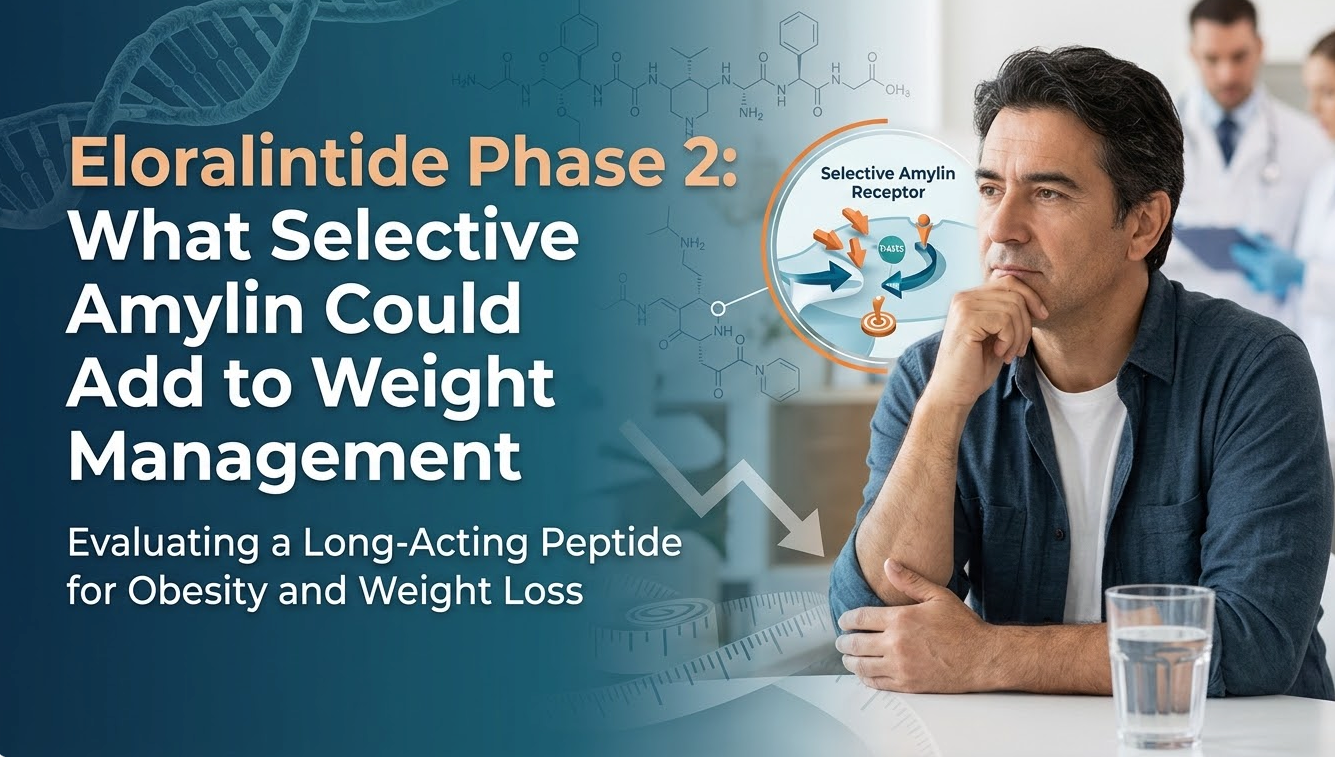
The 48-week Phase 2 clinical readout for Eloralintide (LY3841136) establishes a major benchmark in the development of non-incretin metabolic therapies. Evaluated as a standalone monotherapy in non-diabetic obesity, these data confirm that selective amylin receptor agonism can rival the weight-reduction magnitude of dual-incretin injectables while engaging an entirely distinct neurohormonal satiety axis.
⚡ Quick Summary: Eloralintide Standalone Phase 2 Results
Quick Answer: In the 48-week Phase 2 standalone monotherapy trial evaluating 263 adults with obesity or overweight without type 2 diabetes, once-weekly eloralintide (LY3841136) demonstrated potent, dose-dependent efficacy, achieving an estimated mean body weight reduction ranging from 9.5% to 20.1% across treatment arms under the efficacy estimand, compared to just 0.4% with placebo. As a selective, long-acting amylin receptor agonist, eloralintide operates independently of the GLP-1 receptor, restoring physiological hindbrain satiation and delivering biologic-level weight loss with a manageable, predominantly mild-to-moderate gastrointestinal adverse event profile.
| Evaluation Arm (48 Weeks) | Mean Weight Loss (Efficacy Estimand) | Placebo-Subtracted Difference | Primary Outcome Status |
|---|---|---|---|
| Eloralintide Highest Dose Cohort | -20.1% | -19.7% (p < 0.0001) | Met primary endpoint; high-tier responder curve |
| Eloralintide Lower/Mid Dose Arms | -9.5% to -16.2% | -9.1% to -15.8% (p < 0.0001) | Clear, dose-proportional metabolic response |
| Placebo Control Arm | -0.4% | Standardized trial baseline | Standard double-blind lifestyle baseline |
| Clinical Tolerability Profile | Manageable GI events | Dose-dependent escalation | No new unexpected systemic safety signals |
What Is the Compound? Mechanism of Selective Amylin Receptor Agonism
Eloralintide (LY3841136) is an investigational, long-acting synthetic peptide designed to act as a potent and selective agonist at human amylin receptors (AMY1, AMY2, and AMY3). Amylin is a 37-amino-acid neuroendocrine hormone naturally synthesized and co-secreted with insulin by pancreatic beta cells in response to food intake. Unlike native human amylin, which is chemically unstable and aggregates rapidly into insoluble amyloid fibrils, eloralintide incorporates proprietary sequence modifications and a fatty-acid moiety, enabling reversible albumin binding and supporting once-weekly subcutaneous administration.
The pharmacological profile of eloralintide establishes a non-incretin pathway for weight regulation:
- Hindbrain Area Postrema & NTS Activation: Amylin receptors are concentrated in the area postrema and nucleus of the solitary tract (NTS) in the caudal brainstem. Binding to calcitonin receptor core complexes coupled with receptor activity-modifying proteins (RAMPs), eloralintide triggers homeostatic postprandial fullness signals that terminate meals naturally.
- Avoidance of GLP-1 Neurocircuitry Overload: Classical GLP-1 receptor agonists act heavily on hypothalamic nuclei and mesolimbic reward structures, frequently inducing aversive visceral signals, severe food revulsion, and chronic nausea. Amylin agonism promotes satiation through distinct neural pathways, preserving dietary satisfaction while lowering overall calorie consumption.
- Glucagonostatic Modulation: Eloralintide suppresses meal-stimulated hyperglucagonemia without compromising counter-regulatory glucose defenses, slowing gastric nutrient dumping into the duodenum without causing hypoglycemia.
This biological independence makes eloralintide a compelling candidate both as a standalone monotherapy for patients who cannot tolerate incretin therapies and as a synergistic anchor in multi-mechanism combination regimens.
How the Study Worked: Standalone Phase 2 Trial Architecture
The Phase 2 study was engineered as a prospective, randomized, double-blind, placebo-controlled trial to define the standalone dose-response curve, metabolic kinetics, and safety of eloralintide in the absence of co-administered incretins:
1. Study Population & Demographics
Enrolled 263 adult participants presenting with obesity (BMI ≥30 kg/m²) or overweight (BMI ≥27 kg/m² with weight-related comorbidities), strictly excluding patients with type 2 diabetes to evaluate non-diabetic weight regulation.
2. 48-Week Treatment Duration
Subjects underwent structured dose titration followed by sustained maintenance through Week 48, allowing investigators to observe long-term weight trajectory, plateau kinetics, and metabolic stabilization.
3. Multiple Dose-Ranging Cohorts
Evaluated several once-weekly subcutaneous dose cohorts against matching placebo, identifying the minimum effective dose and establishing the optimal exposure ceiling for Phase 3 development.
4. Efficacy Estimand Framework
The primary analysis quantified percentage body weight reduction under the efficacy estimand (evaluating participants on continuous active therapy), isolating the compound's full pharmacological potency.
Complete clinical protocol parameters and primary corporate releases are documented in the Eli Lilly Primary Study Announcement.
Results and Key Findings: High-Magnitude Monotherapy Weight Loss
The 48-week standalone data confirmed that selective amylin receptor agonism can achieve deep weight loss on par with dual incretin co-agonists:
- Up to 20.1% Mean Weight Reduction: In the highest-dose cohort, eloralintide delivered an estimated 20.1% mean reduction in body weight from baseline at Week 48 under the efficacy estimand, compared to just 0.4% in the placebo group (p < 0.0001). The net placebo-adjusted weight reduction reached 19.7%.
- Dose-Dependent Biological Gradient: Across the intermediate and lower dose arms, weight reductions ranged from 9.5% to 16.2%, demonstrating clear, predictable dose proportionality and robust pharmacological receptor engagement.
- Surpassing First-Generation Incretin Benchmarks: In the landmark STEP 1 trial, subcutaneous semaglutide 2.4 mg (Wegovy) achieved an average on-treatment weight loss of 16.9% at 68 weeks. Achieving 20.1% at 48 weeks establishes eloralintide as the first selective amylin monotherapy to surpass the 20% weight-loss threshold.
- Standalone vs. Combination Context: These figures reflect eloralintide administered strictly as a single agent; they must be interpreted independently from the EloraTZP study, which evaluates eloralintide co-administered with tirzepatide.
The Study in Plain English: Understanding Amylin vs. GLP-1 Dynamics
Interpreting clinical trials in non-incretin obesity pharmacotherapy requires understanding how biological targets differ from familiar GLP-1 mechanisms:
| Trial Terminology | Clinical / Biological Definition | Real-World Patient Meaning |
|---|---|---|
| Selective Amylin Agonist | Synthetic peptide engineered to stimulate calcitonin/RAMP core complexes in the hindbrain | Signals natural, post-meal fullness directly to the brain without requiring GLP-1 receptor activation |
| 20.1% Weight Reduction | Proportional drop from starting weight (e.g., losing ~44 lbs from a 220 lb baseline) | High-magnitude weight loss capable of resolving sleep apnea, joint pain, and metabolic syndrome |
| Efficacy Estimand | Evaluates weight reduction assuming uninterrupted adherence to the study medication | Measures full biological capability in patients who take the injection consistently as prescribed |
| Standalone Monotherapy | Evaluating a drug alone without pairing it with an existing approved incretin therapy | Proves that the peptide drives massive weight loss on its own merits, rather than piggybacking on GLP-1 |
Key Insights: What Makes the Eloralintide Phase 2 Readout Critical?
The clinical contribution of the eloralintide Phase 2 standalone trial reshapes strategic thinking across the obesity therapeutics pipeline:
- Breaking the "Amylin Is Only an Adjuvant" Myth: For years, industry consensus assumed amylin analogues could only deliver modest 8–10% weight loss alone, serving primarily as additives to GLP-1 regimens (such as cagrilintide in CagriSema). Achieving a 20.1% standalone reduction disproves this assumption, demonstrating that a sufficiently potent, long-acting amylin agonist can function as a premier primary therapy.
- An Evidence-Based Alternative for GLP-1 Non-Responders: Approximately 10–15% of patients treated with GLP-1 therapies experience poor weight-loss responsiveness or discontinue therapy due to intractable nausea, vomiting, or gastrointestinal hypomotility. Eloralintide offers a validated, non-GLP-1 pathway capable of achieving identical or superior weight loss.
- Laying the Groundwork for the ENLIGHTEN Phase 3 Program: These robust 48-week Phase 2 data provided the statistical justification and dose-selection parameters required for Eli Lilly to launch the global, multi-trial Phase 3 ENLIGHTEN registration program.
Tolerability & The Complete Safety Profile
Throughout the 48-week evaluation period, eloralintide demonstrated a safety and adverse-event spectrum characteristic of neuroendocrine appetite modulators:
- Gastrointestinal Event Profile: Mild-to-moderate nausea, vomiting, and constipation were the most frequently reported treatment-emergent adverse events (TEAEs). Consistent with other satiety peptides, gastrointestinal events clustered predominantly during dose escalation and diminished over maintenance.
- Discontinuation Rates: Discontinuations due to adverse events were dose-dependent; detailed publication tables will clarify exact all-cause versus gastrointestinal-specific dropout percentages.
- Absence of Hypoglycemia or Systemic Organ Toxicity: Because amylin’s suppression of glucagon is strictly glucose-dependent, no clinically significant hypoglycemia occurred in this non-diabetic cohort, with hemodynamic and laboratory parameters remaining stable.
For complete trial documentation and primary disclosures, reference the Eli Lilly Investor News Release.
Comparative Research Themes & Next-Generation Metabolic Pipelines
To contextualize eloralintide within the broader landscape of obesity pharmacotherapy, researchers compare single-, dual-, and non-incretin mechanisms:
| Investigational / Approved Approach | Molecular Class & Targets | Administration Route | Clinical Differentiator |
|---|---|---|---|
| Eloralintide (Standalone Phase 2) | Selective Amylin Agonist (LY3841136) | Weekly Subcutaneous Injection | Non-incretin monotherapy delivering up to 20.1% weight loss at 48 wks |
| Petrelintide (ZUPREME-1) | Selective Amylin Analogue (ZP8396) | Weekly Subcutaneous Injection | Non-incretin amylin monotherapy; 10.7% loss at 42 wks with low GI AEs |
| Cagrilintide (CagriSema Program) | Dual Amylin/Calcitonin Agonist | Co-formulated with Semaglutide | Pairs hindbrain fullness with GLP-1 hypothalamic satiety synergy |
| Tirzepatide (Zepbound / SURMOUNT) | Dual Agonist: GIP + GLP-1 | Weekly Subcutaneous Injection | Established global standard delivering 20.9%–25.3% weight loss at 72 wks |
For a detailed analysis of next-generation selective amylin pharmacology, explore our guide: What Is Eloralintide? Next-Gen Selective Amylin Agonist Guide. To review comparative head-to-head amylin data, read our analysis: Eloralintide vs Cagrilintide: Amylin Agonists Compared. Research scientists evaluating laboratory-grade analogues can reference the Eloralintide Research Catalogue Entry, noting that laboratory reagents do not replicate clinical-grade pharmaceutical drug products.
What Patients and Clinicians Can Look Forward To
Eloralintide remains an investigational peptide undergoing active Phase 3 evaluation; it is not yet approved by the U.S. FDA or international health authorities. However, the completion of this Phase 2 trial confirms that Eli Lilly has advanced a non-incretin monotherapy into the upper tier of weight-loss efficacy.
For clinicians and patients, eloralintide represents the vanguard of a broader therapeutic menu. In the future, chronic weight management will not be restricted solely to GLP-1-based mechanisms. Patients will have access to selective amylin agonists that achieve double-digit weight reduction through distinct physiological pathways, offering personalized options based on individual tolerability and metabolic profiles.
Questions for the Next Stage of Research
While the 48-week Phase 2 standalone results provide proof-of-concept, several vital clinical questions guide ongoing Phase 3 investigation:
- Long-Term Durability in the ENLIGHTEN Program: Will the 20.1% weight loss continue to deepen or stabilize through 68 to 72 weeks of continuous therapy in global Phase 3 cohorts?
- Preservation of Lean Muscle Mass: Does selective hindbrain amylin signaling spare lean skeletal muscle mass more effectively than high-dose GLP-1/GIP receptor co-agonists?
- Combination Synergy in EloraTZP: What magnitude of weight loss will be achieved when eloralintide is combined with tirzepatide—could triple-target (amylin + GIP + GLP-1) therapy exceed 25% to 30% total body weight reduction?
Explore Our Research Tools
To assist laboratory scientists and clinicians in tracking peptide calculations, experimental schedules, and analytical observations, explore our specialized software suite:
- Calculate volume measurements and concentration parameters with the interactive Peptide Calculator.
- Structure research intervals, timing windows, and observation phases inside the Protocol Builder.
- Log laboratory markers, baseline patient metrics, and analytical notes with the Protocol Tracker Tool.
Scientific References & Primary Trial Documents
- Eli Lilly and Company: Lilly's Selective Amylin Agonist Eloralintide Demonstrated Significant Weight Loss in Phase 2 Study (Primary Press Release)
- What Is Eloralintide? Next-Gen Selective Amylin Agonist Guide
- Eloralintide vs Cagrilintide: Amylin Agonists Compared
Clinical Verdict: The 48-week Phase 2 eloralintide standalone clinical trial establishes that selective amylin receptor agonism achieves profound, dose-dependent weight reduction of up to 20.1% in non-diabetic obesity. By proving that a non-incretin peptide acting on hindbrain satiety circuits can rival the clinical potency of dual-incretin therapies, eloralintide introduces an evidence-based mechanism that will help define the next era of metabolic medicine.
← View all clinical research, trials & peptide analyses in our Blog Archive