What Is Eloralintide? Next-Gen Selective Amylin Agonist Guide
Within obesity medicine and metabolic pharmacology, glucagon-like peptide-1 (GLP-1) and glucose-dependent insulinotropic polypeptide (GIP) receptor agonists have established modern standards for weight management and glycemic control. However, long-term metabolic homeostasis involves signaling pathways beyond the incretin system. Neuroendocrine hormones that regulate meal termination and nutrient transit via distinct central circuits offer alternative therapeutic avenues.
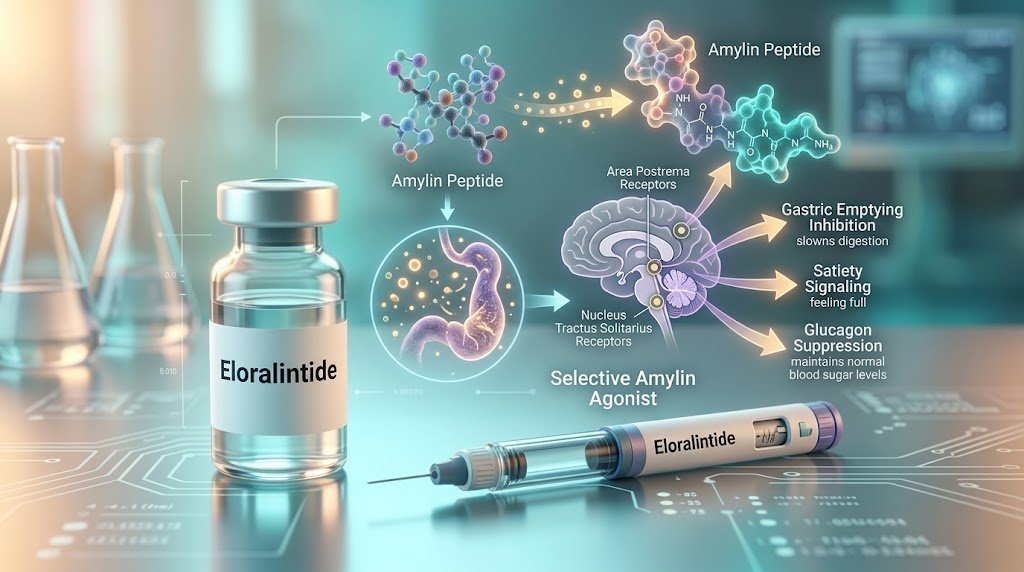
Eloralintide represents a major advance in this next wave of metabolic pharmacology. Developed by Eli Lilly as a potent, long-acting, highly selective amylin receptor agonist, eloralintide provides continuous receptor occupancy on a once-weekly administration schedule. By targeting amylin receptor complexes directly rather than relying on incretin pathways, it activates central satiety centers, slows gastric transit, and preserves lean body mass. This guide details eloralintide’s molecular architecture, receptor activation mechanisms, documented research protocols, and key scientific pairings.
Quick Summary: What Is Eloralintide at a Glance?
Quick Answer: Eloralintide is an investigational, long-acting selective amylin receptor agonist developed by Eli Lilly. By targeting functional heterodimeric amylin receptor complexes (CTR partnered with RAMP1, RAMP2, or RAMP3) in hindbrain satiety centers, it provides once-weekly receptor activation that suppresses appetite, slows gastric motility, and achieves up to 20% weight reduction as a standalone monotherapy in Phase 2 clinical trials.
| Protocol Parameter | Investigational Guidelines |
|---|---|
| Administration Route | Subcutaneous (Sub-Q) injection into adipose tissue |
| Administration Cadence | Once weekly (every 7 days), consistent timing |
| Titration Strategy | Conservative 4-week stepwise escalation to assess GI adaptation |
| Primary Monitored Biomarkers | Body composition (DEXA), food intake, HbA1c, fasting glucose, glucagon |
| Research Duration | 12 to 24 weeks in chronic metabolic and obesity evaluation models |
What Is Eloralintide?
Eloralintide is a synthetic, engineered peptide analogue of human amylin. Endogenous amylin is a 37-amino-acid peptide co-secreted with insulin by pancreatic beta cells that regulates post-meal glucose appearance. Despite its metabolic utility, native amylin suffers from rapid enzymatic breakdown, an elimination half-life of under 15 minutes, and a tendency to aggregate into insoluble amyloid fibrils in solution.
Eloralintide resolves these biochemical liabilities through purposeful sequence modifications and structural stabilization. Key design features include:
- Selective Amylin Agonism: High-affinity binding across functional amylin receptor complexes with reduced off-target divergence at unrelated calcitonin family receptors.
- Extended Half-Life Profile: Structural modifications support an elimination half-life of roughly 7 days, enabling once-weekly subcutaneous dosing.
- Aggregation Resistance: Engineered amino acid substitutions prevent the beta-sheet self-assembly and cytotoxic amyloid fibril formation characteristic of wild-type amylin.
- Standalone Efficacy: Demonstrates marked adiposity reduction and caloric intake suppression as a monotherapy, while retaining flexible compatibility with incretin-based protocols.
Mechanism of Action: CTR and RAMP Receptor Complexes
Unlike standard single-protein G-protein coupled receptors, functional amylin receptors are heterodimers formed by a core Calcitonin Receptor (CTR) coupled to one of three Receptor Activity-Modifying Proteins (RAMP1, RAMP2, or RAMP3):
- AMY1 Complex (CTR + RAMP1): High affinity for amylin and calcitonin gene-related peptide (CGRP).
- AMY2 Complex (CTR + RAMP2): Mediates balanced amylin and calcitonin signaling.
- AMY3 Complex (CTR + RAMP3): Highly responsive to amylin; expressed strongly in metabolic hindbrain centers.
Upon subcutaneous administration, eloralintide initiates a coordinated cellular cascade:
- Heterodimeric Receptor Docking: Eloralintide binds the extracellular and transmembrane interfaces of the CTR-RAMP complex, stabilizing an active receptor conformation.
- Gαs Activation & cAMP Generation: Receptor engagement recruits stimulatory G-protein alpha subunits (Gαs), activating membrane-bound adenylyl cyclase to convert cytosolic ATP into cyclic adenosine monophosphate (cAMP).
- Downstream Kinase Phosphorylation: Elevated cAMP stimulates Protein Kinase A (PKA) and exchange proteins directly activated by cAMP (EPAC), initiating intracellular phosphorylation cascades.
- Hindbrain Satiation Cascades: In the area postrema and the nucleus of the solitary tract (NTS), receptor activation stimulates noradrenergic projections to the lateral parabrachial nucleus, generating satiety and meal-termination signals.
- Modulation of Gastric Kinetics: Peripheral vagal efferent signaling decelerates gastric emptying, smoothing postprandial glucose entry into the small intestine without blunting baseline hunger physiology.
Key Benefits of Eloralintide in Metabolic Models
Preclinical data and early-phase clinical evaluations demonstrate distinct therapeutic advantages over legacy amylin analogues and isolated incretin regimens:
- Non-Incretin Satiety Signaling: Operates through calcitonin-family hindbrain neurocircuitry rather than hypothalamic GLP-1/GIP pathways, providing an independent avenue for appetite regulation in models exhibiting incretin resistance or receptor desensitization.
- Lean Mass Retention: By modulating meal termination without inducing continuous, severe gastric stasis, amylin receptor agonists encourage caloric restriction while supporting skeletal muscle mass preservation alongside resistance training models.
- Stabilization of Postprandial Glucose: By slowing gastric motility and curbing inappropriate postprandial glucagon secretion from pancreatic alpha cells, eloralintide reduces glycemic variability independently of direct insulin secretion.
- Favorable Tolerability Dynamics: High receptor selectivity reduces non-specific calcitonin receptor signaling, which preclinical studies correlate with lower incidence of treatment-limiting nausea during dose titration.
Documented Laboratory Research & Dosing Protocols
Preclinical and translational research models structure experimental parameters around eloralintide’s extended pharmacokinetic profile. Syringe units can be calculated using our free Peptide Calculator, while administration schedules are tracked inside the Protocol Tracker Tool.
| Protocol Parameter | Investigational Guidelines |
|---|---|
| Administration Route | Subcutaneous (Sub-Q) injection into adipose tissue |
| Administration Cadence | Once weekly (every 7 days), consistent timing |
| Titration Strategy | Conservative 4-week stepwise escalation to assess GI adaptation |
| Primary Monitored Biomarkers | Body composition (DEXA), food intake, HbA1c, fasting glucose, glucagon |
| Research Duration | 12 to 24 weeks in chronic metabolic and obesity evaluation models (see our Cycle Timing Guide) |
Synergistic Research Pairings
Because amylin receptor signaling operates independently of incretin pathways, research models frequently evaluate eloralintide alongside complementary metabolic and tissue-protective compounds:
- Semaglutide: Evaluating dual-pathway metabolic control by pairing selective amylin agonism with established GLP-1 receptor activation. Review comparative incretin data in our Semaglutide GLP-1 Research Guide.
- Tirzepatide: Investigating multi-pathway convergence by pairing eloralintide with dual GIP/GLP-1 co-agonism to assess whether hindbrain amylin signaling enhances dual-incretin metabolic outcomes. See our Tirzepatide Dual Incretin Guide.
- Retatrutide: In advanced metabolic studies examining triple GIP/GLP-1/Glucagon agonism, researchers evaluate amylin co-administration to balance high thermogenesis with central satiety signaling. Detailed trial outcomes are covered in our Retatrutide Dosing & Trial Evidence Guide (or view Retatrutide research vials).
- Cagrilintide: Compared side-by-side with alternative amylin analogues in our Eloralintide vs. Cagrilintide Comparison Guide.
- Comprehensive Metabolic Landscape: Benchmark eloralintide against the full spectrum of emerging agents in our Best GLP-1 for Weight Loss Guide.
- BPC-157: In preclinical investigations evaluating gastrointestinal transit adaptation, research teams observe whether cytoprotective pentadecapeptides support mucosal integrity during amylin-mediated gastric deceleration. Read more in our BPC-157 Research & Dosing Guide.
- TB-500: Teams analyzing cellular structural integrity and actin regulation evaluate TB-500 (Thymosin Beta-4) alongside body composition protocols.
- GHK-Cu: For studies monitoring collagen synthesis, dermal remodeling, and extracellular matrix stability during significant adipose reduction, scientists reference the copper tripeptide detailed in our GHK-Cu Copper Tripeptide Guide.
Laboratory Handling, Reconstitution & Storage Standards
Preserving the secondary and tertiary structural stability of engineered amylin analogues requires strict laboratory cold-chain standards (detailed step-by-step in our Beginners Guide to Peptides):
- Diluent Selection: Reconstitute lyophilized peptide vials using sterile, pharmaceutical-grade Pfizer Hospira Bacteriostatic Water containing 0.9% benzyl alcohol to prevent microbial contamination over repeated testing intervals. For cell-culture or in-vitro binding assays sensitive to preservatives, utilize sterile 0.9% Sterile Bacteriostatic Saline.
- Reconstitution Technique: Direct the diluent stream smoothly down the inner glass wall using a sterile EasyTouch 31G Syringe. Avoid spraying directly onto the lyophilized cake. To prevent shear-induced degradation, swirl the vial gently until completely dissolved; do not shake or agitate vigorously. Review instructions on how to reconstitute peptides and how much bacteriostatic water to add.
- Storage Conditions: Store dry lyophilized powder at -20°C for long-term stability. Once reconstituted, store the liquid solution between 2°C and 8°C (36°F to 46°F), shielded from light and mechanical vibration within a dedicated Peptide Vial Case or insulated Compact Travel Case, and utilize within 28 to 30 days.
Eloralintide underscores the therapeutic potential of expanding beyond incretin mono-therapies into selective neuroendocrine receptor targeting. By delivering sustained, once-weekly activation of functional amylin receptor complexes, it represents a compelling candidate for future multi-pathway metabolic protocols.
← View all peptide guides, research & protocols in our Blog Archive