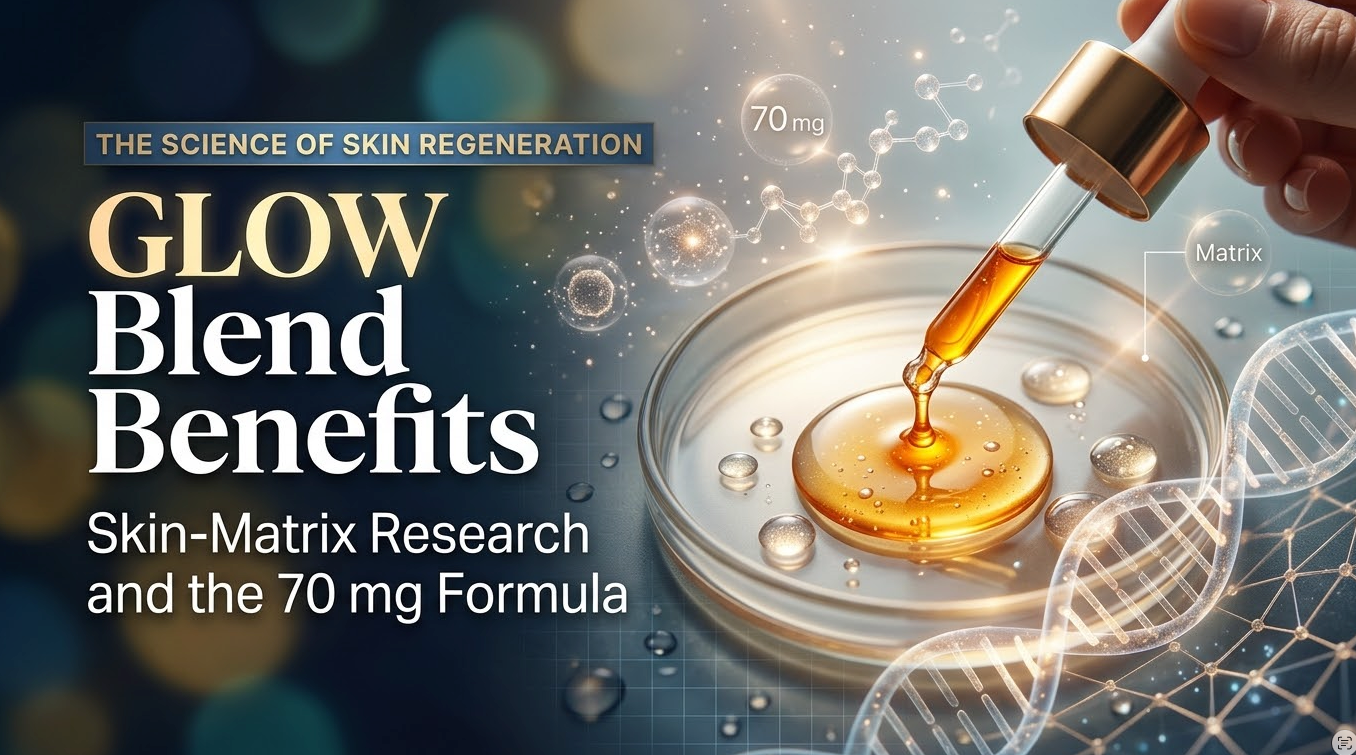
Combining standalone tissue-repair peptides into a unified sequence matrix has become one of the most effective strategies in modern regenerative biochemistry. The GLOW Blend unites three benchmark molecules—GHK-Cu, BPC-157, and TB-500—into a single 70 mg vial. However, calculating research concentrations requires knowing the exact GLOW blend ingredients ratio: a calibrated 50:10:10 mass breakdown that drives extracellular matrix synthesis, angiogenesis, and cell migration in unison.
⚡ Quick Summary: GLOW Blend Ingredients & 70 mg Ratio
Quick Answer: The authentic GLOW Blend (70 mg total) is formulated in a fixed 5:1:1 mass ratio (50:10:10 mg) containing 50 mg GHK-Cu (Copper Peptide), 10 mg BPC-157 (Body Protection Compound), and 10 mg TB-500 (Thymosin Beta-4). GHK-Cu accounts for ~71.4% of the total mass to drive dermal collagen remodeling, while BPC-157 and TB-500 supply balanced 14.3% fractions to accelerate localized microvascular repair and actin-mediated cell migration.
| Blend Component | Mass in 70 mg Vial | Formula Share | Primary Cellular Pathway |
|---|---|---|---|
| GHK-Cu (Copper Tripeptide-1) | 50 mg | 71.4% (5 parts) | Collagen/elastin synthesis, MMP regulation, gene resetting |
| BPC-157 (Pentadecapeptide) | 10 mg | 14.3% (1 part) | VEGFR2 angiogenic signaling, fibroblast granulation |
| TB-500 (Thymosin β4 Fragment) | 10 mg | 14.3% (1 part) | Actin sequestration, cell motility, soft-tissue regeneration |
The Triad Mechanism: Why the 5:1:1 Ratio Works
In single-agent research, each of these three peptides addresses a distinct phase of tissue remodeling. The 50:10:10 architecture synchronizes these steps so that structural matrix synthesis, blood vessel sprouting, and cell movement occur simultaneously:
1. GHK-Cu: Extracellular Architecture
Provides the structural foundation (50 mg) by stimulating collagen types I and III, activating glycosaminoglycan synthesis, and neutralizing oxidative stress.
2. BPC-157: Microvascular Angiogenesis
Upregulates VEGFR2 to build the new capillary network required to supply oxygen and nutrients directly to regenerating connective tissue beds.
3. TB-500: Cellular Motility
Regulates actin polymerization, allowing keratinocytes, stem cells, and endothelial precursors to migrate rapidly into areas of tissue disruption.
Accelerate Multi-Pathway Tissue Remodeling
Experience the synergy of authentic 50:10:10 compounding. Inspect certified analytical purity and laboratory-verified specifications for the GLOW formulation.
Shop Research GLOW Blend (70 mg) →Understanding Concentration Math: Total Mass vs. Component Yield
A frequent calculation pitfall when working with blended peptides is confusing total vial concentration with individual ingredient yield. When you dissolve a 70 mg vial, you are not administering 70 mg of a single chemical entity:
- Reconstitution Baseline: Adding 2.0 mL of Pfizer Hospira Bacteriostatic Water to a 70 mg GLOW vial creates a total combined concentration of 35 mg/mL.
- The Component Breakdown: Within that 35 mg/mL solution, each 1.0 mL contains exactly 25 mg GHK-Cu, 5 mg BPC-157, and 5 mg TB-500.
- Dose per Unit: On a standard U-100 syringe (where 10 units = 0.10 mL), drawing 10 units delivers 2.5 mg GHK-Cu, 500 mcg BPC-157, and 500 mcg TB-500.
| Draw Volume (U-100 Syringe) | Total Blend Mass | GHK-Cu Yield | BPC-157 Yield | TB-500 Yield |
|---|---|---|---|---|
| 5 Units (0.05 mL) | 1.75 mg | 1.25 mg (1,250 mcg) | 250 mcg (0.25 mg) | 250 mcg (0.25 mg) |
| 10 Units (0.10 mL) | 3.50 mg | 2.50 mg (2,500 mcg) | 500 mcg (0.50 mg) | 500 mcg (0.50 mg) |
| 20 Units (0.20 mL) | 7.00 mg | 5.00 mg (5,000 mcg) | 1,000 mcg (1.00 mg) | 1,000 mcg (1.00 mg) |
Double-check your unit-to-mass conversions before drawing using our interactive Peptide Calculator.
Synergistic Research Pairings & Blend Evolutions
Depending on your experimental tissue targets, compare GLOW against related specialized combinations:
- GLOW vs. KLOW (The 4-Way Formula): For research models where mucosal or acute systemic inflammation is present, explore KLOW Blend, which adds 10 mg of KPV (80 mg total) to downregulate NF-κB pathways. Read our comparative analysis: GLOW vs. KLOW: Comparing the 70mg & 80mg Blends.
- Standalone Copper Tripeptide: To study high-dose GHK-Cu collagen modulation without systemic angiogenic peptides, evaluate pure GHK-Cu. Read our detailed guide: What Is GHK-Cu? Clinical Evidence & Dosing.
- The Pure Angiogenesis Standard: If your focus is purely tendons, ligaments, and muscular recovery without dermal copper signaling, evaluate the classic Wolverine Blend (BPC-157 / TB-500). Review full protocols in our Wolverine Blend Guide.
Hardware Selection: Delivering Multi-Compound Formulations
Because GLOW incorporates high-molecular-weight peptides and dark copper ions, equipment selection directly affects stability and precision:
- Reusable Injection Pens: Instead of puncturing rubber stoppers daily and risking particulate coring, transfer your reconstituted GLOW solution into 3mL Injection Pen Glass Cartridges and pair with the V3 Reusable Injection Pen. The mechanical lead-screw delivers audibly calibrated micro-volumes with zero fluid loss in needle hubs.
- Precision Manual Syringes: If drawing directly from the vial, utilize Easy Touch 31G U-100 Syringes with 0.5 mL barrels. The ultra-fine 31-gauge needle glides cleanly through septums without tearing.
- Light-Blocking Case Protection: GHK-Cu copper complexes are photo-sensitive and degrade when exposed to fluorescent lab lights or direct sunlight. Store your active vials upright inside the Compact 4-Slot Case or the high-capacity 10-Slot Peptide Vial Case. For mobile protocols, carry supplies inside the insulated Compact Peptide Travel Case.
Protocol Builder & Tracking Tools
Maintain consistent documentation across your GLOW research cycles:
- Protocol Structuring: Set up your reconstitution volumes, concentration ratios, and weekly schedules inside the Protocol Builder.
- Observation Logging: Record daily tissue metrics, unit draws, and cold-chain dates inside the Protocol Tracker Tool.
Frequently Asked Questions
Why does reconstituted GLOW have a deep blue color?
The distinctive bright blue color comes entirely from the GHK-Cu (copper tripeptide-1) component. Copper ions (Cu2+) naturally form a vivid blue coordination complex in aqueous solutions. A clear, rich blue confirms genuine copper complexation.
Does 70 mg GLOW mean the vial contains 70 mg of GHK-Cu?
No. The 70 mg figure represents the total combined mass of all three peptides. GHK-Cu makes up 50 mg, while BPC-157 and TB-500 account for 10 mg each (50:10:10 mg).
Can GLOW be reconstituted with bacteriostatic saline instead of water?
Standard Bacteriostatic Water is the recommended diluent. While some researchers use 0.9% BAC Saline to reduce injection sting, high ionic sodium chloride concentrations can alter copper-ligand binding kinetics in certain high-concentration preparations. BAC water remains the primary standard.
Related Reading & Scientific References
- GLOW vs KLOW Peptide: Comparing the 70mg & 80mg Blends
- What Is GHK-Cu? Copper Tripeptide Pathways, Dosing & Clinical Evidence
- What is the Wolverine Blend? Mechanism of Action, Research & Dosing Protocols
By uniting high-dose GHK-Cu with the systemic angiogenic repair of BPC-157 and TB-500, the GLOW Blend delivers a calibrated 5:1:1 tissue remodeling triad. Understanding component concentrations ensures reproducible research dosing and dependable experimental clarity across all dermatological and soft-tissue protocols.
← View all peptide guides, research & protocols in our Blog Archive