
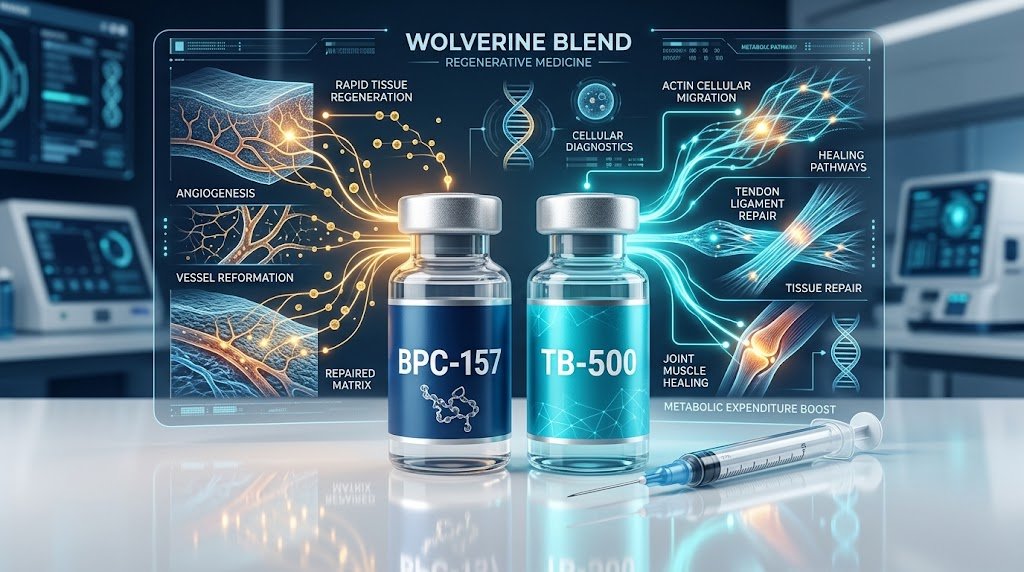
What is the Wolverine Blend? Mechanism of Action, Research & Dosing Protocols
Named informally in online biohacking and fitness circles after the comic book character known for near-instant cellular regeneration, the "Wolverine Blend" has become one of the most widely discussed combination formulations in modern peptide research.
While popular recovery culture presents this mixture as an all-in-one remedy capable of resolving complex musculoskeletal injuries overnight, objective laboratory science evaluates it through a much more specific lens: dual-pathway tissue remodeling. By pairing a localized growth factor stimulator with a systemic cellular migration peptide, researchers seek to understand how these distinct mechanisms interact.
Quick Summary: What Is the Wolverine Blend at a Glance?
Quick Answer: The Wolverine Blend is a co-formulation combining equal parts BPC-157 and TB-500 into a single research solution. While BPC-157 stimulates localized VEGFR2 angiogenesis and FAK-paxillin fibroblast migration, TB-500 sequesters globular G-actin to drive systemic cellular motility and downregulate NF-κB inflammation. Together, they provide non-overlapping tissue repair and parallel collagen alignment without separate injections.
| Parameter | BPC-157 Component (50%) | TB-500 Component (50%) |
|---|---|---|
| Molecular Origin | 15-amino-acid synthetic pentadecapeptide (gastric protein fragment) | Synthetic hexapeptide active fragment (LKKTET) of Thymosin Beta-4 |
| Primary Mechanism | VEGFR2 receptor activation, FAK-paxillin adhesion, local collagen synthesis | G-actin sequestration, cellular migration, NF-κB cytokine modulation |
| Typical Combined Dose | 250–500 mcg daily (part of 500–1000 mcg total blend draw) | 250–500 mcg daily (part of 500–1000 mcg total blend draw) |
| Direct Research Vial | Pre-compounded in 1:1 calibrated vials via the Wolverine Blend (10mg / 20mg) | |
What Is the Wolverine Blend?
The Wolverine Blend is a co-formulation combining two distinct synthetic peptides into a single lyophilized matrix: BPC-157 and TB-500.
Individually, both compounds have established preclinical records in regenerative research. However, their biochemical origins and structural classifications are fundamentally different:
- BPC-157: A 15-amino-acid synthetic pentadecapeptide derived from a stable sequence found in human gastric juice. It operates primarily through localized tissue cytoprotection, growth factor receptor upregulation, and focal adhesion signaling.
- TB-500: A synthetic fragment of Thymosin Beta-4 containing the active LKKTET hexapeptide sequence responsible for actin regulation. It operates through systemic cellular mobilization, actin sequestration, and widespread inflammatory modulation.
Rather than evaluating them as separate daily administrations, laboratories utilize pre-mixed blends—commonly structured in exact 1:1 ratios (5mg BPC-157 / 5mg TB-500 in 10mg vials, or 10mg BPC-157 / 10mg TB-500 in 20mg vials)—to streamline experimental protocols, eliminate double reconstitution, and assess dual-compound synergy.
Mechanisms of Action: The Science of Dual-Pathway Synergy
The theoretical rationale behind combining BPC-157 and TB-500 relies on the premise that optimal connective tissue repair requires both local signal reception and systemic cellular mobilization.
1. Local Receptor Upregulation (BPC-157) Meets Cell Recruitment (TB-500)
Healing hypovascular tissue such as tendons, ligaments, and meniscal cartilage requires recruiting repair cells to an area with naturally poor circulation. In cell models, BPC-157 activates VEGFR2 and the FAK-paxillin pathway, priming local fibroblasts and endothelial cells for adhesion and growth factor uptake. Simultaneously, TB-500 sequesters globular actin (G-actin), giving circulating repair cells the cytoskeletal mobility needed to navigate the extracellular matrix and reach the targeted injury site.
2. Complementary Angiogenesis Pathways
Both peptides facilitate new capillary sprouting (angiogenesis), but they activate different points in the cascade:
- BPC-157 initiates vascular endothelial growth factor receptor activation (VEGFR2-Akt-eNOS), creating the molecular trigger for vessel formation.
- TB-500 drives the physical migration and morphological differentiation of endothelial cells into structured, functional capillary lumens.
Combined, these complementary pathways support rapid microvascular perfusion in oxygen-starved tissues.
3. Multi-Tiered Inflammatory Modulation
Unchecked inflammation destroys tissue architecture, while complete suppression prevents physiological repair. The Wolverine Blend engages two distinct regulatory mechanisms: BPC-157 balances the endothelial nitric oxide synthase (eNOS) system to stabilize vascular permeability, while TB-500 inhibits NF-κB transcription, reducing excessive pro-inflammatory cytokines such as TNF-α and IL-6.
4. Organized Collagen Synthesis vs. Disorganized Fibrosis
A major complication in tendon and muscle healing is the formation of irregular, inelastic scar tissue. In preclinical assays, BPC-157 promotes Early Growth Response 1 (Egr-1) transcription to deposit Type I and Type III collagen, while Thymosin Beta-4 fragments modulate myofibroblast differentiation to ensure collagen fibrils align in parallel, functional bundles rather than tangled scar adhesions.
What Does the Research Actually Show?
Evaluating the Wolverine Blend with scientific rigor requires separating single-compound data from combination literature.
Abundant Individual Data, Limited Formal Combination Trials
The vast majority of published literature evaluates BPC-157 and TB-500 independently. While both molecules have extensive rodent, equine, and in-vitro research bases showing accelerated healing, few formal, published peer-reviewed studies evaluate them administered as a single co-lyophilized formulation in controlled comparative trials.
The protocol rationale for combining them is largely mechanistic—based on their known non-overlapping biological pathways—supported by veterinary observations and extensive observational use in sports performance settings rather than formal Phase III clinical trials.
The Clinical Gap and Regulatory Standing
Neither BPC-157, TB-500, nor their combination is approved by Health Canada, the US FDA, or international health agencies for human therapeutic administration. Both compounds are categorized as unapproved investigational substances, and both are prohibited at all times under the World Anti-Doping Agency (WADA) Prohibited List.
Documented Laboratory Research & Dosing Protocols
Within published observational studies, athletic recovery discussions, and preclinical literature, experimental protocols utilize the following parameters. Researchers commonly map their volume and unit conversions via our free Peptide Calculator and structure observation cycles inside the Protocol Tracker Tool.
| Parameter | Subcutaneous (Sub-Q) Injection Protocol | Topical Application Protocol |
|---|---|---|
| Experimental Focus | Acute soft-tissue damage, tendon/ligament tears, systemic recovery | Superficial wound healing, dermal integrity, localized skin trauma |
| Documented Dosing | 0.5–1.5 mg total blend per day (typically 500 mcg, yielding 250 mcg BPC / 250 mcg TB) | 500 mcg–1 mg active BPC equivalent per application (1–2x daily) |
| Administration Site | Subcutaneous (Sub-Q); systemic administration delivers compounds effectively via blood flow | Applied directly to affected dermal surface |
| Cycle Duration | 4–6 weeks of continuous evaluation (review our Peptide Cycle Timing Guide) | 4–6 weeks of continuous evaluation |
| Washout Window | 2–4 weeks off between cycles | 2–4 weeks off between cycles |
| Screening Panels | CBC, CMP, C-Reactive Protein (CRP) | Baseline CMP, localized skin tolerance |
Active Content Verification: Checking the Ratio
When evaluating combination peptides, researchers must confirm the precise milligram split per active compound. Our calibrated Wolverine Blend features an exact 1:1 active ratio:
- 10 mg Total Vial: 5 mg BPC-157 / 5 mg TB-500
- 20 mg Total Vial: 10 mg BPC-157 / 10 mg TB-500
Always verify the batch Certificate of Analysis (COA) to ensure both sequences demonstrate purity ≥ 98.0% via High-Performance Liquid Chromatography (HPLC) without residual TFA salts.
Related Compounds & Multi-Peptide Blends
Researchers exploring tissue repair mechanisms often cross-reference the Wolverine Blend with single-compound isolates and advanced multi-target formulations:
- BPC-157 Isolate: For protocols isolating localized gastrointestinal and growth factor signaling, review What Is BPC-157?.
- TB-500 Isolate: For studies isolating actin regulation and systemic cellular motility, explore What Is TB-500?.
- GLOW Blend (70mg): Expands the Wolverine Stack by adding GHK-Cu (50mg GHK-Cu, 10mg BPC-157, 10mg TB-500) to simultaneously stimulate deep extracellular collagen remodeling alongside microvascular repair. Learn more on the GLOW Blend product page or read our GLOW vs. KLOW comparison guide.
- KLOW Blend (80mg): The four-peptide recovery formula combining GHK-Cu (50mg), BPC-157 (10mg), TB-500 (10mg), and nuclear anti-inflammatory KPV (10mg) for intensive mucosal and joint recovery. Explore the KLOW Blend.
- GHK-Cu Copper Peptide: For protocols combining extracellular matrix remodeling with cosmetic or follicular research, see What Is GHK-Cu? (or source standalone GHK-Cu 50mg/100mg).
- KPV Peptide: For targeted gut lining and mucosal irritation research, review our KPV Peptide Guide (or view KPV research vials).
Laboratory Handling, Reconstitution & Storage Standards
Co-lyophilized peptide blends require precise laboratory preparation to maintain molecular stability (detailed step-by-step in our Beginner's Guide to Peptides):
- Diluent Selection: Reconstitute lyophilized Wolverine Blend using sterile, pharmaceutical-grade Pfizer Hospira Bacteriostatic Water containing 0.9% benzyl alcohol to prevent bacterial growth over prolonged study windows. 0.9% Sterile Bacteriostatic Saline can also be utilized depending on osmotic test parameters.
- Reconstitution Protocol: Use a sterile EasyTouch 31G Syringe to allow diluent to flow smoothly down the inside glass wall of the vial. Do not spray diluent directly onto the lyophilized cake, and avoid vigorous shaking; roll the vial gently between your palms until the solution is clear.
- Cold-Chain Storage: Store dry lyophilized vials at -20°C for long-term molecular preservation. Reconstituted liquid solutions must be refrigerated between 2°C and 8°C (36°F to 46°F) inside a light-shielded, vibration-damping Peptide Vial Case or insulated Compact Travel Case to protect against mechanical shearing and light exposure.
The Wolverine Blend brings together two complementary biological mechanisms: BPC-157's localized growth factor receptor activation and TB-500's systemic actin-mediated cellular migration. While popular narratives celebrate it as a cure-all, scientifically grounded research recognizes it as an investigational model for dual-pathway tissue remodeling. Maintaining quality verification through third-party COAs and adhering to standard laboratory protocols ensures reproducible experimental data.
← View all peptide guides, research & protocols in our Blog Archive


2 comments