
What Is GHK-Cu? Copper Tripeptide Pathways, Dosing & Clinical Evidence
In cosmetic biochemistry and longevity science, GHK-Cu is routinely hailed as the gold standard for collagen regeneration, hair follicle enlargement, and total dermal remodeling.
While commercial anti-aging marketing frequently packages copper peptides with broad, sweeping claims, the underlying scientific reality is rooted in rigorous extracellular matrix biochemistry. Understanding how GHK-Cu works requires looking at its physiological role as a copper-binding transport complex, its genetic influence on tissue remodeling, and what controlled laboratory models demonstrate.
Quick Summary: What Is GHK-Cu at a Glance?
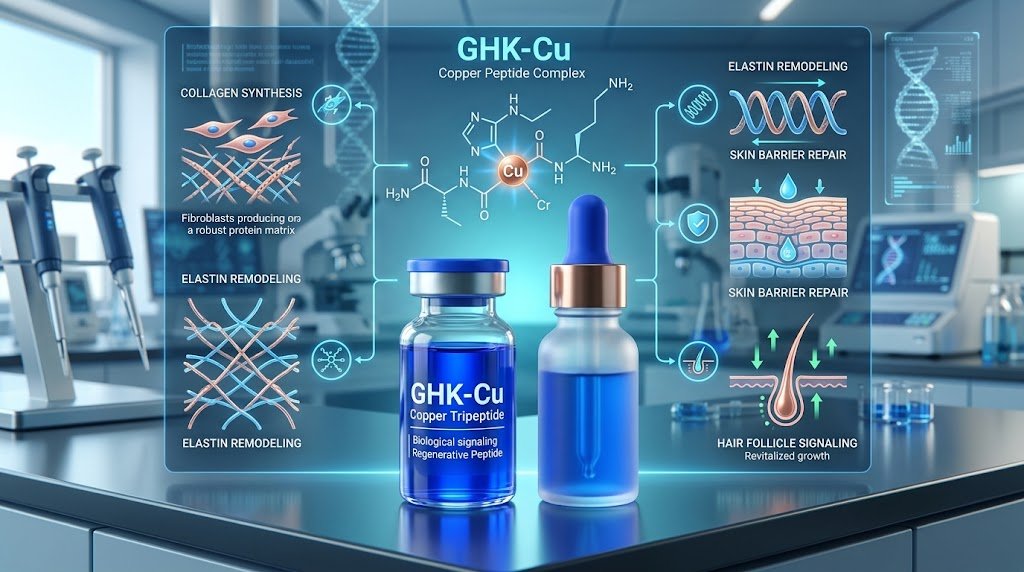
Quick Answer: GHK-Cu (Copper Tripeptide-1) is a naturally occurring plasma tripeptide complexed with divalent copper ions. It promotes structural tissue regeneration by upregulating structural Type I and Type III collagen, elastin, and glycosaminoglycans, balancing matrix metalloproteinases (MMPs), stimulating hair follicle anagen growth, and activating superoxide dismutase (SOD) intracellular antioxidant defense.
| Parameter | Subcutaneous (Sub-Q) Research | Topical / Dermal Protocol |
|---|---|---|
| Primary Focus | Systemic connective tissue regeneration, extracellular remodeling, broad anti-aging | Dermal thickness, fine line softening, scalp microcirculation, hair follicle density |
| Typical Evaluation Dose | 1.0–2.0 mg daily (typically 1.5–2.0 mg for systemic remodeling) | 1%–5% topical solution or serum applied 1–2 times daily |
| Primary Mechanism | Fibroblast activation, collagen/elastin synthesis, MMP/TIMP balance, Cu/Zn SOD activation | Localized dermal extracellular matrix deposition and dermal papilla cell proliferation |
| Reconstitution Solution | Pfizer Hospira Bacteriostatic Water or 0.9% Sterile BAC Saline | Sterile aqueous cosmetic/analytical delivery bases |
What Is GHK-Cu?
GHK-Cu (glycyl-L-histidyl-L-lysine:copper(II)) is a naturally occurring human plasma tripeptide complexed with divalent copper ions (Cu2+).
First isolated in 1973 by Dr. Loren Pickart during studies examining liver tissue aging, GHK was identified as an endogenous blood factor that restored protein synthesis in older tissue cultures to rates typical of younger biological samples.
In human biology, circulating levels of endogenous GHK decline significantly with age—dropping from approximately 200 ng/mL in healthy young adults to roughly 80 ng/mL by age 60. Because of its high binding affinity for copper, GHK functions naturally as a safe physiological delivery system, transporting copper into cells where it serves as an essential cofactor for key metabolic and structural enzymes like lysyl oxidase and superoxide dismutase.
Mechanisms of Action: How GHK-Cu Works at the Cellular Level
GHK-Cu operates across multiple structural, enzymatic, and gene-regulatory pathways:
1. Extracellular Matrix (ECM) Synthesis & Fibroblast Activation
GHK-Cu stimulates the expression and synthesis of essential structural proteins, including Type I collagen, Type III collagen, and elastin. Concurrently, it upregulates key dermal glycosaminoglycans (such as decorin and chondroitin sulfate), improving structural density, tensile strength, and moisture retention in connective tissue matrices.
2. Matrix Metalloproteinase (MMP) Regulation & Tissue Remodeling
True tissue repair requires balance: removing damaged structural debris while laying down new, organized matrix proteins. GHK-Cu modulates both matrix metalloproteinases (MMPs), which break down defective collagen, and tissue inhibitors of metalloproteinases (TIMPs), which prevent excessive tissue breakdown. This dual regulation promotes orderly remodeling rather than tangled, hypertrophic scarring.
3. Hair Follicle Stimulation & Microvascular Perfusion
In follicular research, copper tripeptides have been shown to enlarge hair follicle miniaturization, prolong the anagen (growth) phase, and stimulate the proliferation of dermal papilla cells. These actions are supported by copper-dependent angiogenesis, improving nutrient and oxygen delivery to the follicular base.
4. Antioxidant & Anti-Inflammatory Gene Modulation
GHK-Cu provides direct cellular defense by supplying copper to copper-zinc superoxide dismutase (Cu/Zn SOD), an essential intracellular antioxidant enzyme. Genomic profiling reveals that GHK-Cu downregulates pro-inflammatory markers (including TNF-α and IL-6) while dampening lipid peroxidation and oxidative cellular damage.
What Does the Research Actually Show? Dermal Data vs. Systemic Injections
Evaluating GHK-Cu with scientific rigor requires separating topical cosmetic evidence from systemic injectable protocols.
Strong Preclinical & Topical Clinical Evidence
Unlike many research peptides with data restricted entirely to rodents, GHK-Cu has been evaluated in several controlled human dermatological trials. Peer-reviewed studies on topical formulations demonstrate measurable increases in skin density, collagen synthesis, and wrinkle reduction compared to placebo control creams and conventional retinoids.
The Injectable Research Gap
While topical formulations have human clinical support, subcutaneous injection protocols for systemic longevity and tissue repair are supported primarily by in-vitro cell models, animal wound studies, and clinical wellness observations. Randomized, double-blind trials on long-term subcutaneous administration in humans remain limited.
Regulatory Standing
Topical copper peptides are widely accessible within cosmetic dermatology formulations. However, injectable lyophilized GHK-Cu is classified as an unapproved investigational compound designated strictly for in-vitro laboratory analysis and scientific evaluation.
Documented Laboratory Research & Dosing Protocols
Within published scientific literature and experimental protocols, research models utilize the parameters detailed below. Dilution volumes and unit tick marks can be calculated instantly using our Peptide Calculator, while multi-week cycles can be scheduled inside the Protocol Tracker Tool.
| Parameter | Subcutaneous (Sub-Q) Protocol | Topical Application Protocol |
|---|---|---|
| Experimental Focus | Systemic connective tissue support, systemic anti-aging, broad tissue remodeling | Dermal thickness, collagen synthesis, hair follicle research, localized skin repair |
| Documented Dosing | 1–2 mg per day | 1%–5% cream or serum, applied 1–2 times daily |
| Administration Route | Subcutaneous (Sub-Q) injection | Applied directly to target dermal area or scalp |
| Cycle Duration | 4–8 weeks of continuous evaluation (see our Peptide Cycle Timing Guide) | 4–8 weeks of continuous application |
| Washout Window | 2–4 weeks off between experimental cycles | 2–4 weeks off between cycles |
| Screening Panels | CMP, baseline serum copper and zinc levels | Localized skin patch testing, baseline CMP |
Trace Mineral Balance & Stinging Mitigation
Because copper and zinc utilize shared intestinal and cellular transport mechanisms, extended administration of exogenous copper peptides can potentially influence circulating trace mineral balance. In long-term experimental models utilizing subcutaneous injections, monitoring serum zinc and copper ratios via standard metabolic screening is recommended.
Additionally, pure GHK-Cu is notorious for causing injection-site stinging or firm subcutaneous nodules due to the local osmolarity of the copper ion. To minimize localized irritation, researchers frequently use higher reconstitution diluent volumes (diluting to 2.5–3.0 mL of Bacteriostatic Water) or select 0.9% Bacteriostatic Saline to maintain physiological isotonicity.
Synergistic Laboratory Pairings
In regenerative biology and dermal research, GHK-Cu is frequently cross-referenced or stacked with complementary compounds:
- BPC-157: Frequently co-investigated with BPC-157 to analyze simultaneous angiogenesis and extracellular matrix synthesis.
- TB-500: Paired with TB-500 to combine actin-driven cell migration with dermal remodeling.
- Wolverine Blend: Compared against the dual-pathway action of the Wolverine Blend Guide (or examined as calibrated vials on the Wolverine Blend product page).
- GLOW Blend (70mg): Evaluates GHK-Cu (50mg) co-formulated with BPC-157 (10mg) and TB-500 (10mg) in a single calibrated vial to drive multi-phase collagen and connective tissue recovery. Learn more via the GLOW Blend or our GLOW vs. KLOW Comparison.
- KLOW Blend (80mg): Unites GHK-Cu (50mg), BPC-157 (10mg), and TB-500 (10mg) with nuclear anti-inflammatory KPV (10mg) to calm deep mucosal and systemic tissue inflammation. Explore the KLOW Blend.
- AHK-Cu: Investigated alongside AHK-Cu Copper Tripeptide-3 for specialized hair follicle dermal papilla and scalp density protocols.
Laboratory Handling, Reconstitution & Storage Standards
Lyophilized GHK-Cu exhibits a distinct, natural deep-blue coloration upon reconstitution due to the coordination complex of the cupric (Cu2+) ion:
- Diluent Selection: Reconstitute using sterile, pharmaceutical-grade Pfizer Hospira Bacteriostatic Water containing 0.9% benzyl alcohol to prevent microbial growth during multi-week protocols. Alternatively, 0.9% Sterile Bacteriostatic Saline can be used depending on ionic protocol parameters.
- Reconstitution Protocol: Use a sterile EasyTouch 31G Syringe to introduce the diluent gently against the vial's interior glass wall. Do not spray directly onto the lyophilized cake, and avoid vigorous shaking; gently swirl or roll the vial until the solution is clear and uniform.
- Storage Temperature: Keep lyophilized powder at -20°C for long-term molecular stability. Reconstituted liquid solutions must be refrigerated between 2°C and 8°C (36°F to 46°F) inside a secure, light-shielded Peptide Vial Case or insulated Compact Travel Case to prevent light-induced oxidation and physical degradation.
GHK-Cu represents one of the most thoroughly evaluated regenerative peptides in biochemistry. Its documented ability to coordinate cellular copper delivery, stimulate structural collagen and elastin synthesis, and balance tissue remodeling makes it a cornerstone of regenerative science. Objective laboratory evaluation demands recognizing the proven efficacy of topical applications while maintaining rigorous, controlled standards for systemic investigational protocols.
← View all peptide guides, research & protocols in our Blog Archive


13 comments