
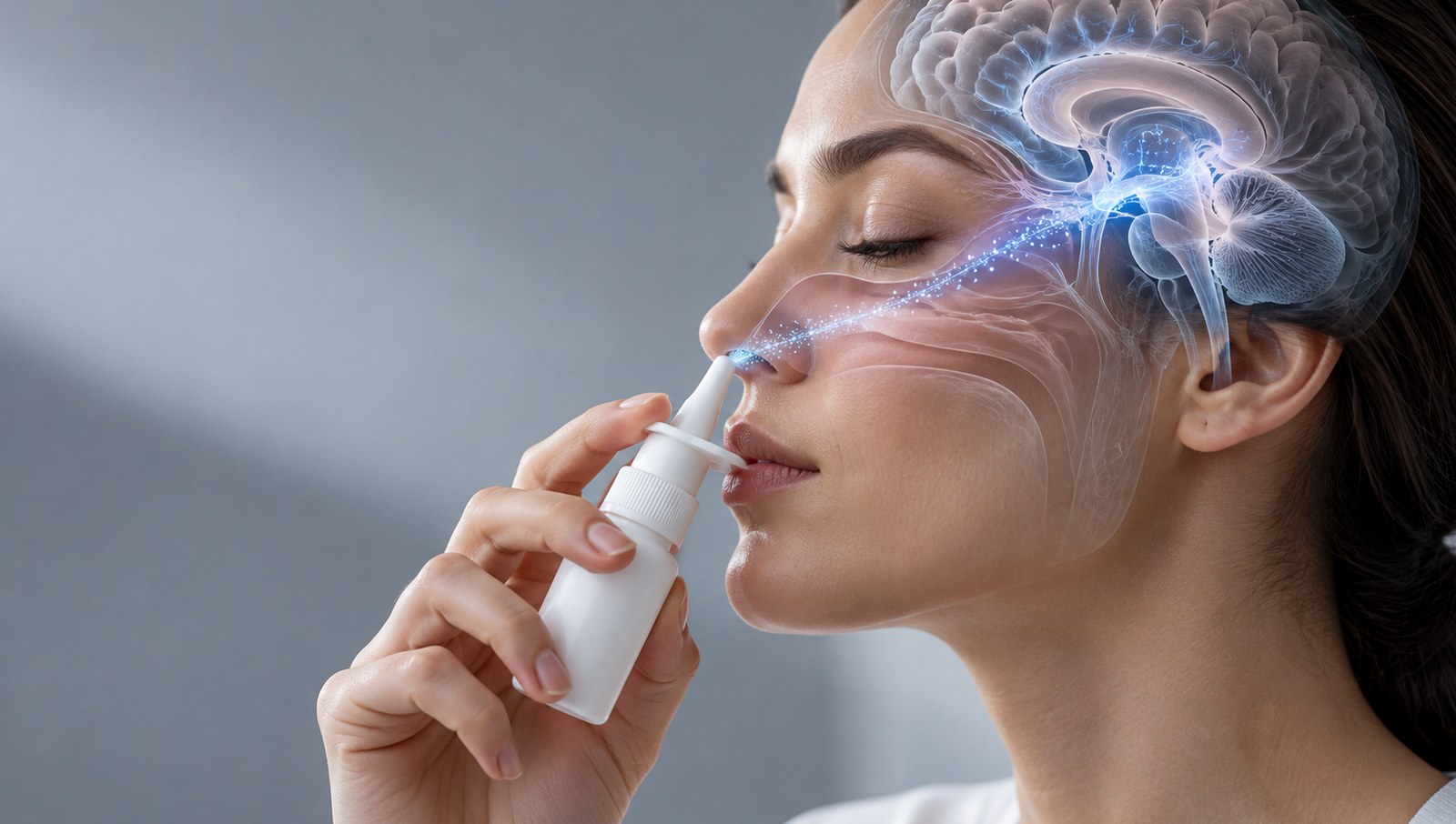
Delivering therapeutic peptides to the central nervous system (CNS) has long been constrained by the blood-brain barrier (BBB), an endothelial wall that excludes over 98% of small-molecule drugs and virtually all large polar macromolecules. Nose-to-brain peptide delivery represents an anatomical workaround: by targeting the olfactory neuroepithelium and trigeminal nerve bundles in the nasal cavity, specific neuroactive compounds migrate directly into cerebrospinal fluid (CSF) and brain parenchymal tissue without relying on systemic circulation.
⚡ Quick Summary: How Nose-to-Brain Delivery Bypasses the BBB
Quick Answer: Nose-to-brain transport utilizes the olfactory and trigeminal neural pathways embedded in the nasal mucosa to shuttle molecules directly into the CNS. This route completely bypasses the tight junctions of the blood-brain barrier, avoids hepatic first-pass metabolism, and prevents rapid enzymatic breakdown in the systemic bloodstream. Research proves that neuropeptides like oxytocin, insulin, Semax, and Selank can reach measurable concentrations in human cerebrospinal fluid (CSF) within 30 to 60 minutes post-insufflation.
| Delivery Pathway | Primary Route / Entry Point | Transport Speed | Target CNS Regions |
|---|---|---|---|
| Olfactory Pathway | Cribriform plate channels & perineural channels | Rapid (paracellular: 30–60 min) | Olfactory bulb, rostral cortex, frontal lobes |
| Trigeminal Pathway | Maxillary & ophthalmic branches in respiratory mucosa | Intermediate to rapid | Brainstem, pons, medulla, caudal brain |
| Systemic Transvascular | Nasal capillary absorption into circulation | Subject to BBB exclusion (<2% penetration) | Limited CNS presence; risk of peripheral off-target effects |
The Blood-Brain Barrier Obstacle in Peptide Research
The blood-brain barrier is constructed of brain capillary endothelial cells linked by complex tight junctions (zonula occludens), supported by pericytes and astrocytic end-feet. This architecture maintains neural homeostasis by barring xenobiotics, circulating toxins, and large hydrophilic peptides.
- Size and Charge Constraints: Molecules exceeding 400–500 Da with hydrophilic properties or charged amino acid side chains are universally turned away by passive diffusion mechanisms.
- Systemic Degradation: Peptides administered subcutaneously or intravenously face systemic peptidases, rapid renal clearance, and hepatic extraction, necessitating disproportionately high doses that risk adverse peripheral side effects.
Anatomy of Direct CNS Infiltration
The nasal cavity is uniquely positioned: it is the only site where the peripheral nervous system directly interfaces with both the external environment and the internal structures of the brain. Two distinct neural pathways facilitate this non-invasive transport:
1. The Olfactory Pathway
Olfactory receptor neurons reside in the upper nasal vault. Molecules travel along perineural channels alongside axon bundles, slip through the fenestrated cribriform plate, and enter the subarachnoid space surrounding the olfactory bulb.
2. The Trigeminal Pathway
The trigeminal nerve (Cranial Nerve V) innervates both the respiratory and olfactory mucosa via its ophthalmic and maxillary branches, delivering solutes directly into the pons, medulla, and caudal brain regions.
3. Paracellular Fluid Flow
Rather than relying solely on slow intracellular axonal transport, small-to-medium peptides leverage rapid bulk flow through perivascular and perineural spaces, circulating into CSF in under an hour.
Standardize Your Solvent Precision & Purity
Accurate reconstitution and physiological stability are fundamental to reproducible biomolecular research. Genuine Pfizer Hospira 30 mL ensures uncompromised, sterile diluent integrity across extended study schedules.
Shop Hospira Bacteriostatic Water 30 mL →Key Neuroactive Peptides Studied via Intranasal Administration
Modern neuropharmacology heavily utilizes the intranasal corridor to study peptides with potent cognitive, neuroprotective, and metabolic signaling roles:
- Synthetic ACTH Analogues (Semax): Originally developed to assist ischemic stroke recovery and cognitive enhancement, Semax demonstrates rapid BBB avoidance, elevating Brain-Derived Neurotrophic Factor (BDNF) without stimulating peripheral corticosteroid spikes.
- Anxiolytic Peptides (Selank): An analogue of the endogenous immunomodulatory peptide tuftsin, Selank alters GABAergic neurotransmission and monoamine levels via intranasal delivery without sedative peripheral effects.
- Intranasal Insulin: Evaluated for metabolic signaling in neurodegenerative models. Intranasal administration elevates central insulin levels and restores synaptic plasticity without inducing systemic hypoglycemia.
- Oxytocin & Neuropeptide Y (NPY): Heavily researched for behavioral modulation, stress attenuation, and sympathetic tone modulation directly within the amygdala and prefrontal cortex.
Formulation Factors: Optimizing Mucosal Permeability & Stability
Bypassing the BBB via the nasal epithelium requires precise chemical formulation to navigate enzymatic barriers and rapid mucociliary clearance:
- Enzymatic Defense: The nasal mucosa contains aminopeptidases and endopeptidases. Protecting peptide structures through sequence modifications (e.g., C-terminal amidation, D-amino acid substitution) or specialized vehicle buffers is critical to prevent pre-absorption degradation.
- Osmolarity and pH Controls: Formulations should maintain an isotonic profile (280–310 mOsm/L) and a pH between 5.5 and 6.5 to avoid damaging nasal cilia. For specific ionic considerations, evaluate Sodium Chloride Saline Bacteriostatic Water 0.9% for osmotic balance.
- Diluent Sterility and Longevity: Reconstitution requires reliable, multi-dose antimicrobial preservation. Review the analytical stability profile of multi-dose diluents in our deep dive: Hospira BAC Water Expiry After Opening: 28 Days vs 60+ Day Reality.
Hardware and Laboratory Dilution Workflows
Rigorous bench protocols and precision measurement ensure predictable concentrations for all compound investigations:
- Accurate Concentration Modeling: Calculate reconstitution math, vial dilutions, and volume metrics accurately using our Peptide Calculator.
- Syringe & Transfer Precision: Eliminate volume dead-space and protect stopper seals when measuring diluents using Easy Touch 31G U-100 Syringes.
- Protocol Auditing: Log compound lots, reconstitution dates, and storage variables with the Protocol Builder and maintain active research timelines using the Protocol Tracker Tool.
- Modular Storage Solutions: Protect sensitive peptide vials from ambient light, temperature fluctuations, and mechanical impact with the Compact 4-Slot Case or the high-capacity 10-Slot Peptide Vial Case.
Frequently Asked Questions
Does nose-to-brain delivery cause systemic side effects?
While a portion of an intranasally administered solution enters the respiratory mucosa and capillary beds (entering systemic blood flow), a significant fraction bypasses circulation entirely via the olfactory and trigeminal tracks. This reduces, but does not completely eliminate, systemic compound exposure compared to subcutaneous or intravenous injection.
What is the typical time window for peptides to enter the CSF?
According to landmark studies by Born et al. and Hanson & Frey, direct extracellular fluid-phase transport allows measurable peptide concentrations to appear in cerebrospinal fluid within 30 to 60 minutes after nasal administration, far faster than traditional axonal transport.
Can any peptide be delivered through the nose to the brain?
No. Molecular weight, lipophilicity, enzymatic vulnerability, and electrical charge directly dictate uptake efficiency. Larger peptides (typically >10–15 kDa) exhibit dramatically reduced mucosal permeability without the inclusion of specialized permeation enhancers or nanoparticle delivery matrices.
References & Foundational Literature
- Hanson, L. R., & Frey, W. H. (2008). Intranasal delivery bypasses the blood-brain barrier to target therapeutic agents, trace elements and DNA to the central nervous system and treat neurodegenerative disease. BMC Neuroscience, 9(Suppl 3), S5.
- Born, J., Lange, T., Kern, W., McGregor, G. P., Bickel, U., & Fehm, H. L. (2002). Sniffing neuropeptides: a transnasal approach to the human brain. Nature Neuroscience, 5(6), 514–516.
- Lochhead, J. J., & Thorne, R. G. (2012). Intranasal delivery of biologics to the central nervous system. Advanced Drug Delivery Reviews, 64(7), 614–628.
The olfactory and trigeminal pathways provide an invaluable mechanism for central nervous system research, allowing peptide researchers to bypass the restrictive blood-brain barrier and avoid extensive systemic degradation. Backed by disciplined aseptic compounding and reliable diluents like Bacteriostatic Water 30 mL Pfizer Hospira, intranasal targeting continues to unlock powerful new avenues for investigative neurobiology.
← View all peptide guides, research & protocols in our Blog Archive
Free 39-page Nootropics & Brain Function Guide — 23 compound profiles

2 comments