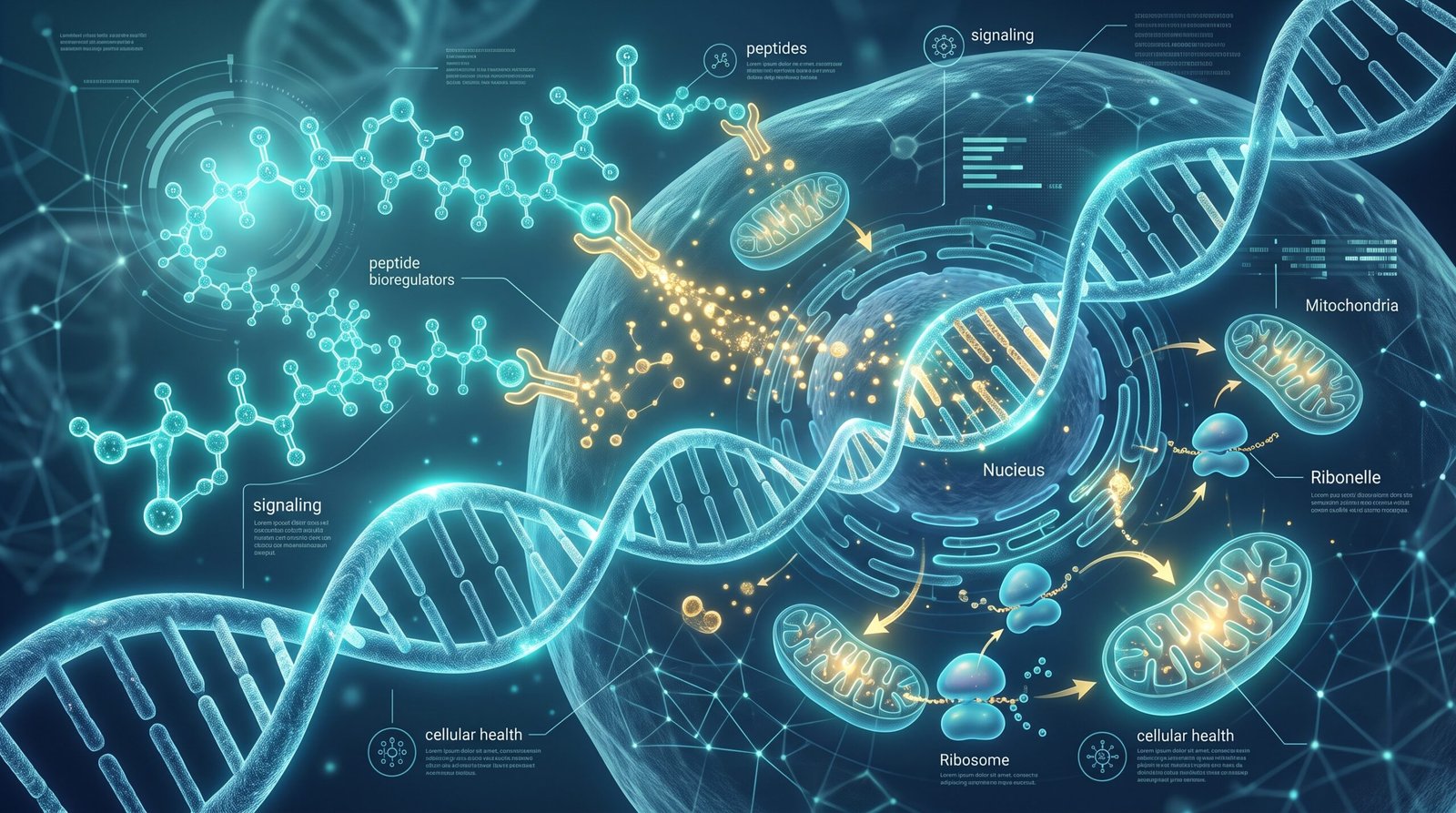
Peptide Bioregulators Explained: Epigenetic Mechanisms & Protocols
Within regenerative biology and gerontology, researchers classify peptide bioregulators as a unique category of ultra-short signaling molecules. Unlike conventional peptides that trigger cell surface receptors, bioregulators travel directly into the cell nucleus to influence gene transcription at the DNA level.
Online biohacking forums frequently promote bioregulators as fountain-of-youth remedies capable of reversing biological age across every organ overnight. Scientific research, however, examines them through a much more precise molecular lens: epigenetic regulation. Exploring bioregulators requires examining their military gerontology origins, their specific interactions with nuclear chromatin, and their distinct tissue-specific targeting.
Quick Summary: What Are Peptide Bioregulators at a Glance?
Quick Answer: Peptide bioregulators are short chains of 2 to 4 amino acids (di-, tri-, and tetrapeptides) with molecular weights below 500 Daltons. Discovered by Professor Vladimir Khavinson, they cross cell membranes directly, penetrate the nucleus, and physically bind DNA grooves to uncoil tightly wound heterochromatin. This direct epigenetic interaction restores youthful protein synthesis in aging or damaged tissues.
| Characteristic | Synthetic Bioregulators (Cytogens) | Natural Extract Bioregulators (Cytomaxes) |
|---|---|---|
| Chemical Structure | Single, highly purified sequence of 2–4 amino acids | Complex organic peptide fractions from young animal tissues |
| Onset of Action | Rapid cellular initiation (fast epigenetic trigger) | Gradual, broad physiological tissue response |
| Typical Evaluation Dose | 100–200 mcg oral daily or 1–10 mg Sub-Q injection | 10–20 mg oral daily (concentrated natural fractions) |
| Primary Application | Targeted laboratory research, intense cellular reset | Broad, prolonged organ maintenance and tissue support |
What Are Peptide Bioregulators?
Peptide bioregulators are ultra-short amino acid sequences—typically consisting of just two, three, or four amino acids (dipeptides, tripeptides, and tetrapeptides)—with low molecular weights under 500 Daltons.
Military medical researcher Professor Vladimir Khavinson first developed these compounds in the 1970s and 1980s at the St. Petersburg Institute of Bioregulation and Gerontology. The initial research aimed to protect military personnel, submariners, and cosmonauts from severe environmental stress, radiation exposure, and rapid tissue degradation.
Khavinson isolated short peptide fractions from juvenile animal organs (such as the pineal gland, thymus, cortex, and vascular walls). He discovered that these tiny fragments restore protein synthesis rates in older, stressed cell samples to levels characteristic of young, healthy donor tissues.
The Operating Mechanism: Epigenetic Gene Regulation
To understand how bioregulators work, consider the difference between a surface door buzzer and a direct software patch:
- Conventional Peptides (The Door Buzzer): Most standard peptides (like Semaglutide or BPC-157) dock into receptor keyholes on the outer cell membrane. They ring a surface buzzer that sets off a secondary messenger cascade inside the cell without the peptide ever crossing the threshold.
- Bioregulators (The Software Patch): Because bioregulators consist of only a few amino acids, they slip directly through the cell wall and nuclear envelope without requiring active transport or surface keys.
Direct Chromatin & DNA Binding
Inside the nucleus, the cell winds its DNA tightly around proteins called histones. As tissues age, experience chronic oxidative stress, or endure cellular fatigue, chromatin regions often compact into dense, unreadable bundles called heterochromatin. The cell's transcription machinery can no longer read the repair instructions contained in those tangled DNA segments, which slows down protein synthesis.
Bioregulators fit directly into the major and minor grooves of the DNA double helix. This complementary physical binding loosens histone packing and unwinds tightly coiled heterochromatin. Unfolding the DNA allows RNA polymerase to reach dormant promoter sequences once again, kickstarting the synthesis of structural and enzymatic proteins specific to that organ.
Tissue Tropism: The Biological Target Principle
Bioregulators display absolute tissue specificity, known in pharmacology as biological tropism. A bioregulator sequence derived from or modeled after pineal tissue influences only pineal cells; it does not trigger cellular actions in hepatic or muscular tissue.
Biochemists divide bioregulators into two primary technical classes:
- Cytomaxes (Natural Extracts): Complex fractions of short, natural peptide chains extracted from specific organs of young bovine donors. They contain a natural spectrum of di-, tri-, and tetrapeptides that deliver a broad, gradual tissue response.
- Cytogens (Synthesized Analogs): Laboratory-synthesized peptides containing exact, single pure sequences of 2 to 4 amino acids. They represent the concentrated active core of natural extracts, driving rapid, targeted cellular signaling.
Primary Classes of Research Bioregulators
Laboratories categorize bioregulators according to the specific tissue system they target:
| Tissue Target | Synthetic Name (Cytogen) | Natural Name (Cytomax) | Primary Biological Research Focus |
|---|---|---|---|
| Pineal Gland (Neuroendocrine) | Epithalon (AEDG) | Endoluten | Telomerase induction, circadian normalization, melatonin regulation |
| Thymus (Immune Command) | Vilon (KE) | Vladonix | T-cell differentiation, immune restoration, chromatin remodeling |
| Vascular Endothelium | Vesugen (KED) | Ventfort | Vascular wall elasticity, microcirculation, arterial repair |
| Central Nervous System | Pinealon (EDR) | Cerluten | Neuronal survival, BDNF activation, hypoxia protection |
| Cartilage & Connective Matrix | Cartalax (AED) | Sigumir | Chondrocyte proliferation, proteoglycan synthesis, joint integrity |
| Hepatic Tissue | Livagen (EDG) | Svetinorm | Hepatocyte detoxification, chromatin decondensation, lipid processing |
Spotlight on Epithalon: The Flagship Bioregulator
Among all bioregulators, Epithalon (synthetic tetrapeptide: Alanine-Glutamic Acid-Aspartic Acid-Glycine) commands the greatest research interest.
In cell culture assays and animal trials, Epithalon directly stimulates the expression of human telomerase reverse transcriptase (hTERT). Telomerase extends telomeres—the protective caps on the ends of chromosomes that naturally erode with each cell division. By preserving telomere length, Epithalon allows somatic cells to surpass the classical Hayflick limit (their maximum replicative ceiling), preserving cellular viability over extended research timelines. Review comprehensive cycling protocols in our dedicated Epithalon Protocol Guide.
Documented Research & Dosing Protocols
Within published gerontology literature, preclinical animal trials, and observational research models, experimental protocols apply the following parameters. Dilution metrics can be mapped using our free Peptide Calculator, while pulsed intervals can be organized in the Protocol Tracker Tool.
| Protocol Parameter | Subcutaneous (Sub-Q) Injectable (Cytogens) | Oral Administration (Cytogens / Cytomaxes) |
|---|---|---|
| Experimental Focus | Rapid chromatin unwinding, intensive cellular reset, telomerase studies | Sustained epigenetic signaling, chronic organ support, maintenance |
| Documented Dosing | 5–10 mg daily (for Epithalon) or 1–2 mg daily (for short Cytogens) | 10–20 mg daily (oral Cytomaxes) or 100–200 mcg pure Cytogens |
| Administration Route | Subcutaneous (Sub-Q) injection | Oral capsule or sublingual drop (taken in a fasted state) |
| Cycle Architecture | Short, concentrated blocks: 10–20 continuous days (see our Cycle Timing Guide) | Standard blocks: 20–30 continuous days |
| Inter-Cycle Washout | Long rest phases: repeated only once every 3 to 6 months | Rest phases: repeated 2 to 3 times per year |
| Key Biomarkers | Baseline organ panels (CMP), telomere assays, immune subsets (CD4/CD8) | Comprehensive metabolic panels, tissue-specific hormone markers |
Oral Bioavailability: Why Bioregulators Survive Digestion
While long peptides (like LL-37 or full growth hormone) degrade rapidly in the stomach, ultra-short bioregulators withstand oral delivery remarkably well.
Their tiny size (2 to 4 amino acids) shields them from non-specific protease cleavage. The gut lining easily absorbs intact di- and tripeptides through PepT1 and PepT2 transporters, moving them into the portal bloodstream intact. While subcutaneous injections provide faster peak plasma concentrations, oral delivery remains a valid method for studying gradual organ maintenance. For a full comparison of systemic paths, explore our guide on Sub-Q vs. IM vs. Nasal Peptide Delivery.
Synergistic Research Pairings
Researchers often pair organ-specific bioregulators with general tissue repair peptides to evaluate multi-tiered healing cascades:
- Vesugen + BPC-157: Scientists pair vascular bioregulators with BPC-157 to analyze simultaneous endothelial gene transcription and VEGFR2 capillary sprouting.
- Cartalax + TB-500: Researchers combine cartilage bioregulators with TB-500 to observe localized chondrocyte protein synthesis alongside systemic actin-driven cell migration.
- Epithalon + MOTS-c: Teams study pineal telomerase induction alongside MOTS-c to assess nuclear DNA preservation alongside mitochondrial metabolic output.
- Vilon + KPV: Investigators pair thymus bioregulators with KPV Peptide to observe balanced T-cell differentiation alongside rapid NF-κB anti-inflammatory regulation.
- General Fundamentals: If you are new to peptide categorization and molecular weights, read our primer on What Is a Peptide? Everyday Analogies.
Laboratory Handling, Reconstitution & Storage Standards
Although their simple chemical structures make them relatively resilient, bioregulators still demand standard laboratory cold-chain care (detailed in our Beginner's Guide to Peptides):
- Diluent Selection: Reconstitute lyophilized bioregulator vials using sterile, pharmaceutical-grade Pfizer Hospira Bacteriostatic Water containing 0.9% benzyl alcohol to prevent bacterial contamination across multi-day testing cycles. Alternatively, use 0.9% Sterile Bacteriostatic Saline for cell-culture and tissue-specific assays.
- Reconstitution Protocol: Use a sterile EasyTouch 31G Syringe to let the diluent trickle gently down the inside glass wall of the vial. Do not spray diluent directly onto the lyophilized cake. Avoid violent shaking; roll the vial slowly between your palms until the powder fully dissolves.
- Storage Standards: Store dry lyophilized powder at -20°C for long-term molecular preservation. Maintain reconstituted liquid solutions between 2°C and 8°C (36°F to 46°F) inside a secure, light-shielded Peptide Vial Case or insulated Compact Travel Case to protect against light degradation and mechanical agitation.
Peptide bioregulators represent an elegant biological control mechanism within peptide science. By slipping directly into the cell nucleus to bind DNA grooves, these tiny amino acid chains reactivate dormant genetic blueprints, restart essential protein synthesis, and restore tissue homeostasis. Following structured cyclic dosing protocols, selecting reliable natural or synthetic analogs, and adhering to strict cold-chain preparation will ensure accurate, reproducible experimental results.
← View all peptide guides, research & protocols in our Blog Archive