Back to Research & Articles
Laboratory Research Notice: This page explains how Tesamorelin dosing is structured in published research and how to calculate concentrations for laboratory work. Tesamorelin referenced here is supplied as a research material, not a medicine. Nothing on this page is medical advice.
Tesamorelin is unusual in this category because there is a real answer to the dosage question: the studied dose is 2 mg subcutaneously, once daily. That is the figure from the clinical programme, not a forum estimate. What follows from it is arithmetic — 60 mg a month, how that divides into vials, and how to turn a 10 mg or 20 mg vial into a syringe you can actually read.
Quick Breakdown: Tesamorelin Dosage at a Glance
Quick Answer: The research and clinical dose is 2 mg once daily, subcutaneously. That is 60 mg per month — three 20 mg vials, or six 10 mg vials. Reconstituted at 2 mL, a 10 mg vial gives 5 mg/mL, so 2 mg is 0.4 mL = 40 units on a U-100 syringe.
| Term |
Figure |
What It Means |
| Daily dose |
2 mg subcutaneously |
The dose used across the published trial programme. |
| Monthly total |
60 mg |
2 mg × 30 days — the number that determines how many vials you need. |
| Concentration |
5 mg/mL at 2 mL diluent |
Set entirely by how much water you add. |
| Volume per dose |
0.4 mL = 40 units |
On a U-100 syringe, at 5 mg/mL. |
Why 2 mg Is the Anchor
Tesamorelin is a stabilised GHRH analogue developed specifically for visceral adipose tissue. Unlike most compounds in this category, it completed a full clinical programme — which means the dose is documented rather than inferred: 2 mg daily, subcutaneous, with outcomes measured in visceral fat rather than body weight.
That matters for research design. A protocol built around 1 mg underestimates the studied exposure; one built around 5 mg is beyond anything the trials used. The 2 mg figure is the only one with outcome data behind it, and the Tesamorelin research guide covers the trial results and the mechanism in detail.
Reconstitution Maths: Vial to Syringe
Both vial sizes reconstitute the same way. The variable is how much diluent you add, and that determines how many units a 2 mg dose requires.
| Vial |
Diluent |
Concentration |
2 mg Dose = Units (U-100) |
| 10 mg |
2.0 mL |
5 mg/mL |
0.40 mL = 40 units |
| 10 mg |
5.0 mL |
2 mg/mL |
1.00 mL = 100 units (full syringe) |
| 20 mg |
4.0 mL |
5 mg/mL |
0.40 mL = 40 units |
| 20 mg |
2.0 mL |
10 mg/mL |
0.20 mL = 20 units |
The pattern to avoid: adding too much diluent at a 2 mg dose pushes the draw to a full 100-unit syringe, which is awkward to measure accurately and doubles the fluid volume. Two millilitres for a 10 mg vial, or four for a 20 mg vial, keeps every dose at 40 units — a comfortable, readable mark. The general conversion is in how much bacteriostatic water to add, and the Peptide Calculator handles any combination.
How Many Vials Per Month
At 2 mg daily you consume 60 mg a month, which makes vial sizing the single biggest driver of cost:
| Vial |
Price |
Days Per Vial |
Monthly Need |
| 10 mg |
$80 |
5 days |
6 vials — $480 |
| 20 mg |
$120 |
10 days |
3 vials — $360 |
The 20 mg vial is $6.00 per milligram against $8.00 for the 10 mg — a third cheaper per month at the studied dose. That is the practical argument for the larger vial, and it is arithmetic rather than a sales claim.
Cycle Length and What the Literature Covers
Tesamorelin trials ran for extended periods — the longest measured in years, not weeks — with visceral fat as the primary endpoint. That is a different design assumption from the shorter cycles common with secretagogues, and it is worth matching if the research question is visceral adipose tissue rather than pulsatile GH release. Cycle questions in this compound are mostly about study duration, not washout.
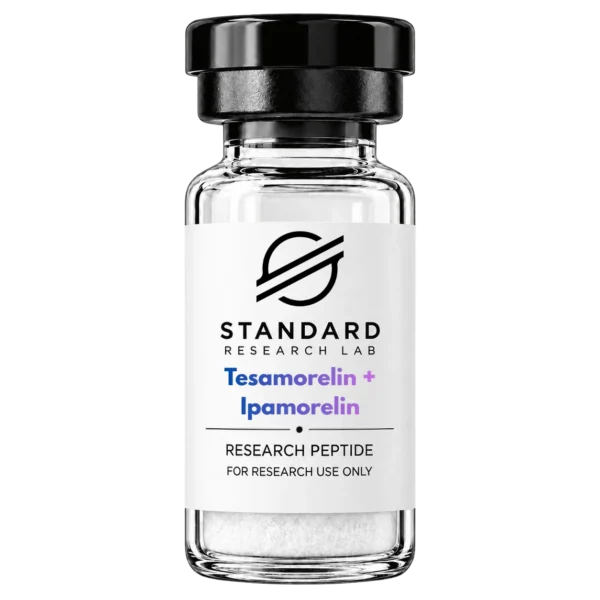
If you are stacking it, the pairing that appears most often in research is with Ipamorelin — covered in the Ipamorelin comparison and available as a Tesamorelin + Ipamorelin blend.
Storage and Handling
- Refrigerate reconstituted vials at 2–8°C, protected from light, in a vial case.
- Work inside the 28-day window after the first puncture — see how long BAC water is good for.
- Record the diluent volume on the vial. At 2 mg a day, a concentration error compounds across ten doses before the vial is finished.
Frequently Asked Questions
What is the standard Tesamorelin dosage?
2 mg once daily, subcutaneously — the dose used across the clinical programme and measured against visceral fat outcomes.
Tesamorelin dosage per week?
14 mg, from 2 mg a day. That is one and a half 10 mg vials, or seven-tenths of a 20 mg vial, per week.
How much BAC water do I add to a 10 mg vial?
2 mL gives 5 mg/mL, which makes a 2 mg dose 40 units. 5 mL gives 2 mg/mL and a 100-unit draw — less convenient, same dose.
Is the dosage different for the 20 mg vial?
The dose is identical. Only the number of doses per vial changes — ten at 2 mg daily.
How much does Tesamorelin cost per month?
At the studied dose, $360 a month using 20 mg vials ($120 each), or $480 using 10 mg vials ($80 each).
Related: for the mechanism and trial evidence, read the Tesamorelin guide or the compound research profile; to compare strengths and order, see the Tesamorelin product page.
Tesamorelin, Priced Per Vial
10 mg $80 · 20 mg $120 — $8.00 and $6.00 per milligram. At the studied 2 mg dose, the 20 mg vial covers ten days. Batch numbers matched to published certificates.
View Tesamorelin →
Tesamorelin is the rare compound here with a documented dose: 2 mg daily, 60 mg a month. Everything else is arithmetic — 40 units at 5 mg/mL, six 10 mg vials a month or three 20 mg vials, and a 33% lower cost per milligram on the larger vial.
→ Read the Full Tesamorelin Research Guide

 ✓ COA
 ✓ COA
 ✓ COA