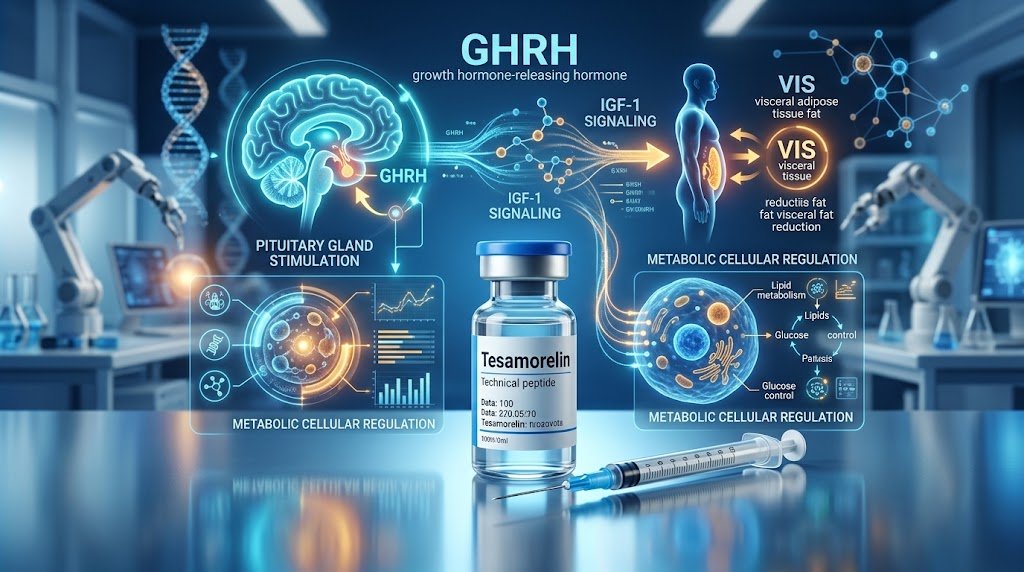
Tesamorelin Guide: Mechanisms, Visceral Fat & Protocols
Within neuroendocrinology and metabolic pharmacology, Tesamorelin represents one of the most potent and clinically validated Growth Hormone-Releasing Hormone (GHRH) analogues ever developed. Engineered specifically to mobilize deep intra-abdominal fat, it provides researchers with an exceptional tool to study targeted visceral adiposity reduction and hepatic lipid clearance.
Online bodybuilding and longevity forums frequently discuss Tesamorelin as a premier stubborn belly fat peptide. However, scientific evaluation looks deeper into its unique structure. Understanding Tesamorelin requires analyzing its full-length 44-amino-acid backbone, the trans-hexenoyl fatty acid modification that shields it from rapid enzymatic degradation, and the physiological cascades that distinguish it from shorter GHRH fragments like Sermorelin and CJC-1295.
Quick Summary: What Is Tesamorelin at a Glance?
Quick Answer: Tesamorelin is a synthetic 44-amino-acid analogue of human growth hormone-releasing hormone (GHRH 1-44) modified with an N-terminal trans-3-hexenoyl group. This modification protects against DPP-4 cleavage, extending its half-life to ~26–38 minutes. It selectively stimulates pituitary pulsatile growth hormone and IGF-1 secretion, preferentially mobilizing deep visceral adipose tissue (VAT) and clearing liver fat while preserving peripheral subcutaneous fat.
| Parameter | Tesamorelin (GHRH 1-44 Analogue) | Sermorelin (Native GRF 1-29) | CJC-1295 No DAC (Mod GRF 1-29) |
|---|---|---|---|
| Sequence Length | 44 amino acids + trans-hexenoyl group | 29 amino acids (native fragment) | 29 amino acids (tetrasubstituted) |
| Enzymatic Protection | N-terminal trans-3-hexenoyl fatty acid | None (rapid DPP-4 cleavage) | D-Ala2, Gln8, Ala15, Leu27 |
| Elimination Half-Life | Approximately 26 to 38 minutes | Approximately 10 to 12 minutes | Approximately 30 minutes |
| Primary Research Focus | Selective visceral adiposity, liver steatosis, IGF-1 | Physiological somatotrophic restoration | Multi-pulse secretagogue synergies |
| Direct Research Supply | Lyophilized calibrated vials available via Tesamorelin (10mg) | ||
What Is Tesamorelin?
Tesamorelin (investigational code TH9507) is a synthetic analogue of human Growth Hormone-Releasing Hormone (GHRH 1-44) with a molecular weight of approximately 5,135.9 Daltons.
Natural human GHRH consists of a 44-amino-acid chain produced in the arcuate nucleus of the hypothalamus. While shorter fragments like Sermorelin (GRF 1-29) contain the core binding residues needed to activate somatotrophs, they clear from circulation in under 10 to 12 minutes due to enzymatic cleavage by dipeptidyl peptidase-4 (DPP-4).
Theratechnologies solved this pharmacokinetic challenge by attaching a hydrophobic trans-3-hexenoyl moiety to the N-terminal tyrosine residue of full-length GHRH 1-44. This fatty acid modification acts as a steric shield, preventing DPP-4 from cleaving the active amino terminal while preserving high binding affinity for the pituitary GHRH receptor. The result is a stabilized GHRH analogue with an elimination half-life of roughly 26 to 38 minutes, producing robust, physiological growth hormone pulses.
Mechanism of Action: Pituitary Pulsatility & Visceral Lipolysis
Tesamorelin acts through a precise, upstream endocrine axis:
1. Pituitary GHRH Receptor Activation
Upon subcutaneous administration, Tesamorelin binds selectively to G-protein coupled GHRH receptors on anterior pituitary somatotrophs. This binding triggers the stimulatory G-protein alpha subunit, turning on adenylyl cyclase to convert cellular ATP into cyclic adenosine monophosphate (cAMP).
2. Protein Kinase A (PKA) Signaling & Storage Discharge
Rising intracellular cAMP activates protein kinase A (PKA). PKA phosphorylates voltage-gated L-type calcium channels, driving an influx of calcium ($Ca^{2+}$) into somatotroph cells. This calcium wave triggers the rapid exocytosis of pre-formed human growth hormone granules into the bloodstream. In parallel, PKA phosphorylates the CREB transcription factor, maintaining intra-cellular GH gene transcription to restock the pituitary's secretory stores.
3. Hepatic IGF-1 Secretion
Circulating growth hormone travels to the liver, where it binds to hepatic GH receptors and stimulates the synthesis and release of Insulin-Like Growth Factor 1 (IGF-1) along with its primary binding protein, IGFBP-3. Systemic IGF-1 mediates cellular regeneration, nitrogen retention, and connective tissue maintenance throughout the body.
4. Selective Visceral Adipose Tissue (VAT) Lipolysis
The hallmark of Tesamorelin is its marked selectivity for Visceral Adipose Tissue (VAT) over subcutaneous fat depots. Deep visceral fat cells carry a high density of growth hormone receptors and beta-3 adrenergic receptors, paired with low alpha-2 adrenergic inhibitory tone. Elevated pulsatile growth hormone directly stimulates hormone-sensitive lipase (HSL) while inhibiting lipoprotein lipase (LPL) in visceral fat beds, mobilizing intra-abdominal triglycerides without causing facial or peripheral subcutaneous fat wasting.
Tesamorelin vs. Sermorelin vs. CJC-1295
Laboratories evaluating GHRH analogues select compounds based on distinct structural and pharmacokinetic profiles:
- Sermorelin (Native GRF 1-29): The unshielded, bioidentical 29-amino-acid fragment. Cleared rapidly within 10 to 12 minutes, it provides discrete, short growth hormone pulses. Learn more in our Sermorelin Protocols Guide.
- CJC-1295 Without DAC (Mod GRF 1-29): Features four amino acid substitutions that extend its half-life to roughly 30 minutes, commonly co-administered with Ipamorelin. Explore this in our CJC-1295 DAC vs. No DAC Guide.
- Tesamorelin: Combines the full-length 44-amino-acid peptide with an N-terminal trans-hexenoyl fatty acid. It delivers the highest documented efficacy for reducing deep abdominal visceral fat and reversing hepatic steatosis.
Documented Laboratory Research & Dosing Protocols
In clinical trials (including Phase 3 lipodystrophy studies) and exploratory metabolic research, published protocols apply the following parameters. Volume dilutions can be calculated instantly using our free Peptide Calculator, while cycle timelines are organized inside the Protocol Tracker Tool.
| Protocol Parameter | Standard Visceral Lipolysis Protocol | Accelerated Metabolic & Hepatic Protocol |
|---|---|---|
| Research Target | Visceral adipose reduction, waist circumference, IGF-1 | Intrahepatic fat clearance, MASH models, trunk lipolysis |
| Documented Dosing | 1.0 mg daily | 2.0 mg daily (single dose or split into 1.0 mg twice daily) |
| Administration Route | Subcutaneous (Sub-Q) injection into abdominal fat | Subcutaneous (Sub-Q) injection into abdominal fat |
| Timing Constraints | Strictly fasted: bedtime or morning upon waking | Fasted: morning upon waking and bedtime |
| Cycle Architecture | 12 to 24 weeks continuous evaluation (see our Cycle Timing Guide) | 12 to 16 weeks on / 4 to 8 weeks washout |
| Key Biomarkers | Visceral fat imaging (DEXA/MRI), IGF-1, fasting glucose | Liver enzymes (ALT/AST), intrahepatic triglycerides, HbA1c |
The Fasted Administration Requirement
Just as with other GHRH secretagogues, metabolic context dictates Tesamorelin efficacy:
- Carbohydrate & Insulin Interference: Consuming dietary carbohydrates prompts pancreatic insulin secretion, which directly triggers hypothalamic somatostatin release. Somatostatin acts as a powerful brake on somatotroph adenylyl cyclase, neutralizing Tesamorelin's ability to stimulate a GH pulse.
- Circulating Free Fatty Acids: Elevated post-prandial lipid levels similarly impair somatotroph responsiveness.
To prevent somatostatin interference, research protocols enforce a strict fasted window of at least two to three hours prior to subcutaneous injection, followed by a 30-to-45-minute wait before nutrient consumption.
Synergistic Research Pairings
Because Tesamorelin upregulates upstream GHRH signaling and mobilizes deep lipid stores, researchers frequently study it alongside complementary metabolic and tissue-repair peptides:
- GLP-1 Receptor Agonists: In advanced metabolic studies, researchers frequently co-evaluate Tesamorelin alongside next-generation incretins (compare compounds in our Best GLP-1 for Weight Loss Guide) to assess dual-pathway fat mobilization. While incretin mimetics drive systemic caloric restriction, delay gastric emptying, and improve insulin sensitivity, Tesamorelin provides pulsatile growth hormone signaling to protect lean muscle mass and accelerate the breakdown of deep visceral adipose tissue.
- Ipamorelin: Co-administering Tesamorelin with Ipamorelin produces dual-pathway somatotrophic synergy. Tesamorelin drives cAMP-mediated hormone synthesis, while Ipamorelin releases intracellular calcium and suppresses somatostatin, yielding an amplified GH pulse without prolactin or cortisol spikes.
- AOD-9604: In metabolic studies, laboratories pair Tesamorelin with AOD-9604 Peptide (or view AOD-9604 5mg) to evaluate targeted adipocyte lipolysis alongside broad visceral fat mobilization.
- 5-Amino-1MQ: Scientists study cellular energetics and fat-cell shrinkage by combining GHRH-mediated lipolysis with intracellular NNMT enzyme inhibition using 5-Amino-1MQ (or view 5-Amino-1MQ vials).
- MOTS-c: Investigators examine skeletal muscle glucose uptake and mitochondrial biogenesis during periods of active fat reduction by pairing protocols with MOTS-c (view MOTS-c 10mg/40mg).
- BPC-157: In systemic tissue models, researchers combine secretagogue protocols with BPC-157 to analyze whether elevated systemic IGF-1 accelerates localized angiogenic recovery.
- TB-500: Research teams pair GHRH analogues with TB-500 to explore concurrent cellular actin upregulation alongside elevated growth factor output.
Laboratory Handling, Reconstitution & Storage Standards
Because Tesamorelin is a large 44-amino-acid peptide with an N-terminal fatty acid modification, maintaining structural integrity across multi-week studies requires strict laboratory cold-chain discipline (detailed step-by-step in our Beginner's Guide to Peptides):
- Diluent Selection: Reconstitute lyophilized Tesamorelin vials using sterile, pharmaceutical-grade Pfizer Hospira Bacteriostatic Water containing 0.9% benzyl alcohol to prevent microbial contamination across multi-dose testing schedules. Alternatively, use 0.9% Sterile Bacteriostatic Saline for cell-culture assays requiring strict isotonicity.
- Reconstitution Protocol: Use a sterile EasyTouch 31G Syringe to let the diluent trickle slowly down the inside glass wall of the vial. Never spray liquid directly onto the lyophilized powder cake. Avoid vigorous agitation, shaking, or vortexing; roll the vial slowly between your palms until the solution turns completely clear.
- Cold-Chain Storage: Store dry lyophilized powder at -20°C for long-term molecular stability. Maintain reconstituted liquid solutions between 2°C and 8°C (36°F to 46°F) inside a secure, light-shielded Peptide Vial Case or insulated Compact Travel Case to protect against mechanical vibration and light degradation.
Tesamorelin demonstrates how targeted molecular engineering can refine a native endocrine hormone into a specialized therapeutic tool. By stabilizing the full 44-amino-acid GHRH sequence with a trans-hexenoyl shield, it delivers robust, pulsatile growth hormone secretion that preferentially clears pathogenic visceral and intrahepatic adipose tissue while respecting natural feedback regulation. Adhering to disciplined fasted administration, monitoring baseline glycemic and IGF-1 markers, and maintaining proper laboratory storage will ensure accurate, repeatable scientific results.
← View all peptide guides, research & protocols in our Blog Archive