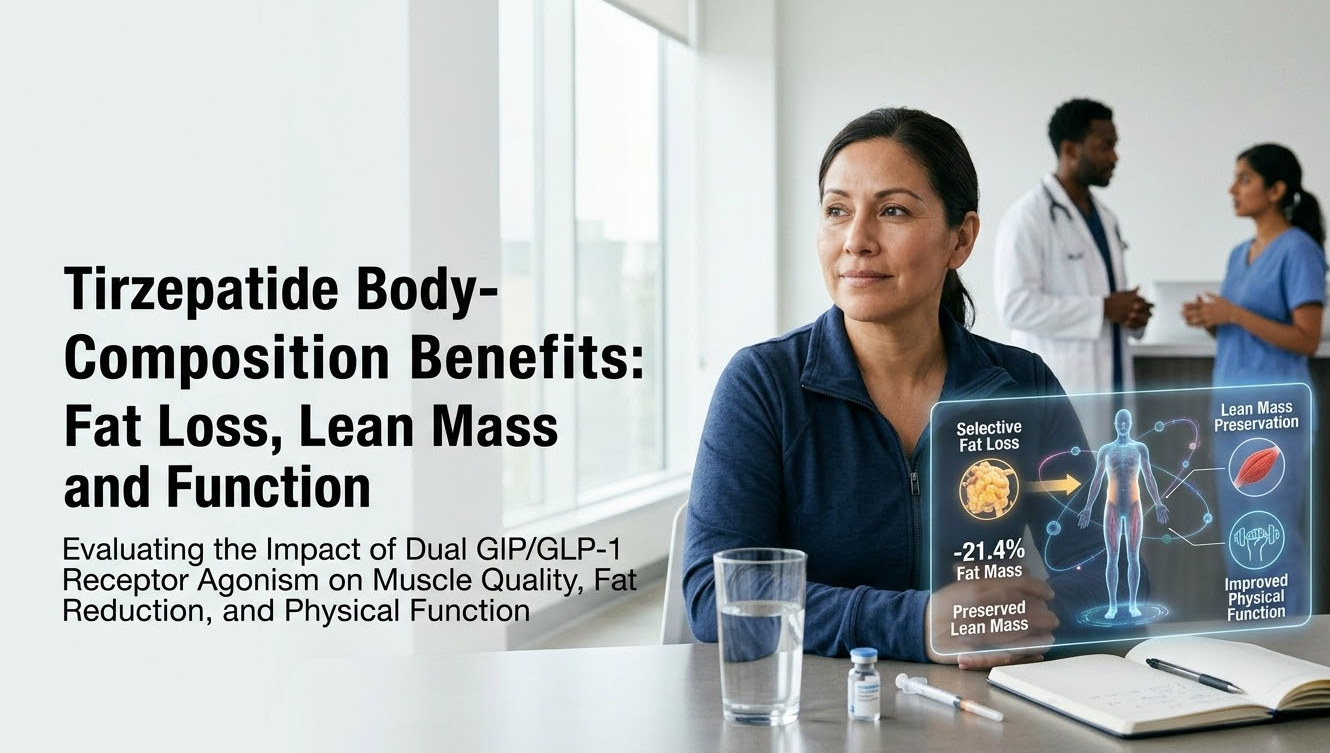
A frequent critique of incretin-based weight loss is the fear that participants are shedding functional skeletal muscle rather than body fat. Headwinds from sensationalized media headlines claim that dual GIP/GLP-1 receptor modulators cause severe muscular wasting. However, evaluating tirzepatide lean mass vs muscle through dual-energy X-ray absorptiometry (DXA) reveals that "lean mass loss" on a scan is far from synonymous with losing contractile skeletal muscle tissue.
⚡ Quick Summary: Tirzepatide Lean Mass vs. Skeletal Muscle
Quick Answer: In clinical trials, lean mass does not equal pure skeletal muscle. On a DXA scan, "lean soft tissue" encompasses intracellular water, blood volume, visceral organ mass, and connective tissue. In the landmark SURMOUNT-1 DXA substudy, approximately 74% of total weight lost was pure adipose tissue, while only ~26% came from lean mass—a ratio identical to or better than standard caloric restriction. Much of that recorded lean loss is attributable to drops in cellular water, glycogen depletion, and shrinking liver/visceral organ volume rather than atrophy of functional muscle fibers.
| Tissue Category | What DXA Actually Measures | SURMOUNT-1 Substudy Response | Functional Research Impact |
|---|---|---|---|
| Total Adipose Mass | Subcutaneous, visceral, and intramuscular fat deposits | -33.9% reduction (constituting ~74% of all lost weight) | Massive reduction in lipotoxicity, visceral inflammation, and liver fat |
| Lean Soft Tissue (LST) | Contractile muscle, intracellular water, glycogen, visceral organ mass | -10.9% reduction (constituting ~26% of all lost weight) | Driven primarily by water, blood volume normalization, and hepatic de-steatosis |
| Lean-to-Total Mass Ratio | The percentage of total body composition composed of functional lean tissue | Increased from 51.5% up to 57.7% | Overall metabolic composition improved; subjects became leaner as a percentage of mass |
The DXA Imaging Fallacy: What Is Lean Mass?
To understand why trial endpoints report lean tissue loss during Tirzepatide research, investigators must look beneath the 3-compartment DXA model. DXA divides total weight into only three buckets: bone mineral content, fat mass, and lean soft tissue (everything else):
1. Intracellular & Extracellular Water
Every gram of stored glycogen holds 3–4 grams of water. As caloric intake plummets, systemic water retention and glycogen deplete rapidly—which DXA tallies entirely as "lost lean mass."
2. Splanchnic & Organ Volume Reduction
Severe obesity causes hepatomegaly (enlarged liver) and hypertrophy of the digestive tract. When ectopic fat and digestive load decrease, liver and organ mass shrink, registering as lean mass loss on DXA.
3. Reduced Support Mass Requirement
Carrying 50 extra pounds requires heavy structural collagen, fascial matrix, and connective scaffolding. When adiposity clears, this superfluous connective tissue naturally atrophies without sacrificing strength.
Advance Incretin & Metabolic Research
Track body composition changes with high-purity dual-incretin mimetics. Inspect certified analytical testing, HPLC purity, and mass spectrometry documentation for research-grade Tirzepatide.
Shop Research Tirzepatide →The Clinical Evidence: SURMOUNT-1 Body Composition Substudy
The definitive radiological data evaluating tirzepatide's impact on tissue composition comes from the SURMOUNT-1 72-week DXA substudy (Heise et al., 2024 / PubMed):
- Unprecedented Fat Specificity: Across the cohort, participants lost an average of 33.9% of their total fat mass compared to a modest 10.9% decrease in lean mass. Fat mass loss accounted for approximately 74% of the total reduction in body weight.
- Improved Lean-to-Fat Ratio: Because fat was cleared three times faster than lean soft tissue, participants’ average lean mass as a fraction of total body weight actually increased from 51.5% at baseline to 57.7% at week 72.
- Comparison to Caloric Restriction: Historical data on standard bariatric surgery or conventional caloric restriction typically shows a 70/30 or 65/35 fat-to-lean loss ratio. Tirzepatide’s 74/26 ratio establishes it as superior to standard starvation diets in preserving functional composition.
- Physical Function & Mobility: Despite the numerical drop in DXA lean soft tissue, physical performance batteries (including grip strength and 6-minute walk tests) showed maintained or improved functional mobility, directly contradicting claims of degenerative muscle wasting.
Synergistic Research Pairings: Preserving Lean Muscle During Incretin Protocols
When running high-magnitude fat loss studies with tirzepatide, researchers often evaluate complementary peptides to protect contractile tissue and sustain cellular energy:
- Mitochondrial Fueling (MOTS-c): Pair incretin action with MOTS-c. While tirzepatide blunts systemic appetite, MOTS-c activates AMPK in skeletal muscle to stimulate GLUT4 glucose uptake and support physical endurance during energy deficits. Read our protocol analysis: What Is MOTS-c? Mitochondrial Signaling & Dosing Evidence.
- Visceral vs. Hepatic Specificity (Tesamorelin): Compare systemic incretin fat loss against Tesamorelin, which selectively mobilizes abdominal visceral and intrahepatic fat while elevating circulating IGF-1 to support muscle protein synthesis. Read: Tesamorelin: Visceral Fat vs Liver Fat & Ectopic Lipids.
- Foundational Incretin Biology: For a deep pharmacokinetic review of dual GIP/GLP-1 receptor activation, read our foundational guide: What Is Tirzepatide? Dual-Incretin Mechanisms.
- Cross-Class Comparison: To evaluate tirzepatide against semaglutide, retatrutide, and novel amylin agonists, explore our full review: Best GLP-1 for Weight Loss: Retatrutide, Semaglutide, Tirzepatide & Amylin Agonists.
Standardized 2.0 mL Reconstitution Math for Research Vials
When working with lyophilized tirzepatide research vials, maintaining exact liquid volume measurement is mandatory. Reconstituting with 2.0 mL of certified Pfizer Hospira Bacteriostatic Water yields the following standardized concentrations:
Concentration Formula: Mass (mg) ÷ Solvent Volume (mL) = Concentration (mg/mL). For example, adding 2.0 mL of BAC water to a 10 mg vial yields an active concentration of 5 mg/mL (500 mcg per 0.1 mL / 10 units on a U-100 syringe).
| Vial Material Amount | Diluent Added (BAC Water) | Final Concentration | Dose per 10 Units (0.1 mL) |
|---|---|---|---|
| 5 mg Vial | 2.0 mL | 2.5 mg/mL (2,500 mcg/mL) | 250 mcg (0.25 mg) |
| 10 mg Vial | 2.0 mL | 5.0 mg/mL (5,000 mcg/mL) | 500 mcg (0.50 mg) |
| 15 mg Vial | 2.0 mL | 7.5 mg/mL (7,500 mcg/mL) | 750 mcg (0.75 mg) |
| 30 mg Vial | 2.0 mL | 15.0 mg/mL (15,000 mcg/mL) | 1,500 mcg (1.50 mg) |
Double-check your volume math, unit hash marks, and target concentration with our free interactive Peptide Calculator.
Hardware Selection: Moving Beyond Disposable Syringes
Administering recurring weekly or micro-dosed incretin protocols requires laboratory delivery hardware that protects fragile molecular bonds and ensures absolute volumetric repeatability:
- Reusable Injection Pens: Avoid syringe graduation errors and stopper coring by loading your reconstituted tirzepatide into 3mL Injection Pen Glass Cartridges and pairing with the V3 Reusable Injection Pen. The mechanical lead-screw delivers audibly calibrated, repeatable micro-volumes with zero needle-hub fluid loss.
- Precision Manual Syringes: If manual draws are preferred, draw with surgical-grade Easy Touch 31G U-100 Syringes with 0.5 mL barrels. The ultra-fine 31-gauge needle glides cleanly through septums without tearing or coring rubber stoppers.
- Secure Lab Storage: Protect your reconstituted incretins from heat and vibration inside the Compact 4-Slot Case or the high-capacity 10-Slot Peptide Vial Case. For mobile protocols, carry supplies inside the insulated Compact Peptide Travel Case.
Protocol Builder & Tracking Tools
Maintain complete laboratory chain-of-custody across your incretin body composition cycles:
- Protocol Structuring: Plan your multi-week titration schedules, dosing steps, and reconstitution volumes inside the Protocol Builder.
- Daily Logging: Record daily weight metrics, functional strength observations, and beyond-use dates inside the Protocol Tracker Tool.
Frequently Asked Questions
Does DXA lean mass loss mean participants are losing skeletal muscle fibers?
No. DXA scans group all non-fat, non-bone mass into "lean soft tissue." This includes extracellular water, blood volume, organ parenchyma, and glycogen stores. Because substantial water and organ de-steatosis occur during rapid weight loss, much of the recorded lean mass reduction reflects fluid and visceral remodeling rather than true skeletal muscle degradation.
How does tirzepatide's body composition impact compare to semaglutide?
In clinical trials, both dual (tirzepatide) and single (semaglutide) incretins show approximately 65–75% of lost weight coming from fat mass. However, tirzepatide generally produces greater total weight loss magnitude, resulting in greater absolute reductions in visceral adipose tissue (VAT) and hepatic steatosis.
Can resistance training and high protein intake prevent lean mass reduction on tirzepatide?
Yes. Clinical and observational trials indicate that incorporating progressive resistance training and maintaining protein intake (≥1.2–1.6 g/kg) preserves skeletal muscle mass and functional strength during incretin-mediated caloric deficits, ensuring that weight loss comes almost exclusively from adipose stores.
Related Reading & Scientific References
- What Is Tirzepatide? Dual-Incretin Mechanisms
- Best GLP-1 for Weight Loss: Retatrutide, Semaglutide, Tirzepatide & Amylin Agonists
- Tesamorelin: Visceral Fat vs Liver Fat & Ectopic Lipids
- Heise et al. (2024): Body Composition Changes with Tirzepatide in SURMOUNT-1 (PubMed)
The radiological evidence confirms that concerns over severe muscle wasting on incretins are largely rooted in misunderstanding DXA imaging parameters. By selectively stripping away dangerous visceral and ectopic fat while preserving functional neuromuscular performance, Tirzepatide delivers a high-quality body composition reset that elevates overall metabolic health.
← View all peptide guides, research & protocols in our Blog Archive