
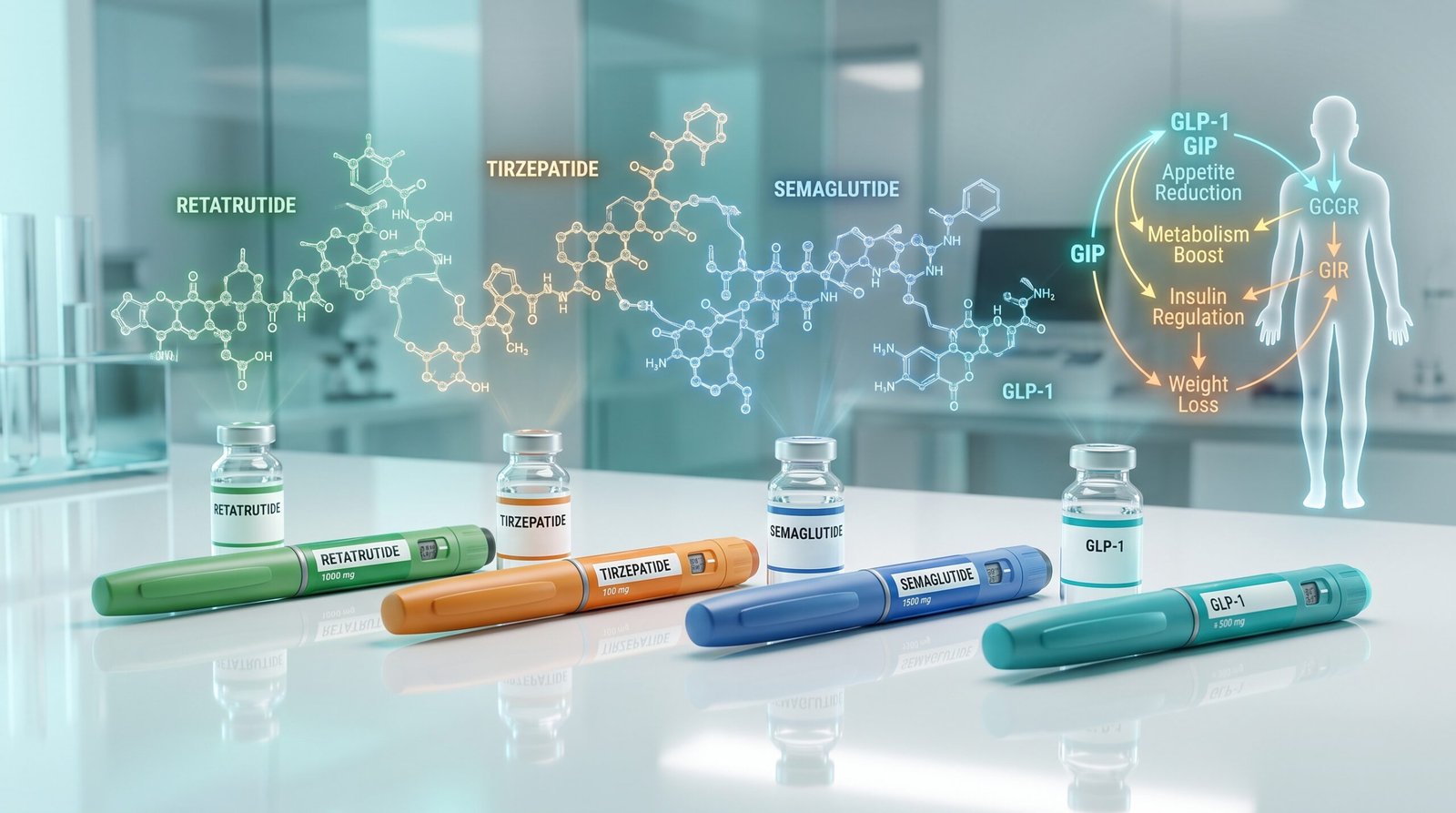
Best GLP-1 for Weight Loss: Comparative Trial Evidence & Next-Gen Peptides
The race to identify the best GLP-1 for weight loss has driven an extraordinary technological revolution in metabolic endocrinology. In less than a decade, therapeutic development has expanded beyond single-pathway incretins into dual and triple agonists—and now encompasses entirely separate neuroendocrine pathways, including long-acting amylin analogues.
Online fitness communities often argue over which compound works best, but rigorous scientific evaluation demands objective data. Determining the top metabolic candidate requires comparing receptor affinities, examining hard trial endpoints, and understanding how next-generation compounds like Cagrilintide and Eloralintide operate alongside established incretin therapies.
Quick Summary: Which GLP-1 Is Best at a Glance?
Quick Answer: In clinical trial benchmarks, Retatrutide leads overall efficacy with up to 24.2% mean weight reduction in Phase 2 trials via triple GIP/GLP-1/Glucagon agonism. Tirzepatide represents the premier dual incretin with ~20.9% loss and superior glycemic control, while Semaglutide remains the benchmark for long-term cardiovascular safety data. Concurrently, amylin-incretin co-formulations like CagriSema demonstrate ~22.7% loss by targeting distinct gut-brain satiety circuits.
| Compound | Class / Target Receptors | Max Trial Dose | Average Weight Loss | Primary Clinical Benchmark |
|---|---|---|---|---|
| Semaglutide | Single GLP-1R Agonist | 2.4 mg weekly | ~14.9% (at 68 weeks) | STEP-1 trial; extensive long-term cardiovascular safety data |
| Tirzepatide | Dual GLP-1R + GIPR Agonist | 15.0 mg weekly | ~20.9% (at 72 weeks) | SURMOUNT-1 trial; superior glycemic and adipose clearance |
| Retatrutide | Triple GLP-1R + GIPR + GCGR Agonist | 12.0 mg weekly | ~24.2% (at 48 weeks) | Phase 2 NEJM trial; unmatched lipolysis and liver fat clearance |
| CagriSema | GLP-1R + Amylin/Calcitonin (DACRA) | 2.4 mg / 2.4 mg weekly | ~22.7% (Phase 3 trials) | REDEFINE trials; co-formulated dual-pathway neuroendocrine control |
| Eloralintide | Selective Amylin Receptor Agonist | Titrated weekly | ~20.0% (Phase 2 trials) | Phase 2 Lancet data; pure selective non-calcitonin amylin agonism |
The Evolution of Incretin Therapies: Single, Dual & Triple Agonism
To understand why newer peptides consistently outperform older generations, researchers examine the receptor pathways involved:
- Monotherapy (GLP-1 Only): Activates glucagon-like peptide-1 receptors to delay stomach emptying, enhance glucose-dependent insulin secretion, and stimulate hypothalamic satiety centers.
- Dual-Incretin Agonism (GLP-1 + GIP): Combines GLP-1 activation with glucose-dependent insulinotropic polypeptide (GIP) agonism. GIP enhances insulin sensitivity, directs lipids toward subcutaneous fat depots, and buffers against gastrointestinal nausea.
- Triple Agonism (GLP-1 + GIP + Glucagon): Introduces glucagon receptor (GCGR) stimulation. While GLP-1 and GIP suppress caloric intake, glucagon accelerates energy expenditure, burns intrahepatic fat, and triggers mitochondrial thermogenesis.
The New Class: Long-Acting Amylin Receptor Agonists
While incretins dominate headlines, pharmaceutical pipelines are advancing a distinct pharmacological class: long-acting amylin analogues.
Natural amylin is a 37-amino-acid peptide that pancreatic beta cells secrete alongside insulin after meals. Endogenous amylin signals satiety through area postrema and hypothalamic circuits while slowing gastric motility. However, natural amylin degrades within roughly 13 minutes. Novel synthetic analogues overcome this limitation by introducing fatty acid side chains to support once-weekly administration.
Crucially, amylin analogues target both homeostatic hunger (energy balance) and hedonic hunger (reward-driven cravings) through neuroendocrine circuits independent of GLP-1. This distinct mechanism allows researchers to combine amylin agonists with GLP-1 therapies to achieve additive weight loss without compounding incretin-specific side effects.
1. Semaglutide: The Proven Foundational Standard
As the pioneer of weekly incretin therapy, Semaglutide delivers pure GLP-1 receptor agonism.
The landmark STEP trial series documented consistent body weight reductions averaging 14.9% over 68 weeks. Beyond weight reduction, Semaglutide possesses the most robust cardiovascular safety dataset in metabolic pharmacology. The SELECT trial demonstrated a 20% reduction in major adverse cardiovascular events (MACE) among non-diabetic cohorts with preexisting heart disease.
However, because Semaglutide acts exclusively through the GLP-1 receptor, roughly 10% to 15% of clinical trial participants experience treatment-limiting nausea during dose escalation. Many subjects also experience an eventual weight-loss plateau between 40 and 52 weeks.
2. Tirzepatide: The Dual-Incretin Champion
By introducing balanced GIP receptor activation alongside GLP-1 signaling, Tirzepatide reset clinical expectations.
In the SURMOUNT-1 trial, non-diabetic participants on the top 15 mg dose achieved an average body weight loss of 20.9% at 72 weeks, with nearly 40% of patients shedding at least a quarter of their baseline mass. The GIP component buffers gastrointestinal distress, allowing patients to tolerate higher effective doses while directing free fatty acids away from liver tissue and into healthy subcutaneous fat beds.
3. Retatrutide: The Triple-Agonist Frontier
In terms of sheer fat-mobilizing power, Retatrutide (view Retatrutide research vials) currently leads all published metabolic trial data.
By adding glucagon receptor agonism to GIP and GLP-1 pathways, Retatrutide attacks metabolic dysfunction from two fronts: it suppresses caloric intake while actively elevating basal energy expenditure. In its Phase 2 trial published in the New England Journal of Medicine, participants reached an average 24.2% weight loss in just 48 weeks without plateauing. Furthermore, sub-studies revealed that over 85% of subjects cleared their intrahepatic liver fat entirely.
Spotlight on Emerging Amylin Analogue Drugs
The newest drug class challenges the assumption that GLP-1 pathways must carry the entire metabolic load:
Cagrilintide (and CagriSema)
Developed by Novo Nordisk, Cagrilintide is a long-acting dual amylin and calcitonin receptor agonist (DACRA). Modified from human amylin with a C20 fatty acid side chain, it exhibits a half-life of roughly 7 days. When combined with Semaglutide in the fixed-dose co-formulation CagriSema, it targets GLP-1 and amylin receptors concurrently. Phase 3 REDEFINE trials document body weight reductions exceeding 22%, while patients report marked reductions in food noise and hedonic cravings.
Eloralintide (LY3841136)
Developed by Eli Lilly, Eloralintide is an investigational, long-acting selective amylin receptor agonist. Unlike earlier non-selective molecules, chemists engineered Eloralintide to activate the amylin receptor complex specifically without off-target binding at the calcitonin receptor. In a 48-week Phase 2 trial published in The Lancet, participants receiving the highest dose achieved up to 20% total body weight reduction as a monotherapy, demonstrating that selective amylin activation can match dual-incretin efficacy on its own.
Survodutide (BI 456906)
Boehringer Ingelheim and Zealand Pharma developed Survodutide as a dual GLP-1 and glucagon receptor agonist. Phase 3 trials demonstrated up to 16.6% weight loss over 76 weeks alongside profound reductions in liver fat, offering strong therapeutic potential for metabolic dysfunction-associated steatohepatitis (MASH).
Which Compound Takes the Crown? The Research Verdict
In metabolic research, declaring the absolute "best" GLP-1 depends on your primary experimental objective:
- For Established Safety & Cardiovascular Protection: Semaglutide remains the standard, backed by extensive long-term real-world safety data and multi-center cardiovascular outcomes.
- For Proven, Highly Tolerated Efficacy: Tirzepatide offers the optimal balance of massive weight reduction (~21%), superior glycemic control, and excellent GI tolerability via GIP buffering.
- For Maximum Fat Mobilization & Hepatic Clearance: Retatrutide leads Phase 2 data, demonstrating that triple-receptor agonism burns fat faster and clears steatotic liver deposits more aggressively than any single or dual incretin.
- For Hedonic Appetite Control Beyond Incretins: Emerging amylin analogues like Cagrilintide (in CagriSema) and Eloralintide represent the next therapeutic frontier, suppressing food cravings through independent neuroendocrine circuits.
- Alternative Titration Frameworks: In clinical models exploring non-weight-loss anti-inflammatory and pain targets, sub-therapeutic dosing models are frequently evaluated. Learn more in our analysis of GLP-1 microdosing protocols.
Synergistic Research Pairings in Metabolic Science
Researchers rarely evaluate incretin and amylin pathways in isolation. Modern metabolic protocols frequently combine these compounds with complementary cellular systems:
- MOTS-c: Investigators co-evaluate incretins with MOTS-c (view MOTS-c 10mg/40mg) to examine skeletal muscle glucose uptake and mitochondrial respiration during periods of severe caloric restriction.
- 5-Amino-1MQ: Scientists study incretins alongside 5-Amino-1MQ (view 5-Amino-1MQ vials) to assess NNMT enzyme inhibition, aiming to preserve lean muscle mass while shrinking visceral fat cells.
- AOD-9604: Research teams explore combining GLP-1 and amylin satiety signaling with the direct adipocyte lipolysis of AOD-9604 Peptide.
- BPC-157: Laboratories pair incretin protocols with BPC-157 to maintain gastrointestinal mucosal integrity during acute gastric slowdowns.
Laboratory Handling, Reconstitution & Storage Standards
Because incretin and amylin peptides consist of delicate amino acid chains, maintaining structural integrity across multi-week studies requires strict laboratory discipline (detailed step-by-step in our Beginner's Guide to Peptides):
- Diluent Selection: Reconstitute lyophilized incretin and amylin peptides using sterile, pharmaceutical-grade Pfizer Hospira Bacteriostatic Water containing 0.9% benzyl alcohol to prevent microbial contamination across multi-week testing cycles. Alternatively, use 0.9% Sterile Bacteriostatic Saline for cell-culture protocols.
- Reconstitution Protocol: Use a sterile EasyTouch 31G Syringe to dispense diluent gently down the inside glass wall of the vial. Never spray liquid directly onto the lyophilized powder cake. Avoid violent shaking; roll the vial slowly between your palms until the solution turns clear. Calculate syringe unit ticks with our free Peptide Calculator and manage interval schedules with the Protocol Tracker Tool.
- Cold-Chain Storage: Store dry lyophilized powder at -20°C for long-term molecular preservation. Maintain reconstituted liquid solutions between 2°C and 8°C (36°F to 46°F) inside a secure, light-shielded Peptide Vial Case or insulated Compact Travel Case to protect against mechanical vibration and light degradation.
The metabolic research landscape is expanding well beyond traditional GLP-1 therapies. While Semaglutide set the foundation and Tirzepatide cemented the superiority of dual incretins, triple agonists like Retatrutide and novel amylin receptor agonists like Cagrilintide and Eloralintide are unlocking new therapeutic targets. Researchers who respect careful titration intervals, monitor comprehensive metabolic blood panels, and maintain proper cold-chain storage will ensure their experimental findings remain accurate, reproducible, and scientifically sound.
← View all peptide guides, research & protocols in our Blog Archive


4 comments