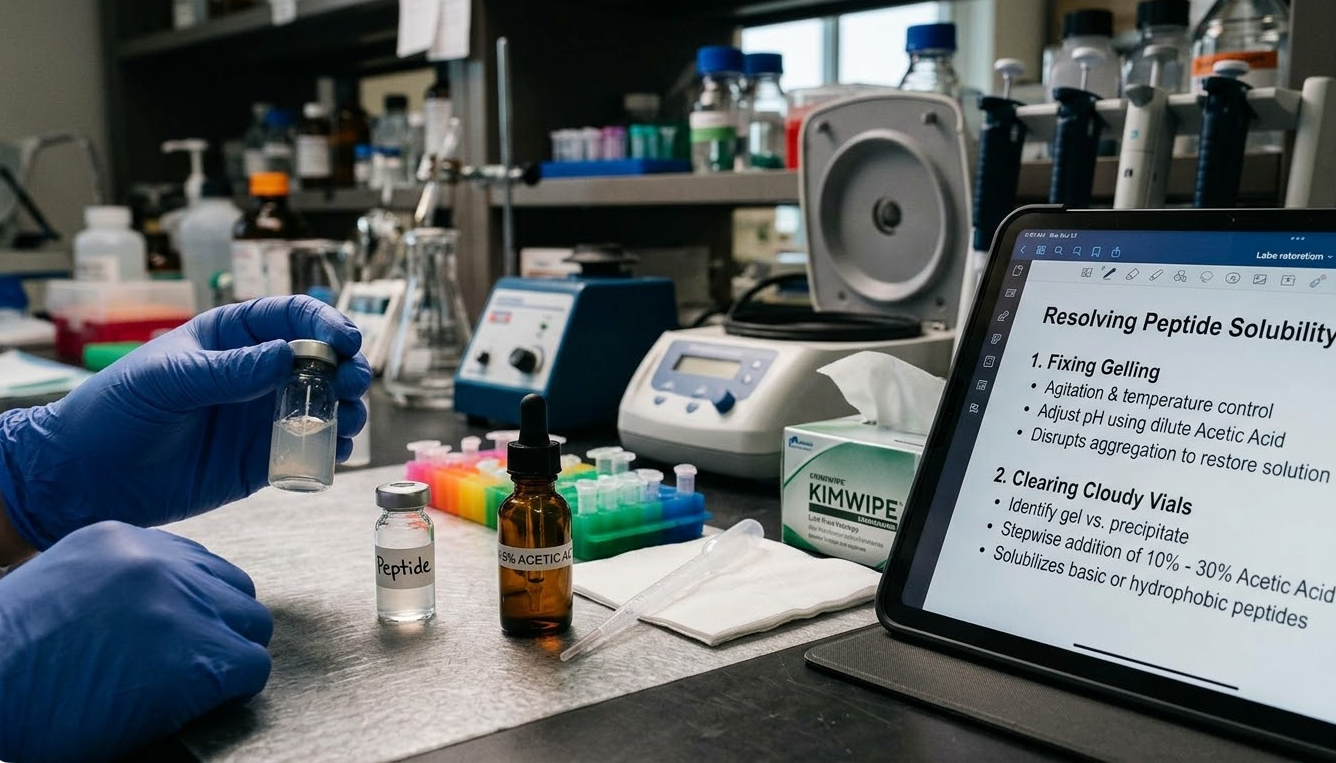
There is nothing more alarming in peptide reconstitution than adding sterile water and watching a clear cake transform into a cloudy suspension or a stubborn, jelly-like blob. When hydrophobic sequences refuse to dissolve, shaking the vial only introduces shear stress that degrades fragile peptide chains. Understanding peptide solubility with dilute acetic acid (0.6%) gives researchers the essential co-solvent tool needed to break gel matrices, alter net electrical charge, and achieve optical dissolution alongside bacteriostatic water.
⚡ Quick Summary: Acetic Acid for Peptide Gelling
Quick Answer: When certain hydrophobic or basic peptides (such as AOD-9604, Fragment 176-191, and IGF-1 LR3) are mixed with neutral water alone, they aggregate and trap liquid into a gel or cloudy mass. Adding a micro-volume (100–200 μL) of 0.6% acetic acid first lowers the pH, protonating the amino acid chains and giving them a net positive electrical charge. This electrostatic repulsion dissolves the gel in seconds. Once clear, the vial is topped up with standard bacteriostatic water to reach full volume and maintain sterile multi-dose preservation.
| Peptide Compound | Gelling / Clouding Risk | Why It Gels in Water Alone | Solubility Protocol |
|---|---|---|---|
| AOD-9604 | Very High (Forms thick gel / jelly) | Strongly hydrophobic C-terminal fragment; repels neutral water | 0.1–0.2 mL 0.6% Acetic Acid first → top up with BAC water |
| HGH Fragment 176-191 | High (Cloudy / white flakes) | Hydrophobic domain aggregates near neutral isoelectric point | 0.1–0.2 mL 0.6% Acetic Acid first → top up with BAC water |
| IGF-1 LR3 / IGF-1 DES | Moderate to High (Aggregation prone) | Large, pH-sensitive growth factor; aggregates easily in neutral BAC | 0.1 mL 0.6% Acetic Acid first → top up with BAC water |
| Standard Peptides (BPC-157, Semaglutide) | Very Low (No gelling) | Naturally hydrophilic sequences; soluble in neutral pH | Direct reconstitution with standard BAC water alone |
The "Jelly Effect": Why Do Certain Peptides Gel Up?
Peptide clumping or gelling is almost always a matter of sequence chemistry, not impure or defective product. When a sequence is composed of dense hydrophobic (water-repelling) amino acid residues, neutral water molecules cannot penetrate the core of the peptide cake:
1. Hydrophobic Aggregation
In compounds like AOD-9604, lipophilic side chains bond with one another to escape neutral water contact, weaving a polymer-like mesh that traps solvent and creates a physical jelly.
2. The Isoelectric Trap
At neutral pH (~7.0), certain peptides reach their isoelectric point where net surface charge drops to zero. With no electrical repulsion between molecules, the chains crash out of solution as milky clouds.
3. Electrostatic Repulsion via Acid
Dilute 0.6% acetic acid donates hydronium ions (H+), charging the basic amine groups. These like-charges repel each other, shattering the gel matrix and restoring liquid clarity.
Stop Throwing Away Gelled or Cloudy Vials
Don't discard stubborn AOD-9604 or IGF-1 cakes. Keep certified, laboratory-grade 0.6% Acetic Acid on your bench to instantly disperse gelled matrices and ensure clean reconstitutions.
Shop Acetic Acid 0.6% →The Co-Solvent Workflow: Acid First, Then Water
A common error is attempting to reconstitute the entire vial with pure acetic acid, which creates an excessively acidic solution that causes intense subcutaneous stinging. Acetic acid is designed to be used as a co-solvent in conjunction with standard diluents like Bacteriostatic Water or Pfizer Hospira BAC Water:
- The Acid Seed (Dissolving the Gel): Draw 0.1 mL to 0.2 mL (100–200 μL) of 0.6% Acetic Acid using a fine syringe like the Easy Touch 31G U-100 Syringe. Drip it directly onto the lyophilized cake. Gently roll the vial between your palms—do not shake. Within 30 to 60 seconds, the gel will break down into a crystal-clear liquid.
- The Preservative Finish (Volume & Sterility): Once the peptide is 100% dissolved and completely transparent, draw your remaining volume of bacteriostatic water (e.g., 1.8 mL to reach a 2.0 mL total volume) and add it slowly down the glass wall.
- The Result: The peptide remains fully dissolved in solution, the pH is buffered toward neutral comfort, and the 0.9% benzyl alcohol in the BAC water provides the antimicrobial defense needed for multi-week storage.
For more troubleshooting on unexpected vial reactions, explore our companion guide: My Reconstituted Vial Is Cloudy or Has Floating Specks—What Happened?.
Which Compounds Require Acetic Acid?
While the vast majority of peptides (like BPC-157, TB-500, and GLP-1s) reconstitute smoothly in plain BAC water, specific research sequences require an acidic co-solvent step:
1. AOD-9604 (Advanced Obesity Drug)
AOD-9604 is the classic culprit for extreme gelling. Because it is a modified lipophilic terminal fragment of human growth hormone, hitting it with neutral BAC water almost always yields a thick jelly blob. Pre-treating the cake with 100–200 μL of 0.6% acetic acid completely prevents gelling and produces a pristine, water-clear solution.
2. HGH Fragment 176-191
Sharing the hydrophobic profile of AOD-9604, Fragment 176-191 frequently crashes out as white floating specks or a milky suspension. The acetic acid co-solvent method drops the pH below its aggregation threshold, holding the peptide monomers in liquid suspension.
3. IGF-1 LR3 & IGF-1 DES
Insulin-like Growth Factor analogues are sensitive protein chains that readily aggregate and lose biological activity if forced into neutral-to-basic pH environments. Acidic reconstitution maintains monomeric stability and stops the formation of insoluble micro-fibrils.
Note on Stinging Peptides: If your compound causes injection stinging due to osmotic gradient shock rather than insolubility (such as MOTS-c), do not use acid. Use Sodium Chloride Saline Bacteriostatic Water 0.9% instead to match physiological extracellular tonicity.
Precision Hardware: From Reconstitution to Delivery
Once your gel-prone peptide is cleanly dissolved, pairing it with advanced laboratory equipment ensures exact volumetric accuracy and compound longevity:
- Reusable Injection Pens: Avoid syringe parallax errors and stopper coring by transferring your clear reconstituted solution into 3mL Injection Pen Glass Cartridges and administering with the V3 Reusable Injection Pen for tactile, click-dialed micro-dosing and zero dead-space waste.
- Low-Dead-Space Manual Draws: If using traditional insulin syringes, select Easy Touch 31G U-100 Syringes with 0.5 mL barrels, which provide wide hash-mark spacing for micro-volume precision.
- Secure Cold-Chain Housing: Acidified and reconstituted peptides must be protected from light and heat. Store your active vials upright inside the Compact 4-Slot Case or the high-capacity 10-Slot Peptide Vial Case. For mobile protocols, secure supplies within the Compact Peptide Travel Case.
Arithmetic & Protocol Planning
Using a co-solvent protocol requires adding your acid volume and water volume together to calculate final concentration:
- Total Liquid Volume: 0.2 mL (Acetic Acid) + 1.8 mL (BAC Water) = 2.0 mL total diluent volume.
- Concentration Math: A 5 mg vial of AOD-9604 in 2.0 mL total volume yields an active concentration of 2.5 mg/mL (250 mcg per 0.1 mL / 10 units on a U-100 syringe). Check conversions with the Peptide Calculator.
- Logging: Document your exact acid-to-water ratios, vial lots, and dates using the Protocol Builder and maintain daily tracking via the Protocol Tracker Tool.
Frequently Asked Questions
Can I use grocery store white vinegar instead of 0.6% acetic acid?
No! Store-bought vinegar is non-sterile, concentrated around 5% acidity, and contains fermentation impurities and trace heavy metals that degrade peptides and cause sterile abscesses. Always use laboratory-grade, sterile 0.6% acetic acid.
Will adding acetic acid cause severe stinging upon injection?
Not when used as a co-solvent. Because you only use 0.1–0.2 mL of 0.6% acid and dilute it with 1.8 mL or more of bacteriostatic water, the final solution is only very mildly acidic and well tolerated subcutaneously.
Can I rescue a peptide vial that has already turned into a gel with BAC water?
Yes. If you accidentally added BAC water first and the vial gelled up, inject 0.1 mL to 0.2 mL of 0.6% acetic acid directly into the gel and gently roll the vial between your palms. In most cases, the acid will break the gel matrix and clear the solution within a few minutes.
References & Standards
- MilliporeSigma Official Peptide Solubility Guidelines & Isoelectric Analysis
- Standard Labs Guide: How to Reconstitute Research Peptides
Don't let hydrophobic aggregation ruin your research investment. By using Acetic Acid 0.6% in conjunction with Bacteriostatic Water, you can reliably prevent and reverse the "jelly effect" in stubborn compounds like AOD-9604 and IGF-1—guaranteeing crystal-clear optical solubility and consistent experimental dosing.
← View all peptide guides, research & protocols in our Blog Archive