Cloudy Peptide After Mixing? Why It Gels & How to Fix It
Seeing a cloudy peptide after mixing or watching your newly reconstituted vial turn into a dense, gelatinous blob is one of the most frustrating moments in the laboratory. You add diluent expecting a water-clear solution. Instead, you end up with milky suspension, floating white flakes, or a jelly-like matrix glued to the bottom of the glass.
The immediate assumption is that the product is defective, degraded, or counterfeit. However, in scientific reality, a cloudy peptide after mixing is rarely a bad synthesis batch. More often than not, the culprit is a fundamental mismatch in solvent chemistry: improper solution pH, low-grade reconstitution diluents, insufficient liquid volume, or cold-temperature precipitation. Below, we break down the biophysical reasons behind peptide clouding and gelling, examine how poor-quality diluents ruin solutions, and outline the established lab protocol to salvage your vial.
Quick Summary: Cloudy Peptide After Mixing at a Glance
Quick Answer: A cloudy peptide or gelled solution is usually caused by an isoelectric point (pI) pH mismatch, hydrophobic aggregation in neutral water (common with AOD-9604 or Frag 176-191), sub-par diluents, or over-concentration. Hydrophobic sequences require initial acidification using 0.6% acetic acid before topping up with pharmaceutical bacteriostatic water to restore complete transparency.
| Observed Presentation | Root Scientific Cause | Corrective Action |
|---|---|---|
| Gel Blob at the Bottom ("Jelly Effect") | Excess concentration paired with insufficient solvent acidity. | Add additional diluent volume to decrease concentration, or add small increments of 0.6% acetic acid to disrupt the cross-linked gel network. |
| Cloudy Suspension with Floating Flakes | Solution pH is resting at the peptide's isoelectric point; solvent crashing out. | Introduce 50–100 μg of sterile 0.6% acetic acid and gently swirl to shift pH and restore clarity. |
The Primary Culprits: Why Peptides Cloud and Gel
1. Reconstitution Solution pH Mismatch
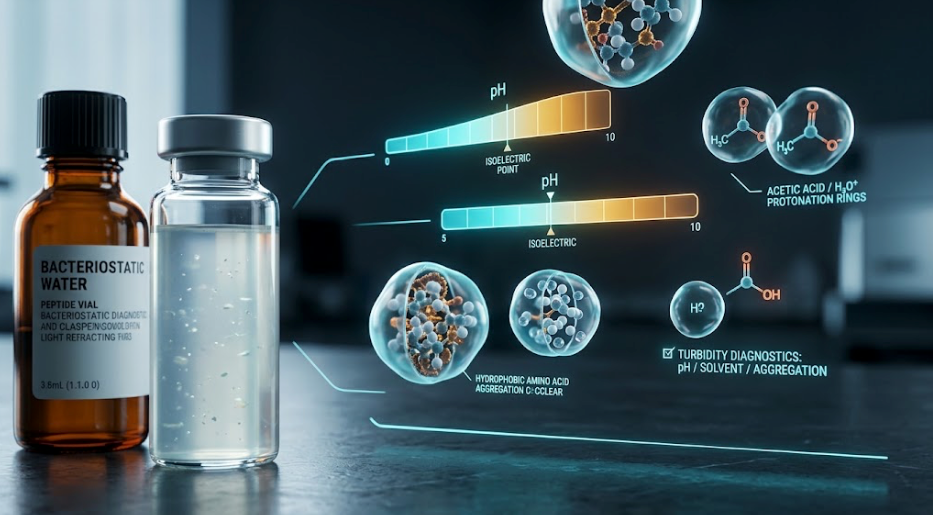
Every peptide sequence possesses an isoelectric point (pI)—the specific pH level at which its net electrical charge reaches zero. When dissolved in a medium at or near its pI, repulsive electrostatic forces between molecules vanish. Without electrical repulsion, hydrophobic side chains spontaneously aggregate, precipitating out as cloudy flakes or cross-linking into a viscous hydrogel network.
2. Substandard or Impure Reconstitution Water
Your reconstitution water might simply be low quality. A portion of generic diluent sold online fails basic quality control standards. It frequently suffers from two severe formulation defects:
- Uncontrolled pH Drift: Cheap diluent often arrives far too alkaline or wildly acidic because it is bottled without proper buffer testing. When mixed with sensitive compounds, this acidic or alkaline swing instantly crashes the peptide out of solution.
- Incorrect Benzyl Alcohol Concentration: Authentic, pharmaceutical-grade bacteriostatic water must contain exactly 0.9% benzyl alcohol. Excess benzyl alcohol acts as an organic solvent that denatures and precipitates sensitive peptide chains, while too little fails to preserve sterility.
To avoid unverified solvent chemistry, researchers consistently recommend relying on gold-standard brands like Pfizer Hospira Bacteriostatic Water or certified laboratory-grade Bacteriostatic Water that guarantees a verified pH and precise 0.9% preservative concentration.
3. Not Enough Diluent (High Concentration Gelation)
Certain peptides have strict saturation ceilings. If you attempt to dissolve 5 mg or 10 mg of a hydrophobic compound in only 1 mL of diluent, the solution becomes hyper-concentrated. At high concentrations, molecular proximity forces hydrophobic domains into contact, causing spontaneous self-assembly into a clear or cloudy gel. Simply adding more diluent volume often relieves this steric crowding.
4. Your Refrigerator Is Running Too Cold
Peptide solubility is directly temperature-dependent. If your laboratory refrigerator runs below 2°C (36°F)—or worse, if the vial sits near the cooling element or back wall where micro-freezing occurs—solute solubility plummets. When temperature drops, the kinetic energy keeping hydrophobic chains in solution decreases, causing the peptide to crash out into white, floating flakes overnight.
Hydrophobic vs. Hydrophilic Sequences: The Chemistry
Whether a compound dissolves cleanly depends on its primary amino acid structure:
- Hydrophilic (Water-Loving): Peptides rich in charged, polar residues (such as lysine, arginine, or aspartic acid) interact favorably with neutral water. Compounds like BPC-157, TB-500, and GHK-Cu Copper Tripeptide dissolve almost instantly into clear solutions.
- Hydrophobic (Water-Repelling): Peptides with non-polar, lipophilic side chains (such as leucine, isoleucine, phenylalanine, or valine) resist neutral water. AOD-9604 and Growth Hormone Fragment 176-191 are classic examples. In neutral-pH water, these molecules fold inward and clump together to minimize water contact, forming an opaque suspension or gel. View our AOD-9604 5mg vials for reference.
Solubility Reference Matrix
Before preparing a review series or testing a vial, consult this solubility matrix to select the correct initial solvent architecture:
| Peptide Sequence | Hydrophobicity Level | Primary / Secondary Solvent Protocol |
|---|---|---|
| BPC-157 | Low (Hydrophilic) | Direct dissolution in pharmaceutical bacteriostatic water. |
| TB-500 (Thymosin Beta-4) | Low (Hydrophilic) | Direct dissolution in pharmaceutical bacteriostatic water. |
| AOD-9604 | High (Hydrophobic) | 0.6% sterile acetic acid first (10–20%), top up with bacteriostatic water. |
| Fragment 176-191 | High (Hydrophobic) | 0.6% sterile acetic acid first (10–20%), top up with bacteriostatic water. |
| CJC-1295 / Ipamorelin | Low to Moderate | Direct dissolution in pharmaceutical bacteriostatic water. |
The Scientific Fix: Acid First, Water Second
Attempting to force a hydrophobic compound to dissolve in neutral bacteriostatic water alone often fails because neutral water cannot shift the local pH away from the peptide’s isoelectric point. The standard laboratory workaround is to acidify the environment first.
Introducing hydronium ions protonates basic amino acid residues and carboxylic side chains. This endows each peptide molecule with a net positive charge. Like charges repel; the resulting electrostatic repulsion forces the peptide molecules apart, preventing aggregation and allowing clean solvation.
Step-by-Step Reconstitution Protocol for Hydrophobic Peptides:
- Acid First: Add a small volume of sterile, laboratory-grade 0.6% acetic acid—roughly 10% to 20% of your total planned diluent volume—directly onto the lyophilized powder using a sterile EasyTouch 31G Syringe.
- Swirl, Never Shake: Gently swirl the vial in slow orbits. Do not shake vigorously, as mechanical agitation causes shear stress and foaming. The powder should dissolve into a crystal-clear liquid within seconds. If cloudiness persists, introduce additional 0.6% acetic acid in 50 μL increments until fully transparent.
- Top Up with Quality Diluent: Once completely dissolved in the acidic phase, add verified, reputable Bacteriostatic Water to reach your final target volume and concentration (calculate metrics using the Peptide Calculator). The initial protonation keeps the molecules soluble even after diluting with neutral solvent.
Storage Warnings for Acidified Solutions
Once a peptide is reconstituted with an acidic co-solvent, maintain strict cold-chain management at 2°C to 8°C (36°F to 46°F) inside a dedicated Peptide Vial Case or insulated Compact Travel Case to shield it from light and vibration.
Crucial Rule: Do NOT freeze acidified peptide solutions. Freezing causes cryo-concentration, where water crystals separate from the acetic acid. This concentrates the acid into localized pockets, exposing peptide bonds to extreme pH shifts that cause irreversible chemical cleavage during thawing. Log your active research intervals inside the Protocol Tracker Tool.
Frequently Asked Questions
Why does my AOD-9604 turn to gel after adding plain bacteriostatic water?
AOD-9604 is an intensely hydrophobic, lipophilic sequence. In neutral-pH bacteriostatic water, its side chains self-assemble into a hydrogel to avoid water contact. Dissolving it in a small fraction of 0.6% acetic acid first protonates the molecules, stopping the gel from forming.
Can I use grocery store vinegar instead of laboratory acetic acid?
Never use household vinegar. Culinary vinegar contains unsterile water, fermentation byproducts, organic residues, and unregulated acid levels. It will contaminate your research sample and rapidly hydrolyze the peptide backbone. Always use sterile, filtered, analytical-grade 0.6% acetic acid.
Does a cloudy vial mean my peptide is low purity or fake?
Not necessarily. If the compound is known to be hydrophobic (like AOD-9604 or Frag 176-191), clouding in neutral water is expected physical chemistry. If the solution clears transparently upon introducing an acidic buffer, the sample is consistent with an authentic peptide acetate salt. To verify exact purity and molecular mass, reference third-party analytical HPLC and mass spectrometry reports (learn How to Read a Peptide COA).
Encountering a cloudy peptide after mixing or a gelled suspension is almost always an issue of solvent pH compatibility, sequence hydrophobicity, or diluent quality rather than bad synthesis. By understanding isoelectric points and utilizing an initial acidic phase for lipophilic chains, researchers can restore complete clarity and preserve sample integrity. Review broader workflows in our Beginner's Guide to Peptides and How to Reconstitute Peptides Guide.
← View all peptide guides, research & protocols in our Blog Archive