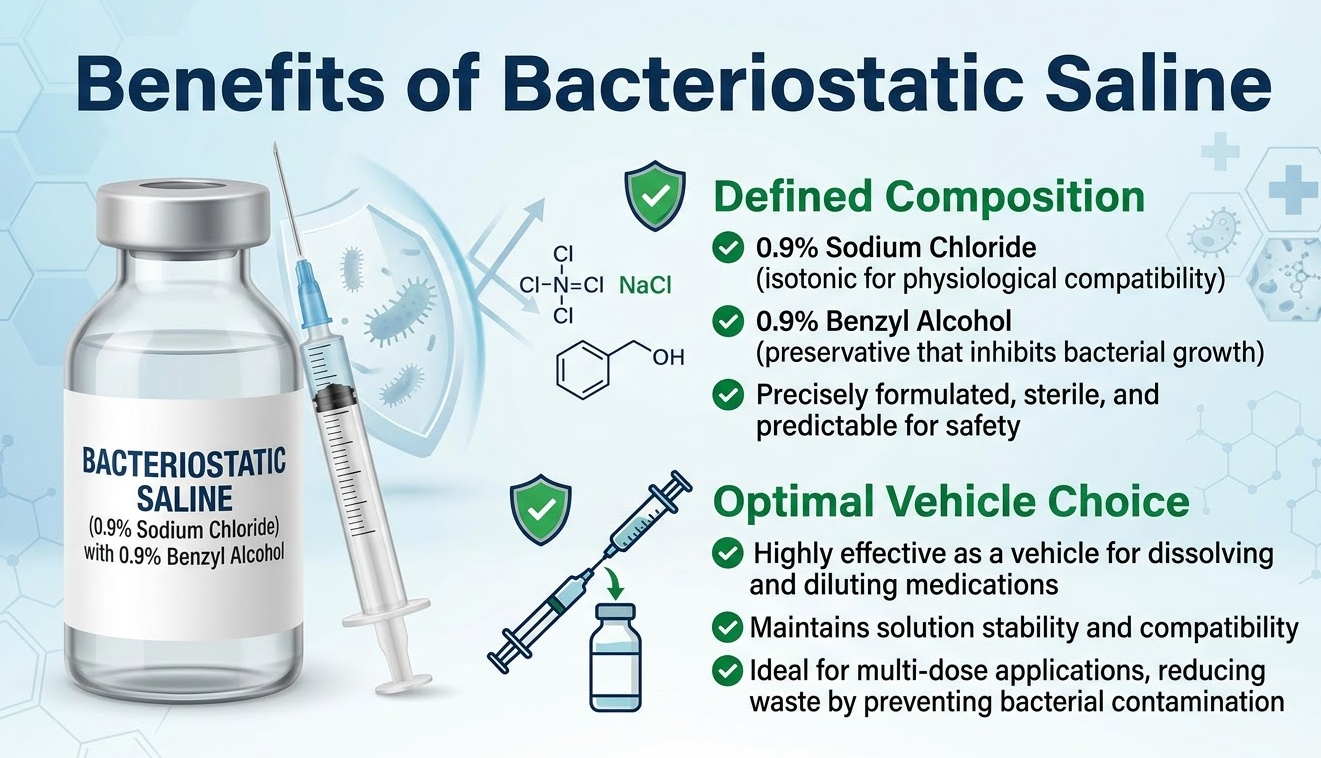
While standard bacteriostatic water is the default reconstitution vehicle for most laboratory peptides, it is not always the best choice. For specialized compounds prone to severe injection-site burning or osmotic shock, choosing an isotonic salt-containing vehicle like Sodium Chloride Saline Bacteriostatic Water 0.9% eliminates tissue stinging, normalizes osmotic pressure, and stabilizes delicate molecular structures.
Bacteriostatic Saline vs. Bacteriostatic Water: Breaking Down the "0.9%"
A common point of confusion among researchers is the term "0.9%." In standard Bacteriostatic Water, the 0.9% refers solely to benzyl alcohol (the antimicrobial preservative) suspended in hypotonic pure water. In Bacteriostatic Saline, the solution contains both 0.9% benzyl alcohol and 0.9% sodium chloride (NaCl).
| Vehicle Property | Standard BAC Water | 0.9% BAC Sodium Chloride Saline |
|---|---|---|
| Tonicity & Osmolality | Hypotonic (~0 mOsm/L ionic strength) | Isotonic (~308 mOsm/L, matches physiological fluid) |
| Preservative System | 0.9% Benzyl Alcohol (9 mg/mL) | 0.9% Benzyl Alcohol (9 mg/mL) |
| Injection Experience | Can cause osmotic sting on larger or sensitive doses | Significantly minimizes stinging and post-injection irritation |
| Primary Purpose | Universal reconstitution baseline | Isotonic stabilization for reactive, stinging, or metabolic peptides |
Why Saline Eliminates the "Peptide Sting"
When a hypotonic liquid (like pure water) is injected subcutaneously, fluid rushes into surrounding cells via osmosis to equalize solute concentrations, triggering cellular distension, nerve irritation, and localized burning. By incorporating 0.9% sodium chloride, Bacteriostatic Saline matches human extracellular fluid osmolarity (~300 mOsm/kg)—preventing osmotic shifts and making administrations virtually painless.
1. True Physiological Osmolarity
Matches natural tissue osmolarity, eliminating localized fluid-gradient shock and severe burning sensations during delivery.
2. Antimicrobial Multi-Dose Protection
Maintains the full 0.9% benzyl alcohol preservative profile, inhibiting bacterial proliferation across multiple needle draws.
3. Reduced Site Flare-Ups
Reduces post-injection swelling, localized erythema (redness), and subcutaneous itching caused by osmotic stress.
Eliminate Unnecessary Injection Stinging
Protect your research subjects from severe osmotic burn while retaining medical-grade multi-dose preservation. Upgrade to certified 0.9% Sodium Chloride Bacteriostatic Saline.
Shop Bacteriostatic Saline 0.9% →Which Compounds Do Better with Bacteriostatic Saline?
While standard GLP-1s and basic growth hormone secretagogues dissolve smoothly in regular BAC water, certain compounds specifically benefit from an isotonic, saline-based vehicle:
1. MOTS-c & Mitochondrial-Derived Peptides
MOTS-c is notorious among researchers for causing intense, stinging injection-site reactions, burning, and localized lumps when mixed with plain hypotonic BAC water. Reconstituting MOTS-c with 0.9% Bacteriostatic Saline tempers this localized burn by matching physiological ionic balance, allowing for higher compliance and far smoother protocol execution.
2. High-Volume or Sensitive Injections
When protocol volumes exceed 0.5 mL per administration, the osmotic difference of plain water creates noticeable tissue distension. Switching to bacteriostatic saline provides an isotonic buffer that allows larger volume deposits without sharp discomfort.
3. Salts-Dependent & Neuro-Active Peptides
Certain sensitive regulatory neuropeptides and cosmetic formulations (such as botulinum toxins and fragile regulatory peptides) expressly call for 0.9% sodium chloride to preserve protein conformation and prevent ionic imbalance during administration.
Caution: Always verify sequence solubility monographs before mixing. A small subset of highly hydrophobic peptides can "salt out" (precipitate out of solution) if exposed to high sodium chloride concentrations. If your vial turns hazy immediately upon mixing, consult our diagnostic guide: My Reconstituted Vial Is Cloudy—What Happened?.
Pairing Saline with Advanced Dosing Hardware
Whether you choose bacteriostatic water or saline, pairing your vehicle with precision equipment prevents dosage errors and vial degradation:
- Reusable Injection Pens: Rather than drawing saline solutions repeatedly with manual syringes, transfer your reconstituted compound into 3mL Injection Pen Glass Cartridges and utilize the V3 Reusable Injection Pen for audibly indexed, precise micro-dosing without dead-space loss.
- Precision Syringes: If manual subcutaneous delivery is preferred, draw with ultra-fine Easy Touch 31G U-100 Insulin Syringes to protect the rubber vial septum.
- Case Containment: Keep your reconstituted saline vials safely indexed, upright, and chilled in cold storage using the Compact 4-Slot Case or the 10-Slot Peptide Vial Case. For mobile protocols, secure supplies within the insulated Compact Peptide Travel Case.
Reconstitution Arithmetic & Protocol Planning
Switching your diluent does not alter your dilution arithmetic—milligrams and liquid volume interact identically in saline and water:
- Calculate Concentration: Dissolving 10 mg of MOTS-c into 2.0 mL of 0.9% Bacteriostatic Saline creates an active 5 mg/mL concentration.
- Eliminate Math Errors: Check volume-to-dose conversions before mixing with the Peptide Calculator.
- Track Your Cycles: Structure your compounding timelines with the Protocol Builder and log daily site observations using the Protocol Tracker Tool.
For more foundational reconstitution instructions, see:
• How to Reconstitute Peptides: The Complete Step-by-Step Guide
• How Much Bacteriostatic Water to Add: Understanding Concentration vs. Dose
Frequently Asked Questions
Does all 0.9% saline contain benzyl alcohol?
No! Standard normal saline (0.9% NaCl) sold in ampoules or IV bags is preservative-free and strictly single-use. Only solutions explicitly labeled Bacteriostatic contain 0.9% benzyl alcohol to prevent bacterial growth during repeated multi-dose draws.
Can I mix bacteriostatic saline with bacteriostatic water?
Yes. If you wish to halve the sodium chloride concentration (creating a 0.45% half-normal saline vehicle), you can mix equal parts sterile BAC water and BAC saline without compromising the 0.9% benzyl alcohol preservative concentration.
Why don't all peptides use saline instead of water?
While saline is superior for reducing stinging in compounds like MOTS-c, certain fragile peptides exhibit reduced solubility in ionic salt environments, causing them to aggregate or precipitate. Standard BAC water remains the default unless a sequence specifically benefits from isotonic salt.
References & Regulatory Labeling
- Bacteriostatic 0.9% Sodium Chloride Injection, USP — FDA DailyMed Official Monograph
- Standard Labs Bacteriostatic Water Specification Reference
Say goodbye to injection discomfort. By combining physiological 0.9% sodium chloride with antimicrobial benzyl alcohol, Sodium Chloride Saline Bacteriostatic Water 0.9% delivers the isotonic cushion needed for sting-prone compounds like MOTS-c without sacrificing multi-dose sterility.
← View all peptide guides, research & protocols in our Blog Archive