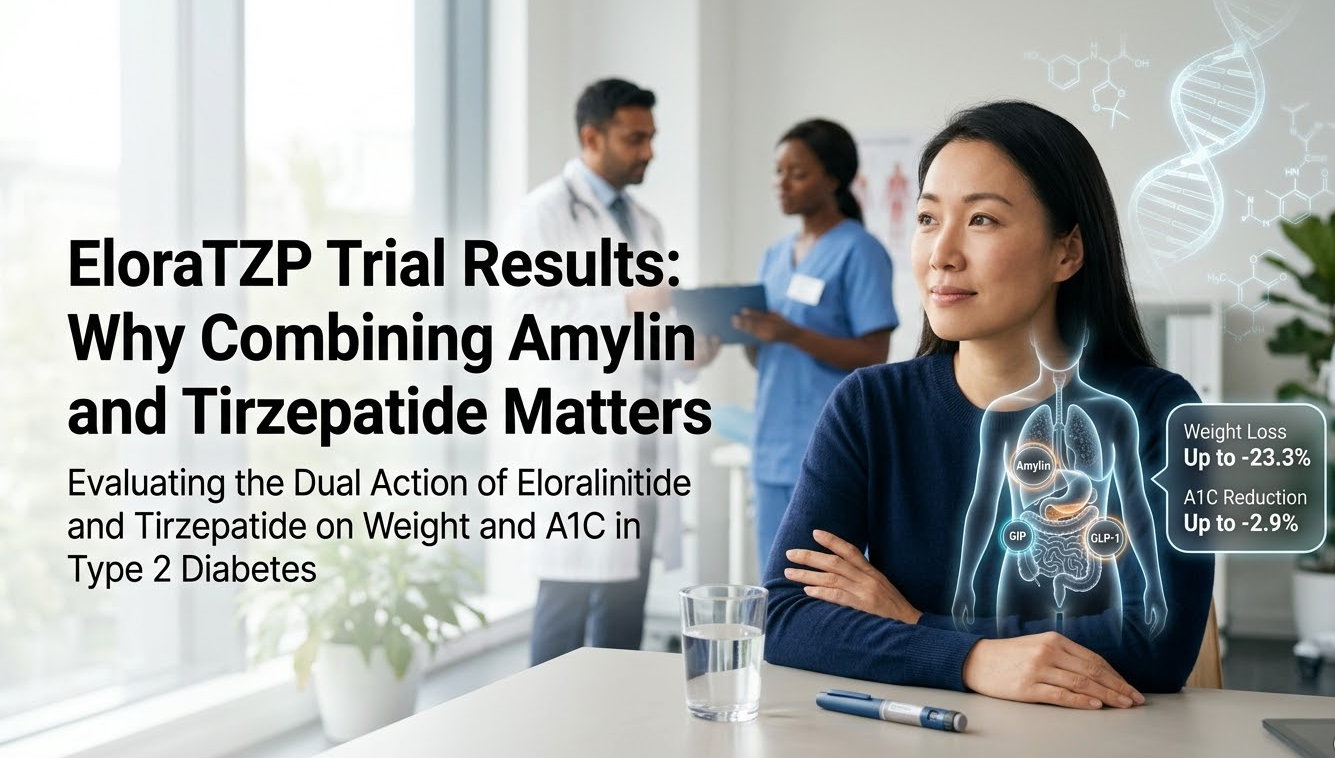
The 48-week Phase 2b clinical trial results for EloraTZP establish a new frontier in combination metabolic endocrinology. By co-administering the selective amylin receptor agonist eloralintide (LY3841136) alongside the dual GIP/GLP-1 receptor agonist tirzepatide in adults with type 2 diabetes and overweight or obesity, this study proves that integrating a third, non-incretin neuroendocrine pathway can break through the historical glycemic and weight-loss ceilings of modern dual-incretin therapies.
⚡ Quick Summary: EloraTZP Phase 2b Trial Results
Quick Answer: In the 48-week Phase 2b EloraTZP trial evaluating 367 adults with type 2 diabetes and overweight or obesity, adding the selective amylin agonist eloralintide to tirzepatide produced dramatic, statistically superior reductions in both body weight and blood glucose compared to tirzepatide monotherapy. Under the on-treatment efficacy estimand, the highest-dose combination achieved an estimated mean body weight reduction of 23.3% (versus 14.8% for tirzepatide 15 mg alone) and an HbA1c reduction of 2.9 percentage points (versus 2.4% with tirzepatide alone). However, this multi-pathway synergy was accompanied by higher gastrointestinal adverse event rates and dose-dependent discontinuations ranging from 10.8% to 27.0%.
| Evaluation Arm (48 Weeks) | Mean Body Weight Loss (Efficacy) | Mean HbA1c Reduction | Adverse Event Discontinuation |
|---|---|---|---|
| EloraTZP Top Combination Cohort | -23.3% (-23.0 kg) | -2.9% points | 27.0% treatment dropout rate |
| EloraTZP Intermediate Combination Tiers | -18.5% to -21.2% | -2.6% to -2.8% points | 10.8% to 18.5% dropout spread |
| Tirzepatide 15 mg Active Monotherapy | -14.8% (-14.5 kg) | -2.4% points | Standard active dual-incretin benchmark |
| Placebo Control Arm | Standard background control | Standard background control | Double-blind lifestyle baseline |
What Is the Compound? Triple-Pathway Synergy: Amylin + GIP + GLP-1
EloraTZP is an investigational combination regimen developed by Eli Lilly that co-administers two distinct long-acting peptide therapies: eloralintide (LY3841136), a selective, long-acting amylin receptor agonist, and tirzepatide, the approved dual glucose-dependent insulinotropic polypeptide (GIP) and glucagon-like peptide-1 (GLP-1) receptor agonist. While retatrutide targets three pathways (GIP, GLP-1, and glucagon) within a single peptide chain, EloraTZP attacks metabolic dysfunction through a distinct three-receptor triad: Amylin + GIP + GLP-1.
The biological rationale for co-targeting amylin alongside dual incretins establishes an expansive multi-organ glucoregulatory and anorexigenic network:
- GIP Receptor Agonism (Insulin Sensitization & Adipose Buffering): Tirzepatide stimulates GIP receptors on pancreatic beta cells to enhance glucose-dependent insulin release while acting on subcutaneous white adipocytes to improve postprandial lipid buffering, clearing circulating toxic free fatty acids (FFAs) and reducing ectopic liver fat.
- GLP-1 Receptor Agonism (Hypothalamic Satiety & Gastric Transit): Engages arcuate hypothalamic nuclei to blunt hunger cues, delays gastric emptying to smooth post-meal glucose spikes, and curbs inappropriate alpha-cell glucagon secretion.
- Selective Amylin Receptor Agonism (Hindbrain Homeostatic Fullness): Eloralintide activates calcitonin core complexes coupled with receptor activity-modifying proteins (AMY1–3) within the area postrema and nucleus of the solitary tract (NTS) in the caudal hindbrain. This mimics endogenous amylin's natural meal-terminating satiation signal while providing independent glucagonostatic control, entirely bypassing the hypothalamic neurocircuits targeted by incretins.
- Separate Injections vs. Future Co-Formulation: In this Phase 2b trial, participants received eloralintide and tirzepatide as two separate, concurrent subcutaneous injections. Eli Lilly has initiated formulation engineering to combine both molecules into a single fixed-dose autoinjector for upcoming registrational Phase 3 trials.
By engaging hypothalamic satiety (GLP-1), adipose lipid buffering (GIP), and hindbrain meal termination (amylin) simultaneously, EloraTZP provides a triple-action mechanism that addresses appetite dysregulation and insulin resistance from complementary physiological angles.
How the Study Worked: EloraTZP Phase 2b Trial Architecture
The Phase 2b trial was structured as a randomized, double-blind, active- and placebo-controlled factorial study to determine whether adding selective amylin receptor agonism provides clinically meaningful added value beyond high-dose dual-incretin monotherapy:
1. Clinically Representative Population
Enrolled 367 adult participants diagnosed with type 2 diabetes (baseline HbA1c 7.0–10.5%) and overweight or obesity (BMI ≥27 kg/m²), maintained on diet/exercise alone or background metformin.
2. Multi-Arm Factorial Comparisons
Compared multiple escalating dose combinations of eloralintide (ranging up to high-dose tiers) co-administered with tirzepatide against tirzepatide 15 mg monotherapy, eloralintide monotherapy, and matching placebo.
3. 48-Week Treatment Window
Subjects underwent stepped dose titration followed by sustained maintenance over 48 weeks, evaluating long-term glycemic nadir stabilization, weight-loss plateau dynamics, and chronic tolerability.
4. Dual Primary Glycemic & Weight Hurdles
Co-primary regulatory endpoints evaluated change in glycated hemoglobin (HbA1c) alongside percentage reduction in total body weight from baseline to Week 48 under an on-treatment efficacy estimand.
Complete clinical protocol parameters and primary corporate releases are documented in the Eli Lilly EloraTZP Primary Study Announcement.
Results and Key Findings: Breaking Dual-Incretin Efficacy Ceilings
The 48-week data demonstrated that adding selective amylin agonism to dual GIP/GLP-1 therapy produces substantial incremental gains across both primary metabolic domains in type 2 diabetes:
- Unprecedented 23.3% Weight Loss in Diabetes: In the top-tier combination cohort under the on-treatment efficacy estimand, EloraTZP achieved an estimated mean body weight reduction of 23.3% from baseline at 48 weeks, compared to 14.8% with maximum-dose tirzepatide 15 mg monotherapy (an incremental net benefit of +8.5% weight loss, p < 0.0001).
- Profound Glycemic Lowering (-2.9% vs. -2.4%): In HbA1c reduction, the top-dose EloraTZP combination drove a mean reduction of 2.9 percentage points, compared to a 2.4 percentage point drop with tirzepatide 15 mg (an incremental net benefit of -0.5% points, p < 0.001). Reaching a nearly 3.0-point drop in HbA1c in a diabetic cohort represents near-total glycemic normalization.
- Dose-Dependent Factorial Confirmation: Intermediate combination tiers demonstrated consistent, dose-ordered responses (ranging from 18.5% to 21.2% weight loss), confirming that eloralintide contributed substantial, dose-proportional metabolic efficacy beyond the active tirzepatide backbone.
- Efficacy Estimand Context: These headline numbers reflect the on-treatment efficacy estimand (evaluating participants on continuous active therapy). While intention-to-treat figures will adjust for dropouts in full publication tables, the biological potency of triple-pathway signaling is confirmed.
The Study in Plain English: Understanding Combination Incretin/Amylin Metrics
Interpreting clinical trials in multi-pathway metabolic pharmacology requires understanding how incremental benefit is judged against active benchmarks:
| Trial Terminology | Clinical / Assessment Definition | Real-World Patient Meaning |
|---|---|---|
| Active-Comparator Monotherapy | Testing the new combination directly against the highest approved dose of tirzepatide (15 mg) | Proves what adding amylin contributes beyond the most potent approved weight-loss drug on the market |
| 2.9 Percentage Point A1c Drop | Absolute numerical reduction in 3-month blood-sugar glycation (e.g., an 8.9% baseline dropping to 6.0%) | Drives the vast majority of diabetic patients into completely normal, non-diabetic blood-sugar ranges |
| 23.3% Weight Reduction in T2D | Proportional drop from starting weight (e.g., losing ~51 lbs from a 220 lb starting baseline) | Surgical-tier weight loss achieved in a diabetic population that historically struggles to lose weight |
| Discontinuation Spread (10.8%–27.0%) | The percentage of patients across combination dose arms who stopped therapy due to side effects | Highlights the clinical challenge: combining powerful appetite drugs can cause intolerable nausea for some patients |
Key Insights: What Makes the EloraTZP Readout Landmark?
The clinical contribution of the EloraTZP Phase 2b trial reshapes strategic thinking across the obesity and diabetes therapeutics landscape:
- Proving That Tirzepatide Has Not Reached the Biological Limit: Tirzepatide 15 mg is widely recognized as the gold standard of approved metabolic pharmacotherapy, achieving ~13% to 15% weight loss in type 2 diabetes. Achieving a 23.3% weight reduction with EloraTZP proves that the human metabolic axis has not reached an absolute ceiling; adding a non-incretin hindbrain signal unlocks substantial extra fat loss.
- Dual Neuroanatomical Targeting: GLP-1 and GIP act heavily within hypothalamic and autonomic tracts. Amylin operates independently within the caudal hindbrain (area postrema and NTS). By dividing the therapeutic burden across two distinct brain regions, EloraTZP achieves deep total appetite suppression and meal termination.
- The Gastrointestinal Tolerability Tradeoff: The primary clinical hurdle exposed by this trial is treatment persistence: adverse-event discontinuations reached 27.0% in the top combination tier. While the biological synergy is undeniable, escalating two potent therapies simultaneously challenges gastric comfort, demonstrating that Phase 3 success will depend entirely on developing gentler, slower dose-titration curves.
Tolerability & The Complete Safety Profile
Throughout the 48-week evaluation period, EloraTZP exhibited an adverse-event spectrum characteristic of high-potency incretin and amylin receptor agonism, highlighting clear tolerability differences across dose tiers:
- Gastrointestinal Adverse Event Profile: Nausea, vomiting, diarrhea, and constipation were the most frequently reported treatment-emergent adverse events (TEAEs). Consistent with other multi-hormone regimens, gastrointestinal events were more frequent in the combination arms than with tirzepatide monotherapy, peaking during early titration steps.
- Wide Discontinuation Spread (10.8% to 27.0%): Discontinuations due to adverse events ranged from 10.8% in lower-dose combination tiers up to 27.0% in the highest-dose cohort. This notable spread demonstrates that while lower combination doses are well tolerated, aggressive co-escalation to maximum doses compromises treatment persistence.
- Absence of Hypoglycemia or Systemic Toxicities: Because both tirzepatide and eloralintide modulate insulin and glucagon in a strictly glucose-dependent manner, rates of clinically significant hypoglycemia remained low in this cohort, with hemodynamic and laboratory profiles remaining stable.
For complete safety data disclosures and subgroup tables, reference the Eli Lilly Primary Corporate Announcement.
Comparative Research Themes & Next-Generation Metabolic Pipelines
To contextualize EloraTZP within the broader landscape of diabetes and obesity therapeutics, researchers compare multi-pathway peptide mechanisms across late-stage trials:
| Investigational / Approved Approach | Molecular Class & Architecture | Target Receptor Pathways | Phase 2/3 T2D Outcome Profile |
|---|---|---|---|
| EloraTZP (Phase 2b) | Two-Drug Co-Administration (Future Co-Form.) | Triple-Pathway: Amylin (Eloralintide) + GIP/GLP-1 (Tirzepatide) | -23.3% weight loss & -2.9% HbA1c drop at 48 wks |
| CagriSema (REDEFINE 2) | Fixed-Dose Co-Formulation | Dual Agonist: Amylin (Cagrilintide) + GLP-1 (Semaglutide) | -13.7% ITT / -15.7% on-treatment weight loss at 68 wks |
| Retatrutide (TRIUMPH-2) | Unimolecular Triple Agonist | Tri-Agonist: GIP + GLP-1 + Glucagon | -20.8% weight loss & -1.5% to -1.6% HbA1c drop at 80 wks |
| Tirzepatide (SURPASS-2) | Dual Incretin Peptide | Dual Agonist: GIP + GLP-1 | -13.1% weight loss & >2% HbA1c drop at 40 wks (15 mg dose) |
For an in-depth review of standalone selective amylin biology, explore our guide: What Is Eloralintide? Next-Gen Selective Amylin Agonist Guide. To review standalone Phase 2 monotherapy data, read: Eloralintide Standalone Phase 2 Results: 48-Week Amylin Trial. To evaluate dual-incretin pharmacology, explore: What Is Tirzepatide? Dual-Incretin Mechanisms. Research scientists evaluating laboratory-grade analogues can reference the Eloralintide Research Catalogue Entry, noting that laboratory reagents do not replicate regulated drug products.
What Patients and Clinicians Can Look Forward To
EloraTZP remains an investigational combination regimen that is not yet approved by the U.S. FDA or international health authorities. However, following the completion of this Phase 2b trial, Eli Lilly announced plans to advance EloraTZP into a global, registrational Phase 3 clinical program in late 2026.
For clinicians and patients managing type 2 diabetes, EloraTZP points toward an advanced multi-hormone treatment option. If Phase 3 trials successfully co-formulate both peptides into a single weekly injection while optimizing titration to reduce gastrointestinal discontinuations, EloraTZP could provide an option capable of achieving over 23% weight loss and near-complete glycemic normalization in patients with advanced metabolic disease.
Questions for the Next Stage of Research
While the 48-week Phase 2b EloraTZP findings establish clear proof-of-concept, several vital clinical questions guide the transition into registrational Phase 3 trials:
- Single-Device Co-Formulation Success: Will Eli Lilly's combined, single-syringe co-formulation replicate the exact pharmacokinetic exposure, liquid chemical stability, and efficacy observed with two separate injections?
- Optimizing Titration to Cut Dropouts: Can slower, extended titration intervals (e.g., 6-week steps) reduce the 27.0% high-dose discontinuation rate to levels comparable to tirzepatide monotherapy?
- Multi-Year Maintenance and Beta-Cell Durability: Will the dramatic 2.9% HbA1c drop and 23.3% weight loss persist through 2, 3, and 5 years, delaying or permanently preventing beta-cell failure in long-standing diabetes?
Explore Our Research Tools
To assist laboratory scientists and clinicians in tracking peptide calculations, experimental schedules, and analytical observations, explore our specialized software suite:
- Calculate volume measurements and concentration parameters with the interactive Peptide Calculator.
- Structure research intervals, timing windows, and observation phases inside the Protocol Builder.
- Log laboratory markers, baseline patient metrics, and analytical notes with the Protocol Tracker Tool.
Scientific References & Primary Trial Documents
- Eli Lilly and Company: Lilly's EloraTZP Combination (Eloralintide and Tirzepatide) Demonstrated Significant Reductions in Weight and Blood Sugar in Phase 2b Study (Primary Announcement)
- Eloralintide Standalone Phase 2 Results: 48-Week Amylin Trial
- What Is Eloralintide? Next-Gen Selective Amylin Agonist Guide
- What Is Tirzepatide? Dual-Incretin Mechanisms
Clinical Verdict: The 48-week Phase 2b EloraTZP clinical trial establishes that combining selective amylin receptor agonism via eloralintide with dual GIP/GLP-1 receptor agonism via tirzepatide achieves unprecedented metabolic efficacy in type 2 diabetes, delivering a 23.3% mean body weight reduction and a 2.9 percentage point drop in HbA1c. While the 10.8% to 27.0% discontinuation spread underscores the necessity of optimized dose-titration schedules in forthcoming Phase 3 co-formulation programs, EloraTZP confirms that multi-pathway neuroendocrine co-targeting represents an effective, evidence-based frontier in cardiometabolic medicine.
← View all clinical research, trials & peptide analyses in our Blog Archive