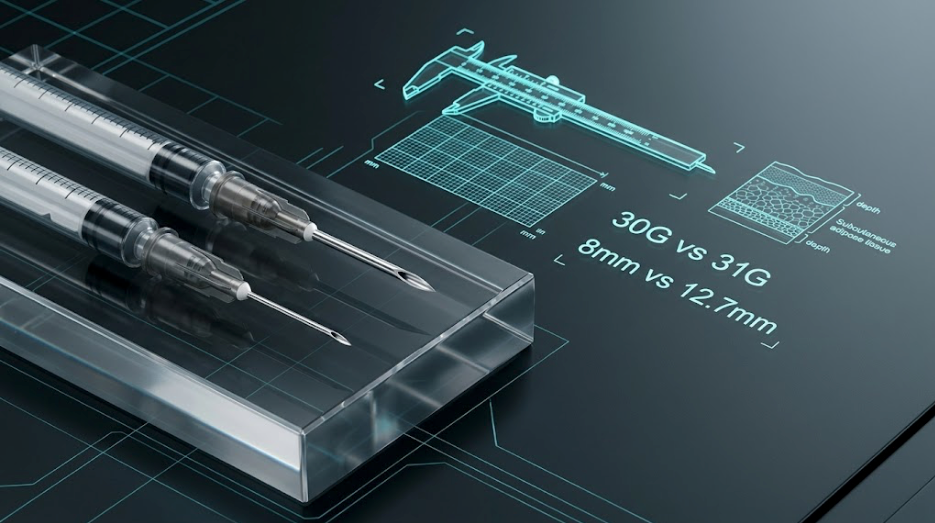
Peptide Needle Gauge & Length: 30G vs 31G & 8mm vs 12.7mm
Selecting the right peptide needle gauge and length is one of the most critical decisions when establishing a reliable administration protocol. Using the wrong needle specification creates daily friction: needles that bend during septum penetration, frustratingly slow fluid draw times, painful tissue trauma, or shallow intradermal wheals caused by incorrect depth targeting.
In research communities, two specific hardware debates dominate: choosing between 30G vs. 31G for needle thickness, and deciding between 5/16" (8 mm) vs. 1/2" (12.7 mm) for penetration depth. Below, we break down the physics of needle diameter, evaluate skin and adipose layer anatomy, and help you select the ideal needle specifications for your research needs.
Quick Summary: Peptide Needle Gauge & Length at a Glance
Quick Answer: For standard subcutaneous peptide research, an EasyTouch 31G 5/16" (8 mm) insulin syringe serves as the gold standard, offering virtually painless punctures and a safe depth that avoids muscle contact. A 30G option provides slightly stiffer cannula rigidity for faster fluid draws, while 1/2" (12.7 mm) lengths require angled insertion in lean subjects to ensure true subcutaneous placement.
| Hardware Spec | Physical Profile | Best Research Application |
|---|---|---|
| 31G • 5/16" (8 mm) | Ultra-fine diameter; short penetration depth. | The ideal standard. Maximum comfort; perfect for daily subcutaneous administration of watery solutions like BPC-157 or TB-500. |
| 30G • 5/16" (8 mm) | Slightly wider bore; short penetration depth. | Excellent compromise. Faster fluid drawing times with near-zero puncture sensation and guaranteed subcutaneous placement. |
| 31G • 1/2" (12.7 mm) | Ultra-fine diameter; deeper penetration depth. | Ideal for subjects with higher body fat percentages who prioritize pain-free puncture at deeper subcutaneous levels. |
| 30G • 1/2" (12.7 mm) | Rigid cannula; deep penetration depth. | Commonly used for thicker, more viscous peptide formulations, or when administering shallow intramuscular protocols. |
Understanding Needle Gauge: 30G vs. 31G
Needle gauge measures the external diameter of the cannula. In medical manufacturing, the higher the gauge number, the thinner the needle:
- 30 Gauge (30G): Measures approximately 0.31 mm outer diameter with an internal lumen width of roughly 0.16 mm.
- 31 Gauge (31G): Measures approximately 0.26 mm outer diameter with an internal lumen width of roughly 0.13 mm.
While a difference of 0.05 mm sounds microscopic, it creates meaningful differences in fluid dynamics and tissue sensation:
1. Sensation and Tissue Puncture Force
The human epidermis is densely populated with nociceptors (pain receptors). A 31G needle requires significantly less initial puncture force to breach the stratum corneum. For researchers running daily or multi-dose regimens, ultra-fine hardware like an EasyTouch 31G Syringe provides virtually imperceptible entries, minimizing cumulative micro-scarring and bruising over extended multi-week schedules.
2. Flow Rate and Poiseuille’s Law
Fluid flow through a cylindrical tube is governed by Hagen-Poiseuille’s Law, which states that volumetric flow rate is directly proportional to the fourth power of the internal radius ($r^4$). Because a 30G needle has a slightly wider internal bore, drawing fluid through rubber stoppers is noticeably faster. A 31G needle requires a few extra seconds of vacuum hold when withdrawing reconstituted compounds, but it passes watery solutions with ease.
3. Cannula Rigidity (Bending Risk)
Thinner metal means less structural rigidity. If a researcher pierces a thick, unyielding multi-dose vial stopper at an awkward angle, a 31G cannula can occasionally bend or dull. A 30G cannula provides slightly more structural stability, which some find helpful when drawing from heavy pharmaceutical rubber septums.
Understanding Needle Length: 5/16" (8 mm) vs. 1/2" (12.7 mm)
Cannula length dictates where your fluid depot lands anatomically. The target for peptide administration is almost always the subcutaneous adipose layer—the fatty tissue sitting between the dermis and underlying muscle.
Across diverse body types, skin thickness (epidermis plus dermis) averages just 1.5 mm to 2.5 mm. This anatomical constant clarifies the length debate:
The Case for 5/16" (8 mm) Needles (The Gold Standard)
An 8 mm needle easily clears the 2 mm dermal boundary, depositing liquid squarely into the middle of the subcutaneous fat layer without risk of entering muscle:
- Zero Muscle Contact: Accidental intramuscular (IM) injection of peptides can accelerate systemic absorption rates unpredictably, leading to acute flushing or blunted depot release. An 8 mm needle eliminates this risk across standard body types.
- Straight 90-Degree Injections: With an 8 mm needle, you can pinch a fold of skin and insert the needle straight in at a clean 90-degree angle without worrying about over-penetration.
The Case for 1/2" (12.7 mm) Needles
A 12.7 mm needle penetrates significantly deeper into tissue:
- Higher Adipose Depths: For research subjects carrying higher levels of subcutaneous body fat, a 12.7 mm needle ensures the compound deposits deep into the adipose core rather than lingering near transitional fascial planes.
- Lean Subjects Must Angle: In lean individuals with low body fat, a 12.7 mm needle inserted at 90 degrees can strike muscle tissue. To prevent this, a 12.7 mm needle must be inserted at a 45-degree angle into a pinched skinfold.
Barrel Volume: Don't Overlook Syringe Capacity
Selecting your needle is only part of the equation; pairing it with the correct barrel volume is equally vital for measuring precision microgram doses:
- 0.3 mL (30 Units): Features widely spaced unit markings, making it the most precise choice for micro-dosing concentrated compounds where single units matter.
- 0.5 mL (50 Units): The most versatile everyday barrel size, accommodating typical daily research volumes between 10 and 40 units easily.
- 1.0 mL (100 Units): Best suited for diluted compounds or high-volume administration protocols requiring 50 to 100 units per draw.
Best Practices: Clean Hardware Execution
To ensure smooth, consistent administration across multi-week protocols, follow these bench guidelines (calculate precise volumetric draws using the Peptide Calculator and manage schedules inside the Protocol Tracker Tool):
- Reconstitute with Sterile Diluents: Always prepare your lyophilized vials using certified pharmaceutical Bacteriostatic Water with 0.9% benzyl alcohol (review aseptic steps in How to Reconstitute Peptides) to ensure low-viscosity, water-thin solutions that flow effortlessly through 31G cannulas.
- One Puncture, One Needle: Never re-enter a vial with a used needle. Fine 30G and 31G bevels dull instantly upon contact with rubber stoppers. A dulled needle causes tissue drag, micro-tearing, and localized post-injection welts (see Peptide Injection Site Welt Guide).
- Protect Reconstituted Vials: Keep active peptide vials stored safely at 2°C to 8°C (36°F to 46°F) inside a dedicated Peptide Vial Case or insulated Compact Travel Case to prevent temperature shock and light degradation.
For the vast majority of subcutaneous peptide research, the sweet spot for comfort, safety, and precision is a 31G, 5/16" (8 mm) insulin syringe. It eliminates needle phobia, prevents accidental intramuscular penetration, and easily handles aqueous peptide solutions. If you find draw times slightly sluggish or work through dense rubber stoppers, step up to a 30G, 5/16" option for a faster draw with virtually identical comfort. Explore more expert advice in our Blog Archive.
← View all peptide guides, research & protocols in our Blog Archive