
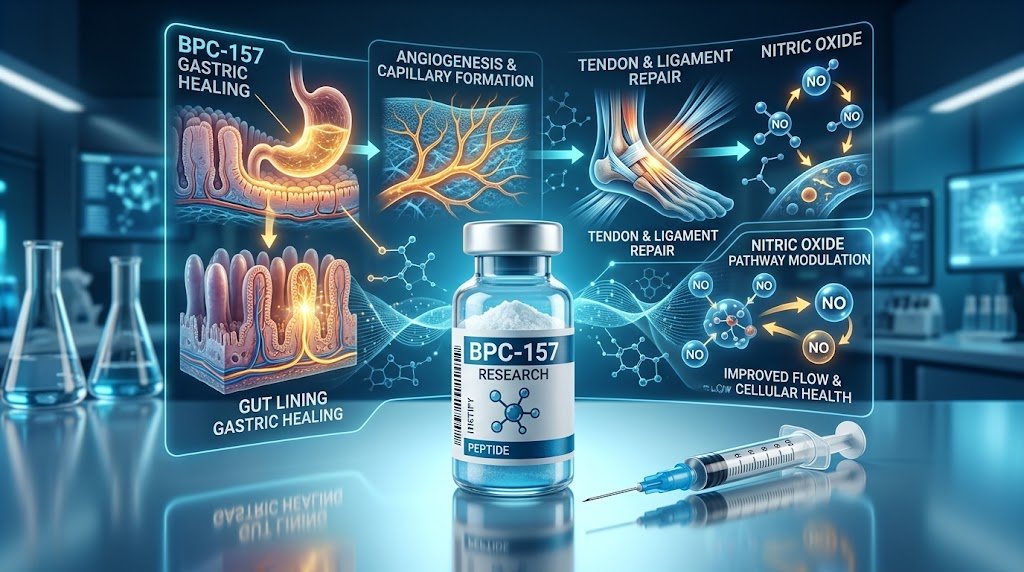
In sports therapy discussions, biohacking circles, and recovery forums, BPC-157 is routinely described as an all-purpose repair agent capable of knitting torn ligaments overnight, reversing chronic tendonitis, and completely resolving intestinal permeability.
While preclinical data confirms substantial biological activity, the popular narrative frequently outpaces verified clinical evidence. Evaluating BPC-157 effectively requires separating its documented molecular pathways and experimental animal models from unsubstantiated therapeutic claims.
Quick Summary: What Is BPC-157 at a Glance?
Quick Answer: BPC-157 (Body Protection Compound-157) is a synthetic 15-amino-acid pentadecapeptide derived from a human gastric juice protein. It promotes soft-tissue healing and gut-lining repair by activating VEGFR2-mediated angiogenesis, modulating nitric oxide (NO) synthesis, and accelerating organized Type I and Type III collagen deposition.
| Parameter | Subcutaneous (Sub-Q) Research | Oral Research Protocol |
|---|---|---|
| Primary Focus | Tendon, ligament, muscle, and systemic connective tissue repair | Gastric mucosal defense, tight junction repair, localized GI tract inflammation |
| Typical Evaluation Dose | 250–500 mcg daily (or 250 mcg twice daily) | 250–500 mcg daily (administered in a fasted state) |
| Primary Mechanism | VEGFR2 angiogenesis and FAK-paxillin fibroblast migration | Direct cytoprotection, eNOS balance, and mucosal blood flow support |
| Reconstitution Vehicle | Bacteriostatic Water or 0.9% Sterile BAC Saline | Diluted in sterile liquid or encapsulated salt form |
What Is BPC-157?
BPC-157, short for Body Protection Compound-157, is a synthetic peptide composed of 15 amino acids (a pentadecapeptide) with a molecular mass of approximately 1,419 Daltons.
Its amino acid sequence represents a partial fragment of a larger protective protein originally isolated from human gastric juice. In gastric physiology, endogenous mucosal proteins defend the stomach lining against hydrochloric acid, proteolytic enzymes, and bile salts.
Researchers isolated and synthesized this specific 15-amino-acid segment because it demonstrated exceptional chemical stability across broad pH ranges—notably resisting enzymatic degradation in gastric acid without requiring artificial carrier coatings.
Initial discovery and foundational research on BPC-157 were spearheaded by Dr. Predrag Sikiric and his research group at the University of Zagreb in Croatia, with subsequent orthopaedic and connective tissue studies expanded by international scientific teams.
Mechanisms of Action: How BPC-157 Works at the Cellular Level
BPC-157 does not rely on a single, dedicated membrane receptor. Instead, it modulates multiple converging repair pathways:
1. Angiogenesis via VEGFR2 Activation
Angiogenesis—the formation of new capillary networks from pre-existing blood vessels—is the most extensively documented mechanism attributed to BPC-157. In cell cultures and ischemic tissue models, BPC-157 stimulates the internal activation of Vascular Endothelial Growth Factor Receptor 2 (VEGFR2). This initiates an intracellular signaling cascade (VEGFR2-Akt-eNOS) that promotes endothelial cell proliferation, migration, and capillary sprouting, delivering oxygen and systemic nutrients to poorly vascularized tissues such as tendons and ligaments.
2. Focal Adhesion Kinase (FAK)–Paxillin Signaling & Collagen Synthesis
Connective tissue healing requires fibroblasts to migrate into an injury site and organize structural proteins. In vitro studies demonstrate that BPC-157 activates the FAK-paxillin pathway, which governs cellular adhesion and directional cell migration. Concurrently, it upregulates Early Growth Response 1 (Egr-1) and increases the expression of growth hormone receptors on fibroblasts, facilitating the transcription and structured, parallel deposition of Type I and Type III collagen rather than disorganized scar tissue.
3. Nitric Oxide (NO) Pathway Modulation
BPC-157 dynamically interacts with the endothelial nitric oxide synthase (eNOS) system. In pharmacological models, it modulates nitric oxide synthesis: counteracting tissue damage induced by both nitric oxide synthase inhibitors (such as L-NAME) and excessive nitric oxide donors (such as L-arginine). This regulatory role stabilizes microvascular permeability, normalizes local vascular tone, and limits ischemic necrosis during acute trauma.
4. Cytoprotection and Gastrointestinal Mucosal Defense
Reflecting its native gastric origin, BPC-157 exhibits pronounced cytoprotective properties throughout the gastrointestinal tract. Animal trials show that it protects and repairs the epithelial barrier against lesions caused by non-steroidal anti-inflammatory drugs (NSAIDs), high ethanol exposure, and systemic physical stress by modulating inflammatory cytokines (reducing TNF-α and IL-6) and maintaining mucosal blood flow.
What Does the Research Actually Show? Preclinical Signal vs. Clinical Reality
Understanding the limitations of current BPC-157 literature is essential for objective scientific assessment.
Preclinical Animal Evidence Dominates the Literature
A 2025 systematic review analyzing 36 studies published between 1993 and 2024 revealed that 35 were preclinical animal studies (primarily Sprague-Dawley rats and mice) and only one was an uncontrolled human chart review.
Animal models consistently show accelerated outcomes—including functional recovery of transected Achilles tendons, healing of severe gastrointestinal fistulas, and salvage of ischemic limbs. However, rodent metabolic rates, tissue repair dynamics, and pharmacokinetics differ substantially from human physiology. Preclinical consistency does not guarantee human clinical efficacy.
The Controlled Human Trial Gap
Randomized, double-blind, placebo-controlled clinical trials for BPC-157 remain sparse in major medical registries:
- Early Phase I and Phase II human trials evaluating BPC-157 for inflammatory bowel conditions (such as ulcerative colitis) and interstitial cystitis were initiated, but final, large-scale Phase III data have never been published in mainstream peer-reviewed journals.
- Despite widespread use across wellness and sports circles, BPC-157 is not approved by regulatory bodies (such as Health Canada or the US FDA) for human therapeutic treatment, and it remains prohibited in competitive athletics under the World Anti-Doping Agency (WADA) Prohibited List.
Documented Laboratory Research & Dosing Protocols
Within published observational studies, veterinary models, and preclinical literature, experimental protocols utilize the following parameters. When organizing study cycles, researchers frequently map their unit math using our free Peptide Reconstitution Calculator and track multi-week timing through the Protocol Tracker Tool.
| Parameter | Subcutaneous (Sub-Q) Protocol | Oral Administration Protocol |
|---|---|---|
| Experimental Focus | Tendon, ligament, muscle, and systemic connective tissue repair | Gastric mucosa, intestinal barrier, and localized GI inflammation |
| Documented Dosing | 200–600 mcg per day (often split into 150–300 mcg doses) | 250–500 mcg per day (taken in a fasted state) |
| Administration Site | Subcutaneous fat (site-specific injection is unnecessary; systemic circulation delivers compounds effectively) | Ingested directly for localized digestive tract contact |
| Cycle Duration | 4–8 weeks of continuous evaluation (review our Peptide Cycle Timing Guide) | 4–12 weeks of continuous evaluation |
| Washout Window | 2–4 weeks off between experimental phases | 2–4 weeks off between experimental phases |
| Screening Panels | CBC, CMP, C-Reactive Protein (CRP) | Fasting CMP, liver enzymes, inflammatory markers |
Synergistic Laboratory Pairings
In regenerative biology research, BPC-157 is frequently co-evaluated alongside complementary peptides to study multi-pathway tissue remodeling:
- TB-500 (Thymosin Beta-4): Often evaluated concurrently with TB-500 to combine localized growth factor activation with systemic actin-driven cellular motility.
- Wolverine Blend: Studied as a pre-combined single solution via the Wolverine Blend Guide (or verified as a pre-calibrated research vial via the Wolverine Blend (BPC-157 / TB-500) product page).
- KPV Peptide: Investigated alongside KPV Peptide for multi-pathway gut barrier recovery, pairing VEGFR2 blood vessel formation with nuclear NF-κB anti-inflammatory suppression.
- GHK-Cu: Paired in dermal and wound closure studies with GHK-Cu Copper Peptide to analyze extracellular matrix restructuring and collagen synthesis.
Laboratory Handling, Reconstitution & Storage Standards
To prevent peptide degradation, laboratory protocols require strict adherence to handling standards (detailed step-by-step in our comprehensive Beginner's Guide to Your First Peptide):
- Diluent Selection: Reconstitute lyophilized BPC-157 with authentic, pharmaceutical-grade Pfizer Hospira Bacteriostatic Water containing 0.9% benzyl alcohol to prevent microbial contamination. Alternatively, 0.9% Sterile Bacteriostatic Saline can be used depending on ionic protocol parameters.
- Aspiration & Reconstitution Technique: Use a sterile EasyTouch 31G Syringe to direct diluent slowly down the interior glass wall of the vial. Never inject liquid directly onto the lyophilized powder cake, and avoid shaking or vigorous agitation; roll the vial gently between your palms until fully dissolved.
- Storage Temperature: Store dry lyophilized vials at -20°C for long-term molecular stability. Reconstituted liquid solutions must be maintained at 2°C to 8°C (36°F to 46°F) inside a secure, light-shielded Peptide Vial Case to prevent mechanical agitation and photo-oxidation.
BPC-157 remains one of the most structurally stable and pharmacologically active research peptides documented in preclinical regenerative medicine. Its targeted influence on VEGFR2 angiogenesis, collagen fiber organization, and gastrointestinal defense is substantiated across dozens of animal studies. However, rigorous evaluation requires maintaining a clear distinction between repeatable animal data and the clinical validation that can only be established through controlled human trials.
← View all peptide guides, research & protocols in our Blog Archive


48 comments