
What Is TB-500?
In musculoskeletal recovery discussions and athletic performance forums, TB-500 is frequently cited as the ultimate systemic healing peptide, widely praised for resolving deep muscle tears, chronic joint stiffness, and impaired connective tissue flexibility.
Much like its frequent counterpart BPC-157, the enthusiastic public discussion surrounding TB-500 often blurs the line between cellular biology and confirmed clinical therapies. Understanding how this peptide functions requires evaluating its cellular actin mechanisms, preclinical animal data, and the real scientific differences between synthetic fragments and the full-length parent protein.
Quick Summary: What Is TB-500 at a Glance?
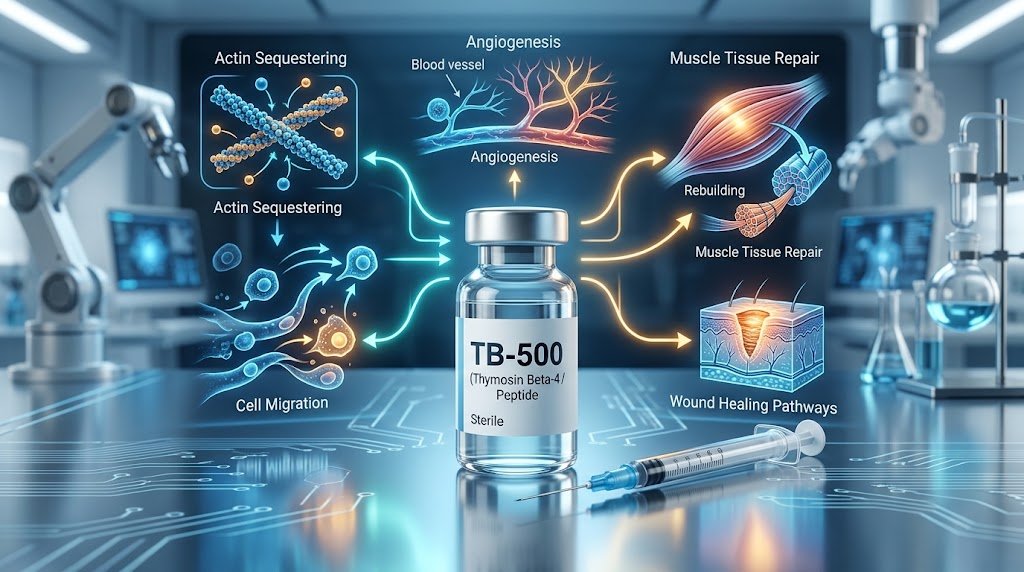
Quick Answer: TB-500 is a synthetic peptide fragment modeled on the active LKKTET actin-binding site of Thymosin Beta-4 (Tβ4). Rather than stimulating growth hormone, it promotes cellular motility via G-actin sequestration, stimulates endothelial cell migration (angiogenesis), modulates NF-κB-mediated inflammation, and encourages parallel collagen deposition to reduce disorganized scar tissue.
| Parameter | Standalone Weekly Bolus Protocol | Daily Synergistic Cadence (Wolverine Stack) |
|---|---|---|
| Primary Focus | Systemic soft-tissue repair, deep muscle tears, cellular motility | Dual-pathway connective tissue remodeling alongside BPC-157 |
| Typical Evaluation Dose | 2.0–2.5 mg twice weekly (Weeks 1–4 loading), then 2.5 mg once weekly | 500 mcg daily (riding alongside daily BPC-157 administration) |
| Primary Mechanism | Actin filament remodeling, cell migration, NF-κB suppression | Concurrent FAK-paxillin growth factor signaling and cellular recruitment |
| Reconstitution Vehicle | Pfizer Hospira Bacteriostatic Water or 0.9% Sterile BAC Saline | Co-lyophilized single solution (Wolverine Blend) |
What Is TB-500?
TB-500 is a synthetic peptide derivative of Thymosin Beta-4 (Tβ4), a naturally occurring 43-amino-acid protein that exists in high concentrations within human blood platelets, wound fluid, and circulating leukocytes.
Thymosin Beta-4 functions as one of nature's primary actin-regulating proteins, playing a direct role in how cells maintain structural integrity, shift shape, and migrate toward damaged tissue. However, synthesizing the full 43-amino-acid chain in commercial laboratory environments is both structurally complex and resource-intensive.
Biochemical researchers identified that the core actin-binding activity of Thymosin Beta-4 is centered on a specific hexapeptide sequence: LKKTET (Leucine-Lysine-Lysine-Threonine-Glutamic Acid-Threonine). TB-500 was engineered as a synthetic fragment incorporating this functional sequence, offering lower molecular weight, enhanced cellular membrane permeability, and reliable laboratory synthesis.
Mechanisms of Action: How TB-500 Works at the Cellular Level
TB-500 operates primarily through cytoskeletal modulation, influencing cellular mobility and broad inflammatory cascades rather than directly stimulating growth hormone receptors:
1. G-Actin Sequestration and Cytoskeletal Remodeling
Actin is the primary building block of cellular architecture, existing either as free single units (globular or G-actin) or polymerized structural filaments (filamentous or F-actin). When tissue trauma occurs, repair cells must quickly dismantle and reassemble their actin filaments to change shape and move. TB-500 binds directly to free G-actin, preventing premature polymerization while maintaining a readily available molecular pool for rapid cellular migration toward damaged matrices.
2. Endothelial Cell Migration and Capillary Sprouting (Angiogenesis)
Restoring vascular supply is critical to healing ischemic or hypovascular structures like tendons and ligaments. In vitro cellular assays demonstrate that Thymosin Beta-4 fragments promote the directional migration and differentiation of endothelial cells, forming organized capillary networks that re-establish localized microcirculation and nutrient delivery.
3. Modulation of Inflammatory Cytokines (NF-κB Downregulation)
Chronic, uncontrolled inflammation damages tissue and triggers maladaptive fibrosis. Research indicates that Thymosin Beta-4 sequences inhibit nuclear factor kappa B (NF-κB) signaling cascades, resulting in measurable decreases in inflammatory cytokines such as TNF-α, IL-1β, and IL-6. This regulation supports a balanced inflammatory phase rather than prolonged tissue destruction.
4. Collagen Alignment and Anti-Fibrotic Activity
Scar tissue formation is characterized by irregular, tangled collagen bundles that reduce structural elasticity. In dermal and cardiac scar models, Tβ4 signaling modulates myofibroblast differentiation, attenuating excessive connective tissue deposition and promoting organized, parallel collagen remodeling rather than rigid fibrotic adhesion.
What Does the Research Actually Show? Full-Length Protein vs. Synthetic Fragment
A rigorous assessment of TB-500 requires distinguishing between the full-length natural protein and the commercial synthetic fragment.
The Literature Disparity: Thymosin Beta-4 vs. TB-500
Much of the published human clinical literature on Thymosin Beta-4 centers on the complete 43-amino-acid sequence, particularly in Phase II clinical trials for ophthalmic indications (neurotrophic keratitis, dry eye syndrome) and topical wound dressings for chronic venous ulcers and bedsores.
By contrast, research specifically utilizing TB-500 (the synthetic fragment) consists almost entirely of in-vitro cell cultures, rodent assays, and historical veterinary tracking in equine racing rehabilitation. Controlled human trials evaluating systemic, subcutaneous injections of synthetic TB-500 for athletic injuries or joint repair remain absent from major clinical databases.
Regulatory Status
TB-500 is not approved by Health Canada, the US FDA, or the European Medicines Agency for human medical use. Furthermore, all Thymosin Beta-4 analogues and fragments are classified as prohibited non-approved substances under Section S0 of the World Anti-Doping Agency (WADA) Prohibited List.
Documented Laboratory Research & Dosing Protocols
Within published observational studies, veterinary records, and preclinical literature, experimental protocols utilize the parameters outlined below. Researchers commonly map their volume and unit conversions via our free Peptide Calculator and structure observation cycles inside the Protocol Tracker Tool.
| Parameter | Daily Subcutaneous Protocol | Split-Dose Weekly Protocol |
|---|---|---|
| Experimental Focus | Acute soft-tissue damage, systemic tissue repair, and cellular mobility | Systemic inflammation, ongoing recovery models, and maintenance evaluation |
| Documented Dosing | 0.5–1 mg per day (common in combination stacks) | 2–5 mg per week (administered as 2 or 3 divided doses) |
| Administration Route | Subcutaneous (Sub-Q); systemic distribution via circulation | Subcutaneous (Sub-Q); systemic distribution via circulation |
| Cycle Duration | 4–8 weeks continuous evaluation (see our Peptide Cycle Timing Guide) | 4–8 weeks continuous evaluation |
| Washout Window | 2–4 weeks off between experimental cycles | 2–4 weeks off between experimental cycles |
| Screening Panels | CBC, CMP, C-Reactive Protein (CRP) | CBC, CMP, systemic inflammatory markers |
Systemic Distribution: Local vs. General Administration
A common misconception in experimental design is that TB-500 must be injected directly into the injured tendon or joint. Because TB-500 has a low molecular weight and works through systemic circulation by sequestering G-actin and promoting endothelial cell recruitment, localized injection is not scientifically required. As detailed in our breakdown on site-specific injection vs. systemic delivery, subcutaneous administration into standard adipose depots provides equivalent systemic bioavailability.
Synergistic Laboratory Pairings
TB-500 is frequently evaluated alongside other research compounds to investigate synergistic tissue regeneration cascades:
- BPC-157: Frequently stacked with BPC-157. While BPC-157 upregulates localized growth factors and VEGFR2 receptors at the site of trauma, TB-500 assists by mobilizing repair cells through the actin network to reach the affected tissue.
- Wolverine Blend: Often evaluated as a single, combined solution via the Wolverine Blend Guide (or sourced directly via the pre-formulated Wolverine Blend (BPC-157 / TB-500) product page) to eliminate double reconstitution steps.
- GLOW Blend & KLOW Blend: Expanded multi-pathway tissue formulations uniting TB-500 with GHK-Cu (GLOW Blend) or GHK-Cu plus nuclear KPV (KLOW Blend) for advanced extracellular matrix and mucosal defense.
- GHK-Cu Copper Peptide: Studied alongside GHK-Cu Copper Peptide (available as standalone GHK-Cu 50mg/100mg) in dermal extracellular matrix remodeling and wound closure research.
- KPV Peptide: Paired with KPV Peptide (or standalone KPV research vials) to observe cell migration in the presence of nuclear NF-κB inflammatory blockade.
Laboratory Handling, Reconstitution & Storage Standards
To prevent peptide degradation and preserve molecular integrity, experimental protocols follow these preparation standards (detailed step-by-step in our Beginner's Guide to Peptides):
- Diluent Selection: Reconstitute lyophilized TB-500 using sterile, pharmaceutical-grade Pfizer Hospira Bacteriostatic Water containing 0.9% benzyl alcohol to prevent bacterial growth over prolonged study windows. 0.9% Sterile Bacteriostatic Saline can also be utilized depending on osmotic test parameters.
- Reconstitution Protocol: Use a sterile EasyTouch 31G Syringe to allow diluent to flow smoothly down the inside glass wall of the vial. Do not spray diluent directly onto the lyophilized cake, and avoid vigorous shaking; roll the vial gently between your palms until the solution is clear. Keep in mind that standard 10 mg research vials have a 3 mL capacity when planning dilution math.
- Cold-Chain Storage: Store dry lyophilized vials at -20°C for long-term molecular preservation. Reconstituted liquid solutions must be refrigerated between 2°C and 8°C (36°F to 46°F) inside a light-shielded, vibration-damping Peptide Vial Case or insulated Compact Travel Case to protect against mechanical shearing and light exposure.
TB-500 offers a well-documented biochemical rationale centered on actin sequestration, cellular migration, and inflammatory pathway modulation. Its preclinical profile in animal wound models and cell culture assays provides strong scientific merit for continued investigation. However, researchers must maintain objective standards, recognizing the distinction between full-length Thymosin Beta-4 and synthetic TB-500, as well as the ongoing need for controlled human clinical evaluation.
← View all peptide guides, research & protocols in our Blog Archive


35 comments