Best Time to Inject Peptides: Fasting, Sleep & Schedule
Determining the best time to inject peptides is a fundamental question in pharmacological research. Reconstituting a high-purity compound with sterile diluent is only half the equation. If an injection is timed incorrectly—such as during postprandial glucose spikes or out of sync with circadian hormonal waves—receptor affinity and downstream signaling can be severely blunted.
Unlike small-molecule drugs with broad therapeutic windows, bioactive peptide sequences rely on precise biological contexts. Endogenous counter-regulatory hormones, circulating insulin, somatostatin secretion, and meal composition directly dictate whether a target receptor is receptive or refractory. Below, we break down the chronobiology behind peptide scheduling, how food intake alters compound efficacy, and the ideal timing protocols across major peptide classes.
Quick Summary: Best Time to Inject Peptides at a Glance
Quick Answer: The optimal injection timing depends heavily on the peptide class. Growth hormone secretagogues (like Ipamorelin or CJC-1295) require a strict 2-hour fasting window and are best timed before bed or in the morning to bypass somatostatin and align with natural circadian peaks. Conversely, non-hormonal tissue repair peptides (BPC-157, TB-500) and long-acting incretins prioritize consistent daily or weekly coverage regardless of meals.
| Peptide Class | Optimal Timing Window | Biological Rationale |
|---|---|---|
| GHRH / GHRP Secretagogues (CJC-1295, Ipamorelin, Sermorelin) |
Night (pre-bed) or morning fasting. | Requires strict 2-hour fasting to avoid somatostatin blunting; synchronizes with slow-wave nocturnal endocrine pulses. |
| Regenerative Peptides (BPC-157, TB-500) |
Consistent daily schedule (morning or evening). | Non-hormonal tissue repair and actin upregulation are independent of meal status; consistency and steady receptor coverage take priority. |
| Lipolytic Fragments (AOD-9604, Fragment 176-191) |
Morning fasted, pre-cardio. | Must be administered in a zero-insulin environment to permit uninhibited beta-3 adrenergic and lipolytic pathway signaling. |
| Long-Acting Incretins (Semaglutide, Tirzepatide, CagriSema) |
Once weekly (any time of day). | Extended 5- to 7-day elimination half-lives make meal timing irrelevant; consistency of injection day is the primary parameter. |
| Mitochondrial Peptides (MOTS-c, SS-31) |
Morning or early afternoon. | Stimulates ATP production and metabolic gene expression; evening administration can disrupt sleep architecture and circadian balance. |
| Cosmetic / Remodeling (GHK-Cu Copper Tripeptide) |
Morning or midday with food/hydration. | Systemic copper assimilation is unlinked to fasting; daytime scheduling reduces the perception of localized subcutaneous ache. |
The Metabolic Gatekeeper: Why Fasting Dictates Timing
For several peptide classes—particularly growth hormone secretagogues (GHS) and lipolytic fragments—nutrient status is the single most critical timing variable. Introducing a secretagogue into a non-fasted biological model often neutralizes its intended signaling cascade:
- The Somatostatin Trigger: Nutrient ingestion (especially carbohydrates and dietary fats) triggers acute releases of glucose, free fatty acids, and insulin. Elevated blood glucose stimulates hypothalamic somatostatin (growth hormone-inhibiting hormone), which directly suppresses pituitary somatotrophs and blocks endogenous hormone release.
- Receptor Desensitization: Circulating insulin and elevated macronutrient metabolites reduce the responsiveness of growth hormone secretagogue receptors (GHS-R1a), rendering compounds like ipamorelin and GHRPs largely ineffective.
- The Pre- and Post-Dose Fasting Window: Standard laboratory benchmarks require at least a 2-hour pre-administration fast and a 30- to 45-minute post-administration buffer before food intake to allow receptor phosphorylation and serum peak concentrations without somatostatin suppression.
Circadian Rhythms and Endocrine Pulsing
The human endocrine system operates on strict circadian oscillation. Pituitary growth hormone release, for example, is not continuous; it occurs in 6 to 12 daily pulsatile bursts, with up to 70% to 80% of total daily output occurring during slow-wave (deep stage 3/4) sleep.
Coordinating administration with natural circadian highs leverages existing physiological cascades:
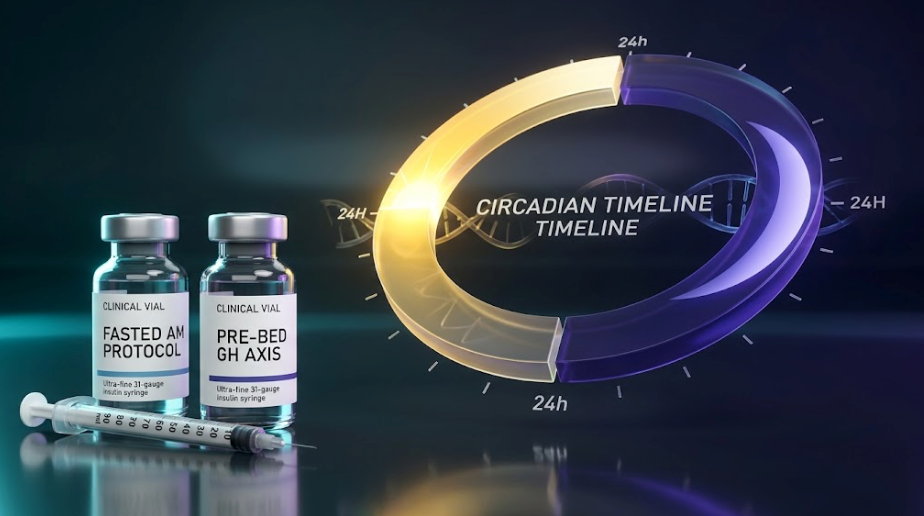
- Pre-Bed Timing for Secretagogues: Administering GHRH or GHRP compounds roughly 30 to 45 minutes before sleep aligns peak plasma concentrations with the nocturnal somatotroph surge, amplifying natural neuroendocrine pulses without altering endogenous rhythmicity.
- Morning Fasting for Metabolic Peptides: In contrast, compounds intended for mitochondrial modulation, lipolysis, or cellular energy pathways function best during morning fasting windows, when baseline insulin is low and metabolic pathways favor substrate mobilization.
Systemic vs. Site-Specific Timing (Does Location Matter?)
A persistent debate in research circles is whether administration timing should align with physical activity, or if subcutaneous injections must be administered "near the injury."
Pharmacokinetic data confirms that subcutaneous injections distribute into systemic circulation through capillary and lymphatic uptake. While administering regenerative compounds like BPC-157 or TB-500 near an injured joint is common in preclinical models, systemic receptor migration ensures bioavailability regardless of local site choice. However, timing post-exercise administration allows natural localized blood flow and hyperemia to assist compound distribution.
Bench Best Practices for Reliable Scheduling
To ensure consistent pharmacokinetics across your research protocol (managed inside the Protocol Tracker Tool), implement these laboratory benchmarks:
- Use Low-Volume Precision Hardware: Accurate microgram dosing requires minimal dead-space barrels. Deliver doses using an ultra-fine EasyTouch 31G Syringe (calculate accurate liquid draws with the Peptide Calculator) to prevent fluid wastage and reduce localized tissue trauma.
- Maintain Diluent Integrity: Always reconstitute dry compounds using certified Bacteriostatic Water with verified 0.9% benzyl alcohol (review handling protocols in How to Reconstitute Peptides), ensuring microbial safety across multi-week dosing schedules.
- Avoid Temperature Shocks Before Use: When retrieving your vial from refrigerated storage at 2°C to 8°C (36°F to 46°F) inside a secure Peptide Vial Case or Compact Travel Case, allow the loaded syringe to sit at room temperature for 3 to 5 minutes prior to administration to prevent cold-fluid sting.
When selecting the best time to inject peptides, start by classifying the compound's biochemical pathway. For hormonal secretagogues and lipolytic fragments, strict fasting and pre-bed circadian alignment are essential to bypass somatostatin and insulin interference. For systemic tissue repair and long-acting metabolic peptides, baseline consistency, steady blood levels, and proper solvent preparation matter far more than clock timing. Explore broader options in our Blog Archive.
← View all peptide guides, research & protocols in our Blog Archive