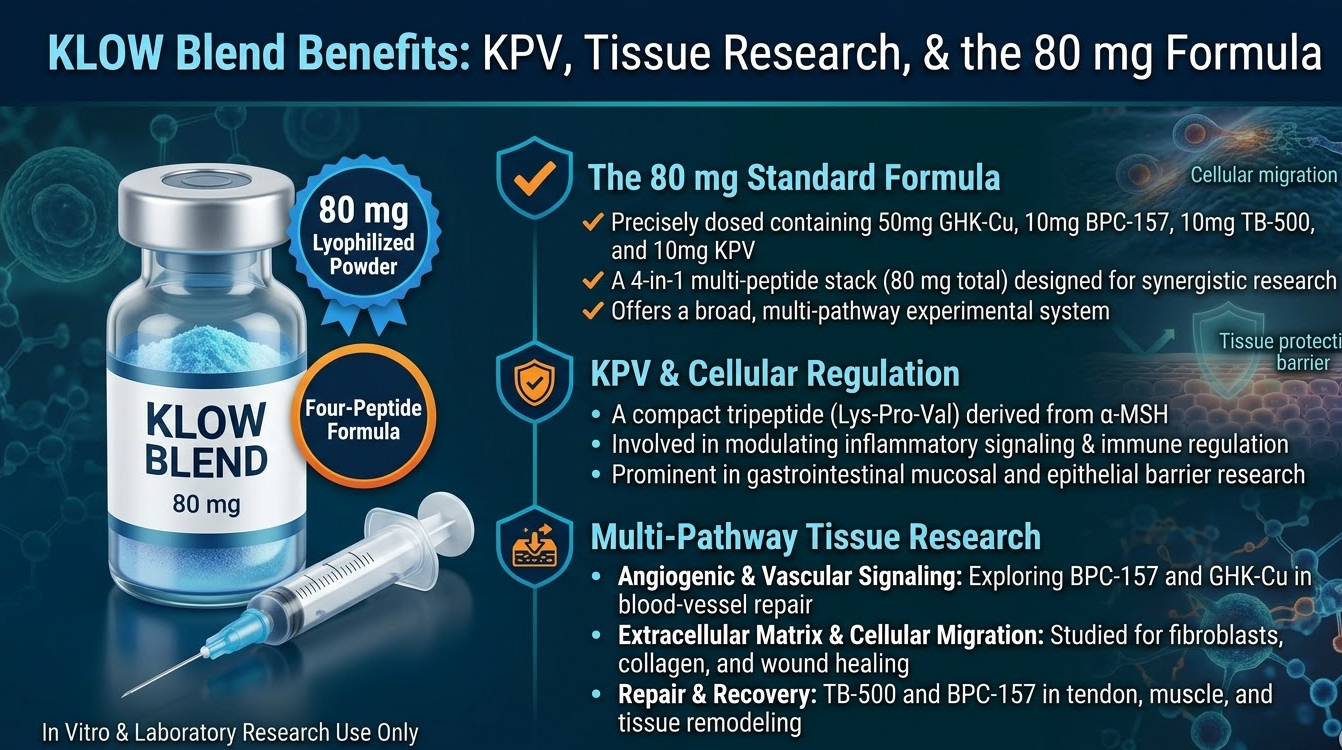
While tissue rebuilding relies heavily on collagen synthesis, microvascular growth, and cell migration, underlying inflammatory signaling can severely blunt the regenerative window. The KLOW Blend takes the established regenerative foundation of GLOW and elevates it to an 80 mg multi-target formulation. Understanding the KLOW blend KPV ingredient explains how adding this tripeptide transforms a 5:1:1 tissue remodeling triad into a calibrated 5:1:1:1 matrix that actively extinguishes NF-κB inflammation while accelerating repair.
⚡ Quick Summary: KLOW Blend & The KPV Advantage
Quick Answer: The KLOW Blend (80 mg total) is formulated in an exact 5:1:1:1 mass ratio (50:10:10:10 mg) containing 50 mg GHK-Cu, 10 mg BPC-157, 10 mg TB-500, and 10 mg KPV. The critical difference between GLOW (70 mg) and KLOW (80 mg) is the addition of KPV (Lys-Pro-Val)—a potent α-MSH tripeptide fragment that downregulates NF-κB nuclear translocation, quenches pro-inflammatory cytokines (TNF-α, IL-6), and protects newly regenerated extracellular matrix from proteolytic enzyme degradation.
| KLOW Ingredient | Mass in 80 mg Vial | Ratio Share | Primary Cellular Target |
|---|---|---|---|
| GHK-Cu (Copper Tripeptide-1) | 50 mg | 62.5% (5 parts) | Dermal fibroblasts, collagen I/III, decorin synthesis |
| BPC-157 (Pentadecapeptide) | 10 mg | 12.5% (1 part) | VEGFR2 activation, nitric oxide signaling, granulation |
| TB-500 (Thymosin β4 Fragment) | 10 mg | 12.5% (1 part) | Actin sequestration, stem cell migration, wound contraction |
| KPV (Tripeptide Lys-Pro-Val) | 10 mg | 12.5% (1 part) | PepT1 transport, NF-κB inhibition, inflammatory cytokine arrest |
The 4th Element: Why KPV Transforms the Research Model
In conventional tissue research, tissue remodeling often battles persistent background inflammation. High levels of inflammatory cytokines trigger matrix metalloproteinases (MMPs) that actively chop up newly formed collagen and extracellular matrix. KPV introduces a biological brake:
1. NF-κB Nuclear Suppression
KPV stops the degradation of IκB-α, trapping the p65 subunit of NF-κB outside the nucleus to shut down transcription of TNF-α, IL-1β, and IL-6.
2. Extracellular Matrix Shielding
By suppressing pro-inflammatory enzymes, KPV prevents MMP-1 and MMP-3 from destroying the fresh collagen laid down by GHK-Cu.
3. Dual Gut & Systemic Cross-Talk
Utilizes active PepT1 cellular uptake channels, allowing researchers to evaluate gut-barrier reinforcement alongside soft-tissue and dermal restoration.
Unite Deep Tissue Remodeling with Anti-Inflammatory Control
Take your tissue research beyond simple healing. Explore the multi-pathway synergy of authentic 50:10:10:10 compounding with certified, laboratory-grade KLOW.
Shop Research KLOW Blend (80 mg) →GLOW vs. KLOW: Choosing the Right Blend Architecture
Understanding which blend matches your experimental protocol comes down to whether ongoing inflammatory signaling is a variable in your research:
- The GLOW Profile (70 mg | 50:10:10): Unites GHK-Cu (50 mg) with BPC-157 / TB-500 (10 mg each). Optimized specifically for structural collagen deposition, dermal firming, microvascular sprouting, and soft-tissue tendon/ligament modeling where baseline inflammation is low. Read the full formula guide: GLOW Blend Ingredients: The 70 mg Formula Explained.
- The KLOW Profile (80 mg | 50:10:10:10): Adds 10 mg of pure KPV to the matrix. Essential for research environments involving acute swelling, chronic gut-barrier disruption, dermatitis, autoimmune-mediated inflammatory flaring, or damaged tissues where chronic inflammation prevents normal healing. Read our head-to-head comparison: GLOW vs. KLOW Peptide: Comparing the 70mg & 80mg Blends.
Understanding Concentration Math: Reconstituting the 80 mg Matrix
Because KLOW contains four distinct compounds in an 80 mg total mass, researchers must avoid confusing total blend mass with individual peptide yield. When dissolving an 80 mg vial with 2.0 mL of Pfizer Hospira Bacteriostatic Water:
- Total Vial Concentration: 80 mg ÷ 2.0 mL = 40 mg/mL combined peptide density.
- Component Concentration per mL: Each 1.0 mL delivers 25 mg GHK-Cu, 5 mg BPC-157, 5 mg TB-500, and 5 mg KPV.
- Standard Draw Yield (10 Units / 0.1 mL on U-100 Syringe): Pulling 10 units delivers a total mass of 4.0 mg, containing 2.5 mg GHK-Cu, 500 mcg BPC-157, 500 mcg TB-500, and 500 mcg KPV.
| Draw Volume (U-100 Syringe) | Total Blend Mass | GHK-Cu Yield | BPC-157 Yield | TB-500 Yield | KPV Yield |
|---|---|---|---|---|---|
| 5 Units (0.05 mL) | 2.00 mg | 1.25 mg (1,250 mcg) | 250 mcg (0.25 mg) | 250 mcg (0.25 mg) | 250 mcg (0.25 mg) |
| 10 Units (0.10 mL) | 4.00 mg | 2.50 mg (2,500 mcg) | 500 mcg (0.50 mg) | 500 mcg (0.50 mg) | 500 mcg (0.50 mg) |
| 20 Units (0.20 mL) | 8.00 mg | 5.00 mg (5,000 mcg) | 1,000 mcg (1.00 mg) | 1,000 mcg (1.00 mg) | 1,000 mcg (1.00 mg) |
Eliminate unit-to-microgram conversion errors before drawing by running your parameters through our free Peptide Calculator.
Synergistic Research Pairings & Standalone Studies
To isolate how KPV influences individual biological pathways versus the full 4-part matrix, compare your data alongside single-ingredient literature:
- The Pure Anti-Inflammatory Baseline: Explore cellular uptake mechanics and intestinal epithelial repair with standalone KPV. Read our detailed analysis: KPV and PepT1: Why Gut Delivery Matters.
- The Structural Matrix Reference: Contrast KLOW’s anti-inflammatory remodeling against pure copper tripeptide gene modulation using pure GHK-Cu. Read our guide: What Is GHK-Cu? Copper Tripeptide Pathways & Dosing.
- Classic Angiogenic Soft-Tissue Healing: Benchmark against the dual-pathway vascular model using the Wolverine Blend (BPC-157 / TB-500). Review protocols in the Wolverine Blend Guide.
Hardware Selection: Delivering Multi-Compound Formulations
Handling an 80 mg four-peptide formulation containing photo-sensitive copper and delicate amino acid chains requires reliable lab hardware:
- Reusable Injection Pens: Avoid repetitive septum punctures and syringe graduation errors by loading reconstituted KLOW into 3mL Injection Pen Glass Cartridges and pairing with the V3 Reusable Injection Pen. The mechanical lead-screw guarantees exact click-dialed micro-volumes with zero needle-hub fluid loss.
- Precision Manual Syringes: If manual draws are preferred, draw with surgical-grade Easy Touch 31G U-100 Syringes with 0.5 mL barrels. The ultra-fine 31-gauge needle glides through stoppers without tearing or coring the rubber.
- Light-Shielded Cold Housing: Copper peptide complexes are photo-sensitive and degrade rapidly under UV and ambient fluorescent lab lighting. Store your active vials upright inside the Compact 4-Slot Case or the high-capacity 10-Slot Peptide Vial Case. For mobile protocols, carry supplies inside the insulated Compact Peptide Travel Case.
Protocol Builder & Tracking Tools
Maintain complete laboratory chain-of-custody across your KLOW research cycles:
- Protocol Setup: Calculate diluent ratios, schedule administration ramps, and document reconstitution lot numbers inside the Protocol Builder.
- Daily Logging: Record daily inflammatory markers, draw volumes, and beyond-use dates inside the Protocol Tracker Tool.
Frequently Asked Questions
Why does KLOW retain the deep blue color of GLOW?
The bright blue color is produced by the copper ion (Cu2+) chelation within GHK-Cu, which constitutes the largest portion of the blend (50 mg out of 80 mg). The additions of BPC-157, TB-500, and KPV are completely colorless in solution and do not disrupt the optical copper complex.
Does KPV colitis research prove KLOW cures bowel disease?
No. Published KPV literature investigates isolated cellular PepT1 transporter kinetics and rodent colitis models (Dalmasso et al., 2008). While KPV demonstrates potent localized and systemic NF-κB downregulation, multi-peptide blends like KLOW must be evaluated under controlled experimental conditions rather than assumed to treat clinical disease.
Can KLOW be reconstituted using 0.9% bacteriostatic saline instead of water?
Standard Pfizer Hospira Bacteriostatic Water is the primary recommended vehicle. While 0.9% BAC Saline is often used with sting-prone peptides to match osmolarity, high ionic salt concentrations can interact with high-density copper peptide complexes over long multi-week storage periods. BAC water ensures maximum solution stability.
Related Reading & Scientific References
- GLOW vs KLOW Peptide: Comparing the 70mg & 80mg Blends
- KPV and PepT1: Why Gut Delivery Matters
- GLOW Blend Ingredients: The 70 mg Formula Explained
- Dalmasso et al. (2008): PepT1-Mediated Tripeptide KPV Transport in Intestinal Inflammation (PubMed)
By integrating the potent anti-inflammatory properties of KPV with the proven tissue-rebuilding triad of GHK-Cu, BPC-157, and TB-500, the KLOW Blend creates an expansive 50:10:10:10 research matrix. Adding KPV ensures that active tissue regeneration occurs in a calm, inflammation-suppressed cellular environment, maximizing experimental reproducibility and structural matrix stability.
← View all peptide guides, research & protocols in our Blog Archive