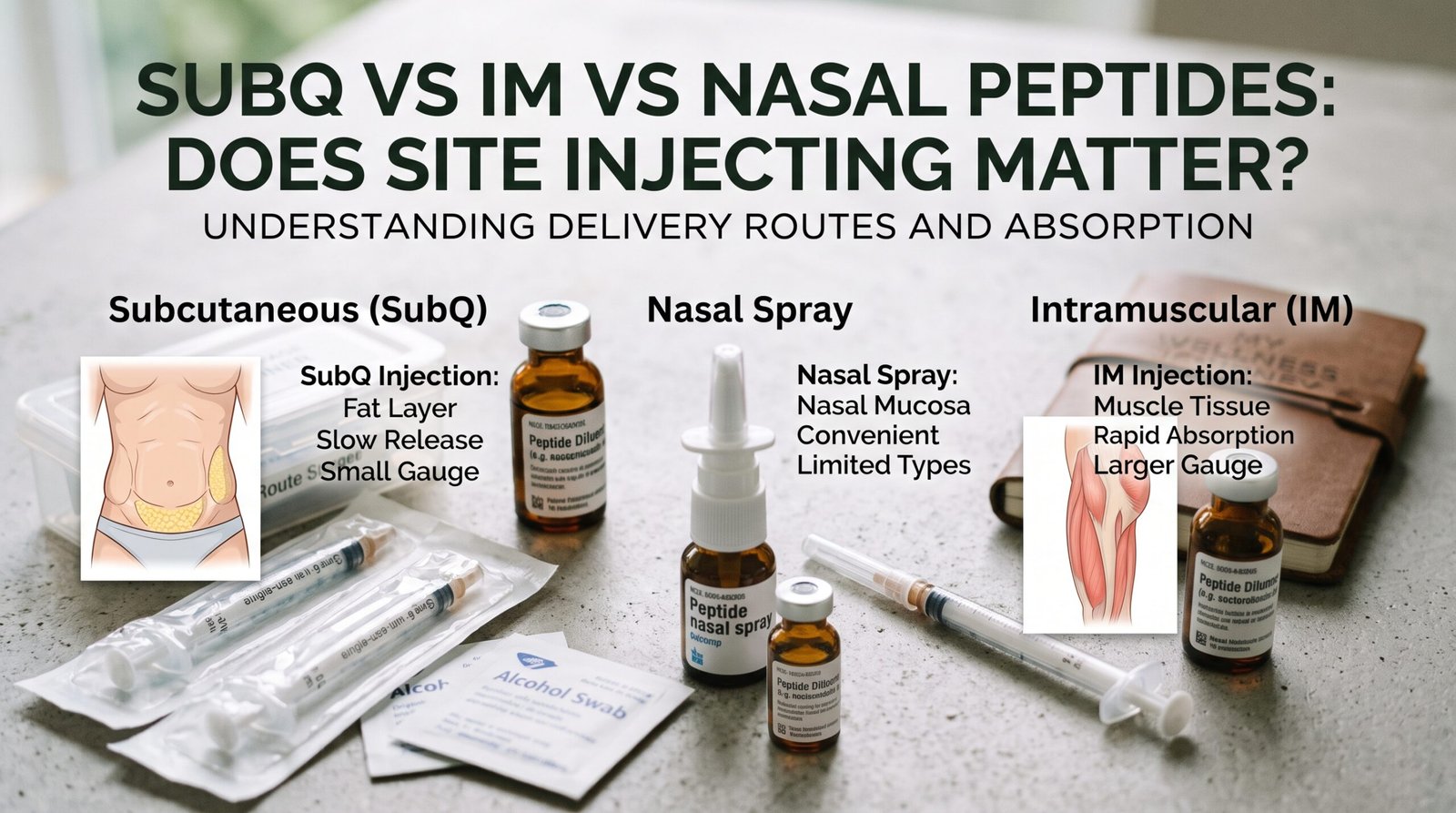
SubQ vs IM vs Nasal Peptides: Does Site Injecting Matter?
Evaluating subq vs im vs nasal peptides is one of the most hotly contested debates across online biohacking forums and sports medicine circles. When researching healing compounds for an injured knee, shoulder, or torn tendon, researchers frequently ask: does injecting "near the injury" actually accelerate recovery, or is site-specific administration a complete myth?
The controversy stems from conflating localized compound exposure with systemic pharmacokinetics. Many believe that depositing liquid next to an inflamed joint floods the damaged tissue directly. However, physiological vascular flow, endothelial permeability, and receptor targeting tell a far more nuanced story. Below, we break down the biodistribution mechanics of subq vs im vs nasal peptides, explore whether localized injecting matters, and provide a clear framework for selecting the right delivery route.
Quick Summary: SubQ vs. IM vs. Nasal Delivery at a Glance
Quick Answer: Site-specific injections near an injury are unnecessary; subcutaneous capillaries rapidly absorb peptides into systemic circulation, where inflammatory cytokines and receptor upregulation guide them directly to damaged tissue. SubQ injection remains the gold standard for steady depot release, IM offers rapid vascular clearance, and intranasal delivery bypasses the blood-brain barrier exclusively for central neurological targets.
| Delivery Route | Absorption Kinetics | Clinical Application |
|---|---|---|
| Subcutaneous (SubQ) | Slow, steady depot absorption; sustained plasma concentrations ($T_{max}$ 30–90 min); peak bioavailability. | The standard benchmark. Ideal for systemic repair (BPC-157, TB-500), metabolic incretins, and daily secretagogues. |
| Intramuscular (IM) | Rapid vascular clearance; sharp plasma spike ($T_{max}$ 10–30 min); shorter sustained duration. | Best for viscous, oil-based suspensions, rapid acute rescue protocols, or specific hormonal formulations requiring high vascular perfusion. |
| Intranasal (Nasal) | Bypasses hepatic clearance and the Blood-Brain Barrier via olfactory/trigeminal nerves directly to the CNS. | Exclusively suited for neurological, cognitive, or central neuropeptides (e.g., Semax, Selank, oxytocin, orexin). |
The Big Myth: "Injecting Near the Injury" (Local vs. Systemic)
The idea of injecting into the skin fold directly adjacent to an injured patellar tendon or rotator cuff sounds intuitive. However, in subcutaneous tissue, capillary uptake dominates over local passive diffusion:
- Rapid Capillary Clearance: Subcutaneous adipose tissue is interlaced with continuous micro-capillaries and initial lymphatic networks. Small peptide molecules (typically under 5,000 Daltons) are drawn into the microvasculature via hydrostatic and oncotic pressure differentials within minutes.
- Negligible Lateral Diffusion: Interstitial fluid in connective tissue does not sit static like water in a sponge. Dense extracellular matrices, collagen bundles, and fascial barriers severely restrict lateral fluid movement. The compound does not simply soak sideways through fibrous tissue into a joint capsule; it enters venous circulation and joins the body's total blood volume.
- Systemic Receptor Homing: Regenerative compounds like BPC-157 and TB-500 exert their actions through systemic upregulation of growth factors (such as VEGF and EGR-1), focal adhesion kinases, and actin polymerization. Damaged tissues naturally upregulate specific receptor densities and inflammatory cytokines, signaling systemic compounds to home in on injury sites regardless of where the injection occurred.
Therefore, injecting into abdominal fat yields virtually the same systemic bioavailability and tissue-healing concentration as an awkward, painful injection near an elbow or knee.
The Hazards of "Localized" Injecting Near Joints
Attempting to close in on an injured joint is not just pharmacokinetically unnecessary; it introduces significant anatomical risks:
- Synovial and Bursal Puncture Risks: Piercing joint capsules or bursae outside of an ultrasound-guided surgical suite risks introducing skin bacteria into enclosed synovial cavities, creating catastrophic septic arthritis.
- Superficial Nerve and Vascular Bundles: Areas surrounding joints (such as the popliteal fossa behind the knee, anterior elbow creases, and wrists) feature major nerve trunks and large superficial blood vessels running close to the surface, raising the risk of nerve trauma or inadvertent intravenous delivery.
- Thin Adipose Layers & Intradermal Blebs: Skin over tendons and joints contains minimal subcutaneous fat. Needles easily deposit fluid intradermally, triggering painful histamine wheals, bruising, and prolonged localized inflammation.
Delivery Route Face-Off: SubQ vs. IM vs. Nasal
Rather than obsessing over anatomical geography, researchers focus on selecting the correct physiological delivery route based on compound size, desired onset, and target tissue barriers:
1. Subcutaneous (SubQ): The Gold Standard for Everyday Peptides
For greater than 90% of non-neurological peptide protocols, subcutaneous injection remains the superior choice:
- Smooth Depot Release: Adipose tissue acts as a biological sponge, slowly releasing peptide molecules into circulation over several hours, avoiding erratic serum spikes.
- Maximum User Compliance: Using an ultra-fine EasyTouch 31G Syringe with a short 8 mm (5/16") needle makes administration virtually pain-free, eliminating the scar tissue buildup and muscle soreness associated with regular IM injections.
- Safe Abdominal Depots: The periumbilical abdominal fat pad provides a broad, highly consistent, well-vascularized surface that absorbs compounds reliably without navigating complex nerve paths.
2. Intramuscular (IM): When Speed Overrides Sustained Release
Skeletal muscle tissue features dense vascular networks and high continuous blood flow:
- Faster Onset, Shorter Plateau: An IM injection delivers the peptide into the central bloodstream much faster than SubQ, causing a sharper peak plasma spike ($C_{max}$) followed by faster renal and enzymatic clearance.
- When Is IM Justified? In clinical medicine, IM delivery is preferred for large-volume emulsions, water-insoluble suspensions, or acute emergency drugs. For small, water-soluble peptides, IM offers no significant regenerative advantage over SubQ while causing higher muscle soreness and micro-trauma.
3. Intranasal: The Direct Central Nervous System Shortcut
The blood-brain barrier (BBB) tightly protects the brain by blocking more than 98% of large, hydrophilic macromolecules circulating in the blood. If your research objective involves central cognition, neuroprotection, or sleep modulation, both SubQ and IM routes fall flat.
Nasal delivery bypasses the circulatory system entirely by utilizing the olfactory neuroepithelium and trigeminal nerve pathways in the upper nasal vault. Peptides diffuse through perineural channels across the cribriform plate straight into the cerebrospinal fluid (CSF) and brain parenchyma in minutes, delivering high central concentrations with zero peripheral side effects.
Best Practices: Clean Hardware and Solvent Standards
Regardless of whether you choose SubQ or nasal routes, maintaining pristine formulation quality prevents adverse reactions (review foundational steps in the Beginner's Guide to Peptides):
- Use Reputable Diluents: Reconstitute lyophilized vials using certified Bacteriostatic Water with verified 0.9% benzyl alcohol (calculate draws using the Peptide Calculator) to guarantee sterility and optimal physiological pH. For compounds prone to subcutaneous stinging or osmotic imbalance, consider Sodium Chloride Bacteriostatic 0.9% Saline to mirror interstitial tonicity.
- Rotate SubQ Injection Quadrants: Avoid injecting into the exact same spot. Rotate between left and right abdominal quadrants, outer thighs, and gluteal areas to prevent localized subcutaneous lipohypertrophy. Log injection cycles inside the Protocol Tracker Tool.
- Enclose Vials Securely: Store reconstituted vials cold at 2°C to 8°C (36°F to 46°F) inside a protective Peptide Vial Case or insulated Compact Travel Case to eliminate light exposure and physical vibration.
Does site-specific injecting actually matter? For tissue repair and systemic metabolic peptides, the answer is an emphatic no. Injecting near an injured joint does not create a localized therapeutic pool; the compound enters systemic circulation and travels via receptor upregulation straight to the damaged tissue anyway. Save yourself the pain, bruising, and risk of joint trauma. Stick to simple, painless subcutaneous injections in standard abdominal fat for systemic healing compounds like BPC-157 and TB-500, and reserve intranasal delivery exclusively for brain-targeted neuro-peptides that need to bypass the blood-brain barrier. Read more in our Blog Archive.
← View all peptide guides, research & protocols in our Blog Archive