How to Backfill a Syringe for Peptides: Safe Stacking Guide
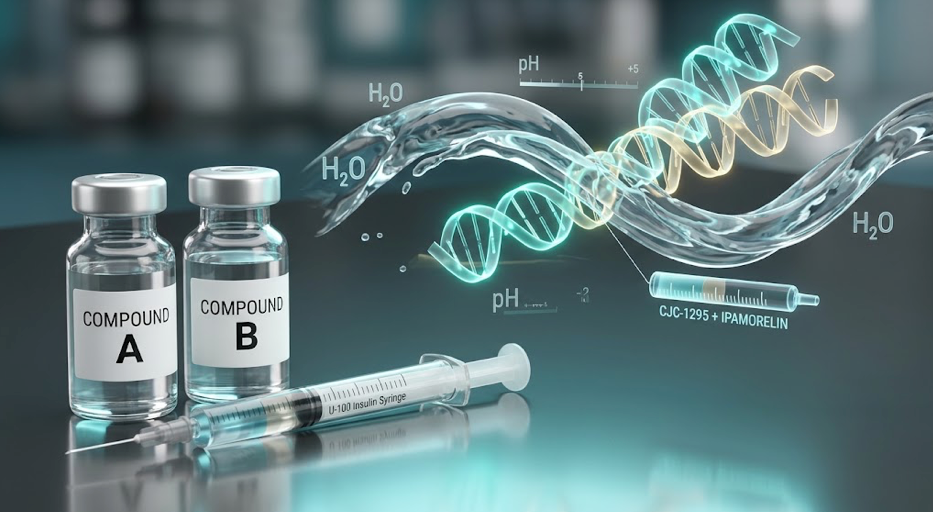
Drawing multiple compounds into the same barrel is a tempting shortcut for researchers managing complex schedules. However, standard "double-dipping"—inserting one needle into multiple vials sequentially—inevitably introduces cross-contamination, dulls needle tips, and alters vial concentrations. If you want to use a single syringe without compromising your master vials, what you should do instead is backfill a single syringe.
Backfilling isolates your supply stock entirely while allowing multiple compatible solutions to be combined in one delivery barrel. However, mechanical technique is only half the battle; the chemical compatibility of the molecules is equally critical. Below, we review how to properly backfill syringe peptides, examine which compounds can safely share a barrel, and highlight the combinations you must never mix.
Quick Summary: Backfilling Peptide Syringes at a Glance
Quick Answer: Backfilling involves removing the syringe plunger and dispensing multiple drawn compound solutions into the back of the barrel, preventing master vial cross-contamination. Compatible hydrophilic peptides like BPC-157 and TB-500 share a barrel safely, while metal-chelating compounds like GHK-Cu Copper Tripeptide and acidic hydrophobic mixes must never be combined.
| Peptide Combination | Compatibility Status | Biophysical Rationale |
|---|---|---|
| BPC-157 + TB-500 | Fully Compatible | The standard regenerative combination. Both are linear, hydrophilic peptides with neutral isoelectric points that share identical bacteriostatic diluent bases. |
| CJC-1295 + Ipamorelin | Fully Compatible | Complementary secretagogues commonly combined to optimize pulse release. Both dissolve stably at neutral pH without aggregation. |
| Sermorelin + GHRP-2 / GHRP-6 | Fully Compatible | Short-chain secretagogue analogues that maintain clear solubility in unbuffered neutral bacteriostatic water when administered immediately. |
| MOTS-c + Humanin | Compatible (Short Window) | Mitochondrial-derived peptides that share similar solution properties, provided both are dissolved cleanly in neutral diluent without acidic excipients. |
Why Backfilling Solves the Double-Draw Dilemma
Standard dual-drawing relies on plunging a previously wet needle into a second sterile vial. That method carries severe drawbacks:
- Zero Cross-Contamination: Backfilling uses dedicated primary draw needles for each stock vial. Because no needle touches more than one rubber septum, your master vials remain 100% chemically isolated and pristine.
- Preserves Needle Sharpness: Piercing an elastomer rubber stopper degrades the microscopic silicone lubricant and curls the needle bevel. When you backfill, the destination syringe's needle never touches a rubber stopper, ensuring a factory-sharp bevel for administration.
- Precision Volumetric Control: Drawing a second liquid into an already-filled barrel creates hydraulic confusion and air bubbles. Backfilling allows you to verify each exact volume independently before combining them.
Step-by-Step: How to Safely Backfill a Syringe
Backfilling requires clean, disciplined bench technique to ensure the interior barrel remains strictly sterile (review general handling rules in our Beginner's Guide to Peptides):
- Prepare Your Sterile Field: Sanitize your workspace and clean the rubber septums of both compound vials using fresh alcohol prep pads.
- Prepare the Destination Syringe: Take your destination EasyTouch 31G Syringe. Leave the needle cap securely in place. Carefully pull the plunger straight out of the back of the barrel and set it on a sterile, untouched surface without letting the rubber gasket touch any unsterile object.
- Draw Compound A: Using a secondary sterile syringe, draw the measured dose of Compound A from its vial. Carefully insert this needle into the open back of the destination barrel and slowly dispense the liquid down the inner wall.
- Draw Compound B: Using a fresh needle (or dedicated secondary syringe), draw the measured dose of Compound B from its vial. Dispense it directly into the open back of the destination barrel alongside Compound A.
- Re-Seat the Plunger: Carefully insert the rubber plunger tip just 1 to 2 millimeters into the back of the destination barrel. Invert the syringe so the capped needle points toward the ceiling.
- Tap and Clear the Air Gap: Gently flick the barrel so the combined fluid drops to the bottom against the plunger. Carefully push the plunger upward until the trapped air pocket vents completely through the needle, stopping the moment a tiny bead of liquid appears at the tip.
- Administer Immediately: Once combined, use the solution right away. Never store pre-backfilled syringes for later use.
Compounds That CAN Be Used Together (Compatible Mixes)
Peptides can share a syringe barrel if they are both water-soluble, share a neutral pH, and dissolve in standard Bacteriostatic Water without chemical clashing:
Compounds That Should NEVER Be Mixed Together
Certain peptides possess fundamentally incompatible chemistries, charges, or structural requirements. Combining these inside a single barrel leads to rapid precipitation, degradation, or severe adverse tissue reactions:
1. GHK-Cu + Virtually Any Other Peptide
Never combine GHK-Cu Copper Tripeptide with other peptides in the same barrel. GHK-Cu contains a tightly chelated copper ($Cu^{2+}$) ion. Free and weakly bound transition metal ions act as potent catalysts for oxidation. When placed in contact with other peptides—especially those with disulfide bridges or oxidation-sensitive residues like methionine, cysteine, and tryptophan—copper catalyzes rapid oxidative cleavage, destroying both molecules.
2. Hydrophobic Peptides (AOD-9604, Frag 176-191) + Neutral Peptides
Hydrophobic compounds such as AOD-9604 and Growth Hormone Fragment 176-191 resist neutral water and require acidic solvents (like 0.6% acetic acid) to remain dissolved. If you backfill an acidic AOD-9604 solution with a neutral compound like BPC-157, the higher pH of the neutral solution will cause the AOD-9604 to instantly crash out into an insoluble, cloudy gel (read more in Cloudy Peptide After Mixing?).
3. Complex Macromolecules & Proteins (hGH) + Small Peptides
Human Growth Hormone (191 amino acids) is a massive, delicate folded protein, not a simple linear peptide chain. It is exceptionally sensitive to interfacial shear stress and charge changes. Mixing hGH with small peptides introduces foreign buffer salts that disrupt delicate tertiary folds, leading to rapid fibrillar aggregation.
4. GLP-1 Analogues (Semaglutide / Tirzepatide) + Other Compounds
Long-acting incretin mimetics rely on precise formulation buffers (often containing sodium phosphate and specific stabilizers) to maintain their monomeric conformation and fatty diacid binding properties. Introducing another peptide disrupts the preservative and buffer system, risking precipitation and erratic absorption.
Rules for Safe Syringe Blending
If you choose to backfill syringe peptides for compatible pairings like BPC-157 and TB-500, follow these laboratory ground rules:
- The 10-Minute Window: Backfilling is strictly an immediate preparation technique. Never pre-fill syringes to store in the refrigerator for days. Over extended periods, blended peptides can form covalent dimers and cross-linked aggregates.
- Inspect Solution Clarity: Hold the filled syringe up to a light source. The combined fluid must be water-clear. If you notice opalescence, white flakes, or clouding, isoelectric precipitation has occurred; discard the syringe.
- Keep Stock Vials Enclosed: Always store your master vials upright at 2°C to 8°C (36°F to 46°F) inside a padded Peptide Vial Case or insulated Compact Travel Case to shield them from ambient light and temperature swings. Verify all volume calculations using the Peptide Calculator and log your active schedules inside the Protocol Tracker Tool.
If you need to administer two compatible peptides in a single session, backfilling a single syringe is vastly superior to double-drawing through vial stoppers. It eliminates master vial cross-contamination, preserves needle sharpness, and ensures dosage accuracy. Just be certain your compounds share neutral solubility, keep incompatible metals and acidic solutions separate, and administer your combined draw immediately. Review full reconstitution steps in our How to Reconstitute Peptides Guide.
← View all peptide guides, research & protocols in our Blog Archive