CJC-1295 Explained: DAC vs. No DAC, Mechanisms & Dosing
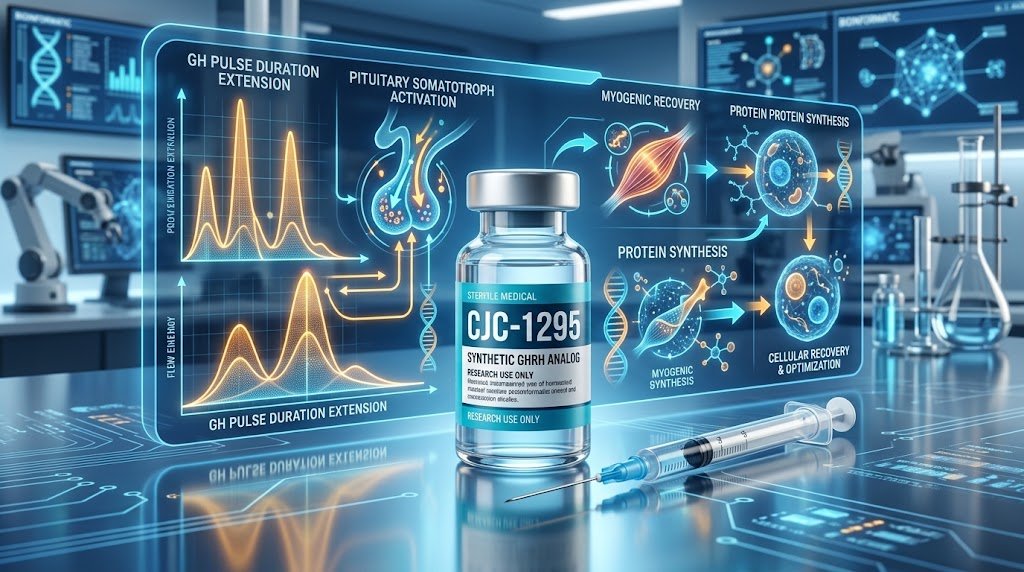
Within pituitary endocrinology and peptide chemistry, CJC-1295 represents an engineered breakthrough in stimulating endogenous growth hormone. By overcoming the rapid enzymatic breakdown that limited early growth hormone-releasing hormone fragments, it provides researchers with an effective tool to investigate somatotrophic signaling.
However, the compound frequently causes confusion in research communities due to the existence of two distinct chemical formats: CJC-1295 with DAC and CJC-1295 without DAC (commonly known as Modified GRF 1-29). This guide breaks down the molecular structure, receptor mechanisms, pharmacokinetic differences, and established laboratory protocols for both variants.
Quick Summary: CJC-1295 at a Glance
Quick Answer: CJC-1295 is a tetrasubstituted 29-amino-acid synthetic analogue of growth hormone-releasing hormone (GHRH). The variant without DAC (Mod GRF 1-29) has a 30-minute half-life that creates natural, physiological growth hormone pulses. The variant with DAC includes a drug affinity complex that binds serum albumin, extending its half-life to 6–8 days and producing continuous baseline growth hormone elevation.
| Characteristic | CJC-1295 Without DAC (Mod GRF 1-29) | CJC-1295 With DAC |
|---|---|---|
| Molecular Profile | Tetrasubstituted GHRH 1-29 peptide chain | Tetrasubstituted GHRH 1-29 + maleimidopropionic acid linker |
| Albumin Affinity | None (circulates as a free peptide) | Forms a covalent bond with circulating serum albumin |
| Elimination Half-Life | Approximately 30 minutes | Approximately 6 to 8 days |
| Hormone Secretion Pattern | Pulsatile (sharp, discrete physiological spikes) | Continuous (elevates baseline secretion around the clock) |
| Typical Research Schedule | 1 to 3 administrations daily (in a fasted state) | 1 to 2 administrations weekly |
| Direct Research Supply | Paired secretagogues available via CJC-1295 / Ipamorelin Blend (10mg) | |
What Is CJC-1295?
CJC-1295 is a synthetic 29-amino-acid peptide analogue of endogenous Growth Hormone-Releasing Hormone (GHRH).
Endogenous GHRH is a 44-amino-acid hormone secreted by the arcuate nucleus of the hypothalamus. Early peptide research established that the full biological activity of GHRH is preserved within its first 29 N-terminal residues (synthesized as Sermorelin). However, native GRF 1-29 is unstable in mammalian serum; circulating dipeptidyl peptidase-4 (DPP-4) cleaves the terminal Tyr-Ala bond within 10 to 12 minutes.
To solve this rapid enzymatic clearance, chemists designed CJC-1295 with four specific amino acid substitutions:
- Position 2 (D-Ala): Protects the N-terminus from DPP-4 enzymatic degradation.
- Position 8 (Gln): Replaces Asparagine to stop spontaneous chemical deamidation.
- Position 15 (Ala): Replaces Glycine to increase structural alpha-helical stability.
- Position 27 (Leu): Replaces Methionine to prevent oxidative degradation in liquid solution.
These substitutions create a tetrasubstituted peptide that maintains high affinity for pituitary GHRH receptors while resisting common serum degradation pathways.
The Core Comparison: DAC vs. No DAC (Mod GRF 1-29)
The functional distinction between the two types of CJC-1295 depends on the presence of the Drug Affinity Complex (DAC):
1. CJC-1295 Without DAC (Modified GRF 1-29)
When synthesized without the Drug Affinity Complex, this compound is biochemically designated as Modified GRF 1-29. With an active half-life of roughly 30 minutes, it remains in circulation long enough to fully engage anterior pituitary somatotrophs, but clears quickly enough to allow somatostatin to restore baseline levels. This produces physiological growth hormone pulses that align with natural circadian rhythms.
2. CJC-1295 With DAC
The complete CJC-1295 structure includes a maleimidopropionic acid linker attached to a C-terminal lysine residue. Following subcutaneous administration, this linker forms a covalent bond with free thiol groups on serum albumin. Because albumin circulates for extended periods, CJC-1295 with DAC maintains a half-life of 6 to 8 days, stimulating the pituitary continuously. While effective at elevating total IGF-1 levels, prolonged continuous stimulation bypasses natural secretory rhythms and can lead to somatotroph desensitization over time.
Mechanism of Action: Pituitary Receptor Signaling
Both forms of CJC-1295 act through identical cellular receptor pathways on anterior pituitary somatotrophs:
- GHRH Receptor Binding: The peptide binds selectively to G-protein coupled GHRH receptors, activating stimulatory G-protein alpha subunits.
- cAMP Generation: Stimulated adenylyl cyclase converts ATP into intracellular cyclic adenosine monophosphate (cAMP).
- PKA Signaling & Storage Exocytosis: Elevated cAMP activates protein kinase A (PKA), opening L-type calcium channels. The influx of extracellular calcium ($Ca^{2+}$) triggers the rapid exocytosis of pre-stored growth hormone granules into systemic circulation.
- CREB-Driven Gene Transcription: Concurrently, PKA phosphorylates CREB within the cell nucleus, stimulating transcription of the $GH1$ gene to replenish the somatotroph's hormone reserves.
- Hepatic IGF-1 Production: Circulating growth hormone binds to receptors in liver tissue, prompting the production and release of Insulin-Like Growth Factor 1 (IGF-1) and its stabilizing binding protein IGFBP-3.
Documented Laboratory Research & Dosing Protocols
Published endocrinological studies and preclinical research separate experimental parameters based on the specific molecular variant evaluated. Reconstitution dilution and unit calculations can be verified with our free Peptide Calculator, while cycle intervals are managed inside the Protocol Tracker Tool.
| Protocol Parameter | CJC-1295 Without DAC (Mod GRF 1-29) | CJC-1295 With DAC |
|---|---|---|
| Research Target | Pulsatile GH restoration, sleep architecture, lipolytic signaling | Continuous systemic IGF-1 elevation, catabolic models |
| Documented Dosing | 100 mcg per administration | 1.0–2.0 mg per administration |
| Administration Frequency | 1 to 3 times daily (pre-bedtime, morning) | 1 to 2 times weekly (e.g., Monday / Thursday) |
| Administration Route | Subcutaneous (Sub-Q) injection into adipose tissue | Subcutaneous (Sub-Q) injection into adipose tissue |
| Fasting Context | Strictly fasted (2–3 hours post-prandial) | Fasting less critical due to extended half-life |
| Cycle Architecture | 8–12 weeks on / 4 weeks washout (see our Cycle Guide) | 6–8 weeks on / 6–8 weeks washout |
| Key Biomarkers | Serum IGF-1, IGFBP-3, fasting glucose, prolactin | Fasting glucose, HbA1c, fasting insulin, comprehensive panels |
The Fasted State Requirement for Modified GRF 1-29
When evaluating CJC-1295 without DAC, ambient metabolic conditions directly influence experimental results:
- Carbohydrate & Insulin Blunting: Elevated blood glucose triggers insulin release, which prompts the hypothalamus to secrete somatostatin. Somatostatin binds to inhibitory Gi pathways on somatotrophs, shutting down adenylyl cyclase and preventing CJC-1295 from eliciting a GH pulse.
- Elevated Free Fatty Acids: High circulating lipid levels similarly impair somatotroph responsiveness.
For this reason, research protocols maintain a fasted window of at least two to three hours prior to subcutaneous injection, followed by a 30-to-45-minute post-administration wait before nutrients are introduced.
Synergistic Research Pairings
Because CJC-1295 targets the cAMP/PKA signaling cascade, laboratories frequently combine it with complementary research peptides:
- Ipamorelin: The most widely researched pairing in secretagogue science. Co-administering CJC-1295 (No DAC) with Ipamorelin produces a synergistic growth hormone pulse significantly larger than the mathematical sum of either peptide alone. CJC-1295 activates cAMP signaling, while Ipamorelin mobilizes intracellular calcium and suppresses somatostatin. Read our full CJC-1295 & Ipamorelin Blend Guide.
- Sermorelin: Evaluated alongside native GRF fragments in our Sermorelin Protocols Guide to compare elimination half-lives and clearance rates.
- BPC-157: In tissue repair models, researchers evaluate secretagogues alongside BPC-157 to analyze whether elevated systemic IGF-1 accelerates localized angiogenic recovery.
- TB-500: Investigators combine GHRH signaling with TB-500 to observe concurrent cellular actin upregulation alongside elevated growth factor output.
- AOD-9604: In metabolic studies, laboratories pair secretagogues with AOD-9604 Peptide (or view AOD-9604 5mg) to evaluate targeted adipocyte lipolysis alongside systemic GH release.
- MOTS-c: Teams evaluate mitochondrial metabolic control alongside pituitary signaling by referencing MOTS-c research protocols.
- 5-Amino-1MQ: Scientists study cellular NAD+ salvage and adipose remodeling by contrasting secretagogue lipolysis with 5-Amino-1MQ NNMT inhibition.
Laboratory Handling, Reconstitution & Storage Standards
Maintaining the conformational integrity of the 29-amino-acid chain requires adherence to standard laboratory cold-chain procedures (detailed step-by-step in our Beginner's Guide to Peptides):
- Diluent Selection: Reconstitute lyophilized CJC-1295 vials using sterile, pharmaceutical-grade Pfizer Hospira Bacteriostatic Water containing 0.9% benzyl alcohol to prevent bacterial contamination across multi-dose testing schedules. Alternatively, use 0.9% Sterile Bacteriostatic Saline for cell-culture protocols requiring strict isotonicity.
- Reconstitution Protocol: Use a sterile EasyTouch 31G Syringe to let the diluent trickle gently down the inside glass wall of the vial. Never spray liquid directly onto the lyophilized powder cake. Avoid vigorous shaking; roll the vial slowly between your palms until the solution turns completely clear.
- Cold-Chain Storage: Store dry lyophilized powder at -20°C for long-term molecular stability. Maintain reconstituted liquid solutions between 2°C and 8°C (36°F to 46°F) inside a secure, light-shielded Peptide Vial Case or insulated Compact Travel Case to protect against mechanical vibration and light degradation.
CJC-1295 illustrates how targeted chemical modifications can address the structural instability of endogenous signaling molecules. Whether evaluating Modified GRF 1-29 to maintain natural pulsatile circadian rhythms or studying CJC-1295 with DAC for sustained systemic receptor activation, choosing the appropriate molecular variant and adhering to strict fasted protocols will ensure accurate, reproducible experimental results.
← View all peptide guides, research & protocols in our Blog Archive