Peptide Cycle: How Long to Run & How Much Time Off?
When structuring a new research protocol, one fundamental question comes up repeatedly regarding a peptide cycle: how long should you run it, and how much time off do you actually need? Introducing synthetic peptides can trigger potent downstream signaling cascades. However, running a protocol without planned breaks often leads to diminishing biological returns, desensitized receptors, and cellular adaptation.
Pausing an administration schedule is not an arbitrary rule; it is grounded in cellular pharmacodynamics. Cells naturally defend themselves against continuous overstimulation by reducing receptor sensitivity. Below, we break down why biological systems desensitize, the core principles that dictate your peptide cycle: how long to stay on, and specific cycle-and-washout timelines across major compound classes.
Quick Summary: Peptide Cycle Duration at a Glance
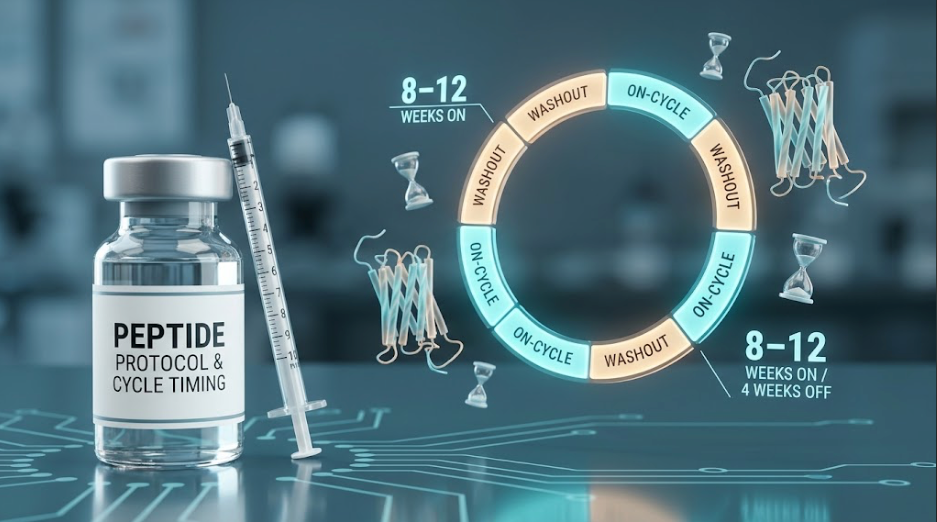
Quick Answer: Most standard research peptide cycles (such as GHRH/GHRP secretagogues) follow an 8 to 12 weeks ON followed by 4 to 8 weeks OFF protocol (mirroring a 1:1 time-on to time-off rule) to prevent receptor downregulation, internalization, and tachyphylaxis. Non-hormonal tissue repair peptides (BPC-157, TB-500) are typically run as milestone-driven cycles until healing is achieved, while long-acting incretins maintain continuous protocols.
| Peptide Class | Recommended Architecture | Biological Rationale |
|---|---|---|
| GHRH / GHRP Secretagogues (CJC-1295, Ipamorelin, Sermorelin) |
8–12 Weeks ON / 4–8 Weeks OFF (or 5 days ON / 2 days OFF pulses) |
Pituitary GHS-R1a receptors internalize rapidly; scheduled 2-day micro-breaks or 1-month full washouts restore cellular receptor density. |
| Regenerative Peptides (BPC-157, TB-500) |
4–8 Weeks ON / 4 Weeks OFF (Run until tissue healing endpoints met) |
Angiogenesis, cell migration, and actin upregulation do not cause classic endocrine shutdown; cycles conclude once objective tissue healing is achieved. |
| Mitochondrial Peptides (MOTS-c, SS-31) |
4–6 Weeks ON / 4–8 Weeks OFF | Mitochondrial biogenesis and metabolic gene expression persist for weeks post-treatment; continuous exposure yields diminishing metabolic returns. |
| Cosmetic / Remodeling (GHK-Cu Copper Tripeptide) |
6–8 Weeks ON / 4 Weeks OFF | Washout windows prevent excess copper accumulation and give extracellular matrix fibroblast remodeling time to stabilize. |
| Long-Acting Incretins (Semaglutide, Tirzepatide, CagriSema) |
Chronic / Extended Maintenance (Washout unrecommended during weight loss) |
Unlike secretagogues, GLP-1 mimetics rely on steady receptor occupancy for metabolic and glycemic control; stopping induces immediate appetite rebound. |
The Biology of Tolerance: Why You Need Time Off
When target tissues are flooded with continuous peptide signaling, homeostatic adaptation kicks in to prevent cellular burnout. This defensive shutdown unfolds in three distinct stages:
- Acute Uncoupling (Tachyphylaxis): Within hours to days of non-stop receptor agonism, intracellular kinases phosphorylate active receptor tails. This recruits β-arrestin proteins, uncoupling the receptor from its primary downstream cascade even while the molecule remains bound.
- Endocytosis (Receptor Internalization): Bound surface receptors are pulled into endosomes via clathrin-coated pits. While some receptors recycle back to the cell wall, prolonged exposure diverts them directly into lysosomes for permanent degradation.
- Transcriptional Downregulation: Over weeks of nonstop stimulation, cell nuclei downregulate messenger RNA (mRNA) transcription for the receptor. This substantially reduces the total count of active binding sites available on cell membranes.
Structuring disciplined time off provides the necessary biological window for lysosomal clearance, new receptor protein translation, and full cell-surface re-sensitization.
The Gold Standard: The "Time-On Equals Time-Off" Rule
In preclinical pharmacology, the foundational guideline for receptor-saturating compounds is the 1:1 rule: time-on equals time-off. If an investigative protocol runs for 8 consecutive weeks, an equivalent 8-week washout period is scheduled before resuming.
This timeline allows several physiological baselines to recover completely:
- Downstream Clearance: While native peptides clear the blood in minutes to hours, secondary endocrine changes (such as circulating systemic IGF-1 or metabolic shifts) can take weeks to return to baseline.
- Pituitary Recovery: For secretagogue compounds that stimulate endogenous pulsatile surges, cycling off prevents somatotroph fatigue and preserves natural hypothalamic-pituitary-axis responsiveness.
- Antibody Attenuation: Continuous, uninterrupted exposure to synthetic peptide sequences can slowly trigger low-affinity neutralizing antibodies. Regular cycle-off breaks help reduce immunogenic memory markers.
Continuous vs. Pulsed Dosing: The 5-on / 2-off Method
For secretagogues like CJC-1295 and Ipamorelin, researchers frequently build micro-washouts directly into their weekly routine. The standard approach is the 5 days ON / 2 days OFF schedule.
By pausing administration for 48 consecutive hours every week (e.g., weekends), the pituitary gland receives a brief rest from exogenous receptor stimulation. This micro-washout allows internalized GHS-R1a receptors to recycle to the plasma membrane, significantly extending the overall multi-month research cycle before a major 4-to-8 week break is required.
Best Practices: Vial Storage During Washout Windows
Managing laboratory stock properly during an off-cycle prevents expensive supplies from spoiling (review fundamentals in our Beginner's Guide to Peptides):
- Finish Reconstituted Vials Before Breaks: Never leave a reconstituted vial sitting in the refrigerator during an 8-week cycle-off period. Diluent preserved with Bacteriostatic Water has a 28-to-30 day lifespan. A breached vial left for two months will suffer deamidation and preservative failure. Track active expiry dates inside the Protocol Tracker Tool.
- Keep Backup Vials Frozen: Unopened, lyophilized backup stock should remain frozen at -20°C inside a dedicated Peptide Vial Case or insulated Compact Travel Case to shield the cakes from light, humidity, and thermal shock.
- Protect Hardware: Store sterile EasyTouch 31G Syringes in a clean, climate-controlled cabinet so equipment remains pristine when the next cycle begins. Calculate microgram concentrations using the Peptide Calculator.
When planning your next peptide cycle: how long you run it depends directly on the receptor system being targeted. For hormonal secretagogues and mitochondrial modulators, plan for 8 to 12 weeks of active use followed by 4 to 8 weeks off (or a full 1:1 time ratio) to prevent downregulatory plateaus. For targeted tissue repair compounds, treat the protocol as milestone-driven: run the peptide until tissue recovery endpoints are met, then cycle off cleanly to assess baseline stability.
← View all peptide guides, research & protocols in our Blog Archive