Back to Research & Articles
Laboratory Research Notice: This page explains how CJC-1295 and Ipamorelin dosing is structured in published research and how to calculate concentrations for laboratory work. These compounds are supplied as research materials for laboratory use, not as medicines. Nothing on this page is medical advice.
The CJC-1295 and Ipamorelin dosage question has two answers that get mixed together constantly: the microgram schedule used in research, and the milligram-per-millilitre concentration you create when you reconstitute the vial. Get the second one wrong and every draw is wrong by a predictable factor. This page separates them, and does the arithmetic for the 10 mg blend.
Quick Breakdown: CJC-1295 and Ipamorelin Dosage
Quick Answer: In research, these are two different schedules run together — Ipamorelin typically at 100–300 mcg per administration, once to three times daily, and CJC-1295 (no DAC) at 100–200 mcg per administration on a similar cadence. The blend is sold as a 10 mg vial (5 mg + 5 mg), and 2 mL of diluent gives you 5 mg/mL combined — 50 mcg per unit on a U-100 syringe, 25 mcg of each compound.
| Term |
What It Means |
Where It Applies |
| Dose (mcg) |
Mass of peptide per administration. |
Research protocols, published studies. |
| Concentration |
Milligrams per millilitre — set entirely by your diluent volume. |
Reconstitution, calculator output. |
| Syringe units |
Tick marks on a U-100 syringe: 100 units = 1 mL. |
Bench work, protocol logs. |
| Cadence |
How many times per day, and whether the two compounds are run together. |
Protocol design. |
Why the Two Compounds Have Separate Schedules
CJC-1295 (without DAC) is a GHRH analogue: it signals the pituitary to release growth hormone. Ipamorelin is a ghrelin-receptor agonist — a GHSR-1a selective secretagogue that does the same job through a different receptor. They are studied together because they act on separate pathways to the same output, but their half-lives differ, and that is why the schedules are not identical.
For the receptor pharmacology, see the CJC-1295 + Ipamorelin research profile and how Ipamorelin's GHSR-1a selectivity works and the DAC versus no-DAC distinction — the no-DAC version is the one supplied in this blend, and it is the shorter-acting of the two.
Reconstitution Maths for the 10 mg Blend
The vial contains 5 mg CJC-1295 and 5 mg Ipamorelin — 10 mg total. Every calculation runs on the total, then splits by the 1:1 ratio.
| Diluent Added |
Combined Concentration |
Per Unit (U-100) |
Each Compound Per Unit |
| 1.0 mL |
10 mg/mL (10,000 mcg/mL) |
100 mcg |
50 mcg |
| 2.0 mL |
5 mg/mL (5,000 mcg/mL) |
50 mcg |
25 mcg |
| 2.5 mL |
4 mg/mL (4,000 mcg/mL) |
40 mcg |
20 mcg |
| 5.0 mL |
2 mg/mL (2,000 mcg/mL) |
20 mcg |
10 mcg |
At 2 mL, a 250 mcg total draw is 5 units and delivers 125 mcg of each compound. At 1 mL, the same 5 units delivers 500 mcg total — double, because the concentration doubled. That is the whole failure mode of blend dosing: people change the diluent and keep the same unit count.
For the conversion in the other direction, and for any vial size, use the Peptide Calculator or read how much bacteriostatic water to add.
Cadence, Timing and Why It Matters Here
Growth hormone secretagogues are studied in pulsatile patterns, not continuous ones — the whole point is to amplify a natural pulse rather than flatten it. Three practical consequences:
- Administered in a fasted state in most protocols, because circulating glucose and insulin blunt the GH response.
- The evening administration aligns with the largest natural pulse of the day, which is why it appears most often in the literature.
- Multiple smaller administrations beat one large one for the shorter-acting compound, where a single dose is cleared before the next pulse window.
Your protocol log should record the diluent volume, the unit count, and the time relative to the last meal — because without those three numbers the data is not reproducible.
What It Costs Per Vial
The blend is supplied as a single 10 mg vial — 5 mg of each compound — for $70, which is $7.00 per milligram of combined peptide. There is no kit minimum and no prescription step.
Compare that with the prescription route: sermorelin and tesamorelin are prescription-only in Canada, which means an appointment, a prescription, and a pharmacy price. CJC-1295 and Ipamorelin are not approved medicines at all — there is no pharmacy shelf to compare against, and no insurer involved. The research vial is the access, not an alternative to it.
Frequently Asked Questions
What is the standard CJC-1295 and Ipamorelin dosage?
Research protocols use Ipamorelin at 100–300 mcg and CJC-1295 (no DAC) at 100–200 mcg per administration, once to three times daily depending on the design. Those figures come from the published literature, not from a label.
How much BAC water do I add to a 10 mg blend?
Enough to land your target draw on a readable part of the syringe. 2 mL gives 5 mg/mL combined — a 50 mcg draw per unit — which is the most common reference point. The table above covers the alternatives.
Is the dosage the same for the two compounds?
The ratios differ slightly because the compounds differ, but in a 1:1 blend they are delivered together, so every unit carries equal amounts of each. Separate vials are the only way to vary the proportions.
How long does a 10 mg vial last?
At 250 mcg total per administration twice daily, that is 500 mcg/day, so a 10 mg vial covers 20 days of research. Once reconstituted, work inside the 28-day window — see how long BAC water is good for.
Does more diluent make it stronger?
The opposite. Mass stays fixed; more diluent lowers the concentration and increases the volume needed for the same mass.
Related: for the full mechanism and protocol background, read the CJC-1295 + Ipamorelin guide or the compound research profile; to compare vial sizes and order, see the CJC-1295 + Ipamorelin product page.
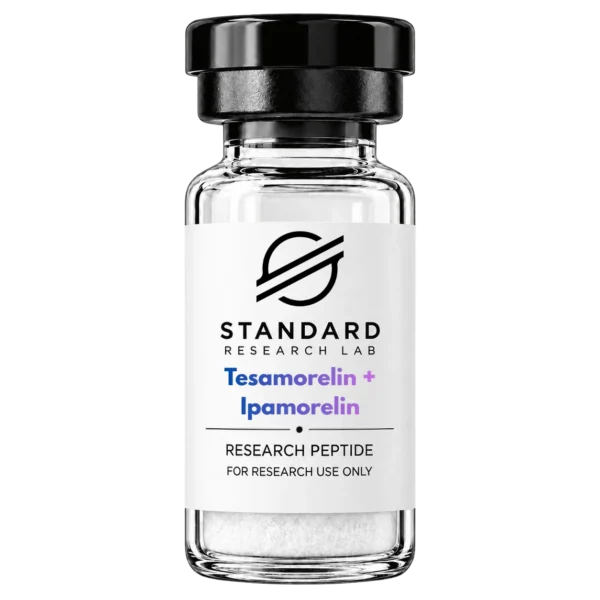
CJC-1295 + Ipamorelin, 10 mg
5 mg of each compound in a single vial, $70 — $7.00 per milligram. Batch number matched to the published certificate, dispatched from British Columbia.
View the Blend →
Dosage means two things here: the microgram schedule from the research literature, and the mg/mL concentration you set with your diluent. The 10 mg blend carries 5 mg of each compound, 2 mL gives 50 mcg per unit, and 25 mcg of each. Write down the volume you added — it is the number everything else depends on.
→ Read the Full CJC-1295 + Ipamorelin Guide
 ✓ COA
 ✓ COA
 ✓ COA