
Ipamorelin: GHSR-1a Selectivity, Protocols & Research
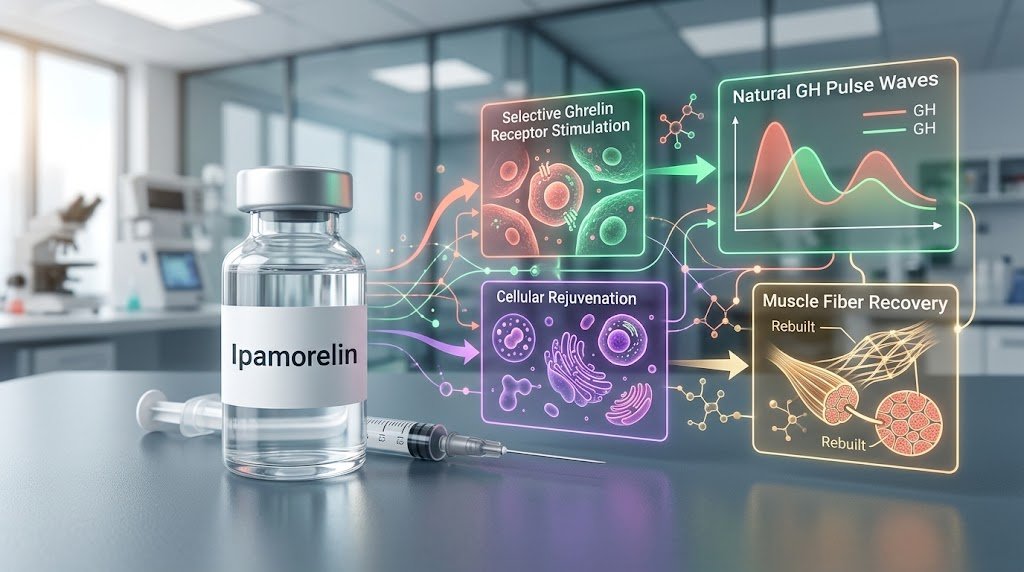
Within pituitary endocrinology and secretagogue pharmacology, Ipamorelin stands as the most selective growth hormone secretagogue ever developed. By targeting the ghrelin receptor without activating off-target neuroendocrine pathways, it stimulates natural growth hormone secretion with clinical precision.
Online fitness forums frequently praise Ipamorelin as a side-effect-free alternative to traditional human growth hormone, emphasizing its fat-burning and recovery potential. However, scientific rigor requires researchers to look past casual claims. Evaluating Ipamorelin demands analyzing its unique pentapeptide structure, its selective stimulation of the GHSR-1a receptor, and why it bypasses the cortisol, prolactin, and appetite spikes that plague earlier secretagogues like GHRP-6 and GHRP-2.
Quick Summary: What Is Ipamorelin at a Glance?
Quick Answer: Ipamorelin is a synthetic pentapeptide that acts as a selective growth hormone secretagogue receptor 1a (GHSR-1a) agonist. It drives growth hormone exocytosis via an inositol trisphosphate (IP3) calcium wave while inhibiting hypothalamic somatostatin, stimulating natural pulsatile growth hormone and IGF-1 secretion without triggering spikes in cortisol, prolactin, or aldosterone.
| Parameter | Ipamorelin (Selective GHRP) | First-Gen Secretagogues (GHRP-6 / GHRP-2) |
|---|---|---|
| Receptor Selectivity | Pure GHSR-1a selective agonist | Non-selective ghrelin receptor binding |
| Cortisol & Prolactin Elevation | Undetectable / Zero stimulation | Moderate to high systemic elevation |
| Appetite / Ghrelin Flush | Negligible | Intense, acute hunger spikes (GHRP-6) |
| Saturation Dose | ~100 mcg per administration (1 mcg/kg) | Variable; higher risk of receptor desensitization |
| Direct Research Supply | Paired formulations available via CJC-1295 / Ipamorelin Blend (10mg) | |
What Is Ipamorelin?
Ipamorelin is a synthetic pentapeptide with the chemical sequence Aib-His-D-2-Nal-D-Phe-Lys-NH2 and a molecular weight of approximately 711.86 Daltons.
Originally synthesized by Novo Nordisk in the late 1990s, Ipamorelin belongs to the third generation of Growth Hormone Secretagogues (GHS). Scientists engineered it to mimic the physiological actions of ghrelin, the endogenous gut hormone that regulates hunger, gastric motility, and pulsatile growth hormone secretion.
Earlier secretagogues—such as GHRP-6, GHRP-2, and Hexarelin—successfully provoked growth hormone discharge, but they lacked receptor specificity. Those older compounds bound indiscriminately to multiple central receptors, causing sharp spikes in adrenocorticotropic hormone (ACTH), cortisol, prolactin, and aldosterone. Novo Nordisk chemists engineered Ipamorelin to isolate somatotroph stimulation, successfully separating growth hormone release from unwanted systemic endocrine side effects.
Mechanisms of Action: Selective GHSR-1a Signaling
Ipamorelin executes its biological actions upstream at the pituitary and hypothalamic level:
1. GHSR-1a Receptor Binding & Calcium Influx
Ipamorelin binds selectively to the Growth Hormone Secretagogue Receptor 1a (GHSR-1a) on the surface of anterior pituitary somatotrophs. This binding event activates the Gq-protein signaling cascade, which stimulates phospholipase C (PLC) to hydrolyze phosphatidylinositol 4,5-bisphosphate into inositol trisphosphate (IP3) and diacylglycerol (DAG). IP3 triggers the immediate release of intracellular calcium ($Ca^{2+}$) from the endoplasmic reticulum, prompting the exocytosis of pre-stored growth hormone granules into circulation.
2. Hypothalamic Somatostatin Suppression
Beyond directly exciting pituitary somatotrophs, Ipamorelin acts centrally within the hypothalamus. It dampens the release of somatostatin (growth hormone-inhibiting hormone). Somatostatin acts as the physiological brake on growth hormone output. By quieting this brake, Ipamorelin clears the way for full, uninhibited secretory pulses.
3. Downstream Hepatic IGF-1 Production
The growth hormone pulses provoked by Ipamorelin travel via the bloodstream to hepatic tissue. In the liver, growth hormone binds to GHR complexes, turning on the synthesis and systemic release of Insulin-Like Growth Factor 1 (IGF-1) and its stabilizing binding protein IGFBP-3. IGF-1 drives peripheral anabolic processes, including nitrogen retention, collagen synthesis, and satellite cell recruitment in muscle and connective tissues.
Why Selectivity Matters: Ipamorelin vs. GHRP-6, GHRP-2 & Hexarelin
The defining characteristic of Ipamorelin is its clean pharmacological footprint. In published in-vitro and animal trials, researchers benchmarked Ipamorelin against earlier-generation secretagogues:
| Compound | GH Release Potency | Cortisol Stimulation | Prolactin Stimulation | Appetite / Ghrelin Flush |
|---|---|---|---|---|
| Ipamorelin | High (physiological pulse) | Undetectable / Zero | Undetectable / Zero | Negligible |
| GHRP-6 | Moderate to High | Moderate elevation | Moderate elevation | Extreme hunger spikes |
| GHRP-2 | Very High | Significant elevation | Significant elevation | Mild to moderate hunger |
| Hexarelin | Highest (supra-physiological) | Severe elevation | Severe elevation | Rapid desensitization |
Even at doses well above the saturation threshold, Ipamorelin does not elevate plasma cortisol or prolactin. This selectivity prevents the anxiety, water retention, gynecomastia risks, and down-regulation associated with non-selective ghrelin mimetics.
Documented Laboratory Research & Dosing Protocols
Within published endocrinology trials, animal models, and investigative research, protocols apply the following experimental parameters for Ipamorelin. Syringe measurements can be calculated with our free Peptide Calculator, while cycle timelines are tracked inside the Protocol Tracker Tool.
| Protocol Parameter | Evening Single-Pulse Protocol | Multi-Pulse Regenerative Protocol |
|---|---|---|
| Experimental Focus | Slow-wave sleep alignment, baseline IGF-1 elevation, recovery markers | Accelerated lipolysis, connective tissue repair, high GH area under curve |
| Documented Dosing | 100–200 mcg per administration | 100–150 mcg administered 2–3 times daily |
| Administration Route | Subcutaneous (Sub-Q) injection into abdominal fat | Subcutaneous (Sub-Q) injection into abdominal fat |
| Timing Window | Strictly fasted: 30–45 minutes prior to sleep | Fasted: morning upon waking, post-exercise, and before sleep |
| Cycle Architecture | 8–12 weeks continuous evaluation (see our Cycle Timing Guide) | 8–12 weeks on (commonly run 5 days on, 2 days off) |
| Inter-Cycle Washout | 4 weeks off between experimental cycles | 4 weeks off between experimental cycles |
| Key Biomarkers | Serum IGF-1, IGFBP-3, fasting glucose, prolactin, morning cortisol | Comprehensive metabolic panel (CMP), HbA1c, fasting insulin |
The Saturation Dose & Fasted Administration
Endocrinological assays identify a definitive saturation dose for Ipamorelin, typically observed at 1 mcg per kilogram of body mass (or approximately 100 mcg per administration). Administering doses beyond 200 mcg produces diminishing returns in growth hormone output because the somatotroph GHSR-1a receptors reach full transient saturation.
Furthermore, metabolic context dictates secretagogue efficacy:
- Carbohydrate & Insulin Blunting: Ingesting carbohydrates triggers insulin release, which stimulates hypothalamic somatostatin secretion. Somatostatin directly counteracts Ipamorelin, shutting down the secretory pulse.
- Lipid Blunting: High levels of circulating free fatty acids similarly dampen somatotroph responsiveness.
To gather valid experimental data, research protocols enforce a strict fasted window of at least two hours before injection, followed by a 30-to-45-minute post-administration wait before introducing food.
Synergistic Research Pairings
Because Ipamorelin activates the calcium/ghrelin secretagogue pathway, researchers frequently pair it with GHRH analogues to trigger multiplicative hormonal synergy:
- CJC-1295 (No DAC / Mod GRF 1-29): Pairing Ipamorelin with CJC-1295 produces a synergistic growth hormone pulse significantly greater than the mathematical sum of either compound alone. CJC-1295 provides the cAMP fuel, while Ipamorelin releases the calcium trigger. Read our comprehensive CJC-1295 / Ipamorelin Blend Guide.
- Sermorelin: Scientists pair Ipamorelin with Sermorelin GHRH to observe dual-pathway pituitary stimulation utilizing the bioidentical 1-29 GHRH chain.
- BPC-157: In musculoskeletal models, researchers pair Ipamorelin with BPC-157 to analyze whether systemic IGF-1 elevation accelerates localized VEGFR2 angiogenic tendon healing.
- TB-500: Research teams combine secretagogues with TB-500 to study cellular actin upregulation alongside elevated systemic tissue-repair factors.
- AOD-9604: In metabolic studies, laboratories evaluate Ipamorelin alongside AOD-9604 Peptide (or view AOD-9604 5mg) to analyze how broad GH elevation interacts with isolated beta-3 adipocyte lipolysis.
- Tesamorelin: Compared against third-generation GHRH secretagogues in our Tesamorelin Research Guide for targeted visceral fat management.
Laboratory Handling, Reconstitution & Storage Standards
To maintain the structural integrity and biological activity of this synthetic pentapeptide, laboratories follow strict handling standards (detailed step-by-step in our Beginner's Guide to Peptides):
- Diluent Selection: Reconstitute lyophilized Ipamorelin using sterile, pharmaceutical-grade Pfizer Hospira Bacteriostatic Water containing 0.9% benzyl alcohol to prevent bacterial contamination across multi-dose testing schedules. Alternatively, use 0.9% Sterile Bacteriostatic Saline for cell-culture and tissue-specific assays.
- Reconstitution Protocol: Use a sterile EasyTouch 31G Syringe to let the diluent trickle gently down the inside glass wall of the vial. Never spray liquid directly onto the lyophilized powder cake. Avoid vigorous agitation or shaking; roll the vial slowly between your palms until the solution turns clear.
- Cold-Chain Storage: Store dry lyophilized vials at -20°C for long-term molecular preservation. Maintain reconstituted liquid solutions between 2°C and 8°C (36°F to 46°F) inside a secure, light-shielded Peptide Vial Case or insulated Compact Travel Case to protect against mechanical vibration and light degradation.
Ipamorelin represents the pinnacle of receptor selectivity within the growth hormone secretagogue family. By activating the GHSR-1a receptor without triggering unwanted cortisol, prolactin, or dramatic hunger spikes, it delivers clean, physiological growth hormone stimulation. Adhering to disciplined fasted protocols, observing the 100 mcg saturation ceiling, and maintaining rigorous cold-chain preparation will ensure accurate, reproducible experimental outcomes.
← View all peptide guides, research & protocols in our Blog Archive


5 comments