CJC-1295 & Ipamorelin Blend Guide: Synergy, Mechanisms & Protocols
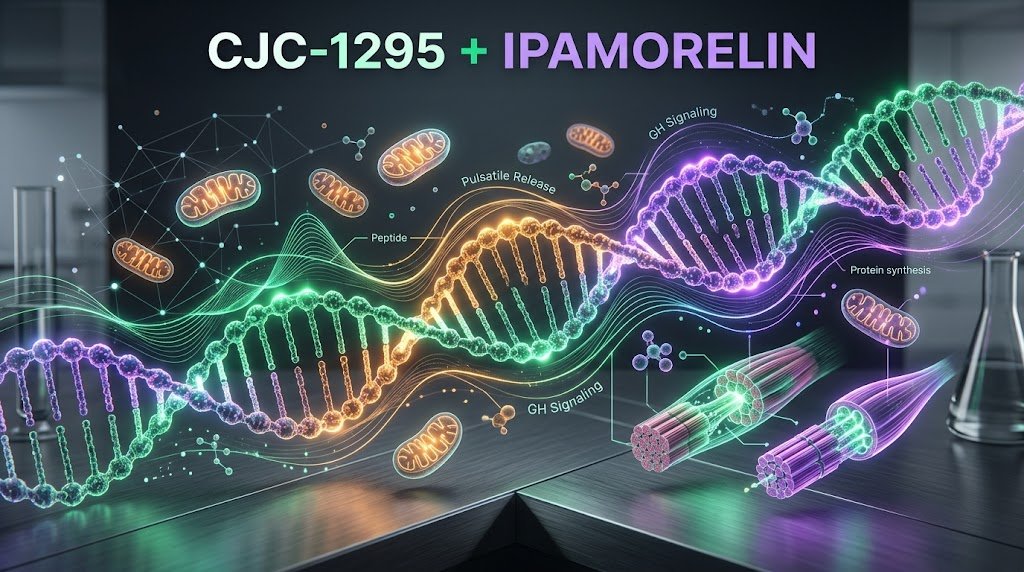
In neuroendocrine research, the combination of CJC-1295 and Ipamorelin represents the benchmark model for stimulating endogenous growth hormone (GH) release. Rather than replacing hormones through exogenous administration, this pairing leverages two distinct, complementary signaling pathways to amplify the pituitary gland's natural secretory pulses.
Online fitness communities often promote this combination as an anti-aging shortcut to rapid fat loss and muscle hypertrophy. However, scientific evaluation demands an understanding of the underlying endocrinology. Researchers must evaluate how Growth Hormone-Releasing Hormone (GHRH) analogues interact with selective Growth Hormone Secretagogue Receptor (GHSR) agonists, understand the pharmacokinetic difference between CJC-1295 with DAC and without DAC, and recognize why strict fasted protocols dictate secretagogue efficacy.
Quick Summary: CJC-1295 & Ipamorelin at a Glance
Quick Answer: The CJC-1295 and Ipamorelin blend pairs a synthetic GHRH analogue with a selective ghrelin receptor agonist (GHRP). By simultaneously increasing cyclic AMP (cAMP) and intracellular calcium influx in pituitary somatotrophs while suppressing somatostatin, this combination generates a multiplicative, natural growth hormone pulse without elevating cortisol, prolactin, or desensitizing receptors.
| Parameter | CJC-1295 Component (Mod GRF 1-29) | Ipamorelin Component |
|---|---|---|
| Pharmacological Class | GHRH (Growth Hormone-Releasing Hormone) analogue | GHSR-1a (Ghrelin receptor) selective secretagogue |
| Intracellular Pathway | G-protein coupled receptor → cAMP / Protein Kinase A activation | Phospholipase C → IP3 / intracellular calcium ($Ca^{2+}$) surge |
| Biological Half-Life | ~30 minutes (No DAC) | 6–8 days (With DAC) | ~2 hours |
| Selective Advantage | Resists rapid DPP-4 enzymatic degradation | Zero stimulation of cortisol, prolactin, or aldosterone |
| Direct Research Supply | Calibrated co-formulations available via CJC-1295 / Ipamorelin Blend (10mg) | |
Understanding the Duo: GHRH vs. GHRP Mechanisms
The human anterior pituitary gland synthesizes and secretes human growth hormone in natural, pulsatile bursts throughout the day and during slow-wave deep sleep. Two primary regulatory hormones control this pulsatile rhythm:
- Growth Hormone-Releasing Hormone (GHRH): Stimulates somatotroph cells to produce and release growth hormone pulses.
- Somatostatin (Growth Hormone-Inhibiting Hormone): Acts as the biochemical brake, shutting down growth hormone release.
- Ghrelin: Binds the secretagogue receptor to trigger acute secretory spikes while countering somatostatin inhibition.
CJC-1295: The GHRH Analogue
CJC-1295 is a synthetic 29-amino-acid analogue of endogenous GHRH (specifically a modified form of Sermorelin, representing the first 29 active residues of natural GHRH 1-44).
Natural GHRH 1-29 breaks down rapidly in serum, exhibiting an elimination half-life under 10 minutes due to cleavage by dipeptidyl peptidase-4 (DPP-4). Chemists modified CJC-1295 by substituting four specific amino acids (positions 2, 8, 15, and 27) with D-alanine, glutamine, alanine, and leucine. These changes resist DPP-4 cleavage, extending its biological half-life to roughly 30 minutes in its non-DAC form. CJC-1295 binds to the GHRH receptor on pituitary somatotrophs, activating the cAMP/protein kinase A (PKA) pathway to boost baseline GH production.
Ipamorelin: The Selective Ghrelin Receptor Agonist
Ipamorelin is a synthetic pentapeptide (Aib-His-D-2-Nal-D-Phe-Lys-NH2) that functions as a Growth Hormone Secretagogue (GHS) and selective ghrelin receptor agonist.
Unlike older-generation secretagogues (such as GHRP-6 and GHRP-2), Ipamorelin displays extraordinary receptor selectivity. It binds the growth hormone secretagogue receptor 1a (GHSR-1a), activating the phospholipase C (PLC) and intracellular calcium cascade to force the exocytosis of stored GH granules. Critically, Ipamorelin does not stimulate cortisol, prolactin, or aldosterone release even at supra-physiological doses, avoiding the intense hunger spikes, anxiety, and fluid retention common to non-selective secretagogues.
The Power of Synergy: Why Combine CJC-1295 with Ipamorelin?
Administering either peptide alone produces a moderate, brief elevation in circulating growth hormone. However, co-administering them triggers a multiplicative, synergistic pulse:
- Dual-Pathway Pituitary Activation: CJC-1295 elevates intracellular cyclic AMP (cAMP) via G-protein signaling, while Ipamorelin drives an influx of intracellular calcium ions ($Ca^{2+}$). These complementary pathways converge to unleash a growth hormone pulse several times larger than either compound produces alone.
- Somatostatin Blunting: While CJC-1295 orders the factory to produce more hormone, Ipamorelin acts as the disinhibitor, suppressing somatostatin's braking effect to clear the path for full granular discharge.
- Preservation of Pituitary Health: Because the combination respects negative feedback loops, circulating growth hormone remains physiological. It elevates Insulin-Like Growth Factor 1 (IGF-1) without shutting down the pituitary somatotrophs or desensitizing cellular receptors.
CJC-1295: With DAC vs. Without DAC (Mod GRF 1-29)
In research laboratories, choosing between the two chemical forms of CJC-1295 fundamentally shapes the hormonal environment:
- CJC-1295 Without DAC (Mod GRF 1-29): Does not contain the Drug Affinity Complex. It exhibits an active half-life of 30 minutes. Researchers pair Mod GRF 1-29 with Ipamorelin to mimic natural human pulsatility, delivering discrete, sharp GH spikes that match endogenous circadian rhythms.
- CJC-1295 With DAC: Contains a maleimidopropionic acid linker that binds covalently to circulating serum albumin. This bond extends the elimination half-life to approximately 6 to 8 days. Rather than creating discrete pulses, CJC-1295 with DAC raises baseline growth hormone and IGF-1 continuously around the clock. Prolonged continuous elevation can eventually lead to pituitary somatotroph desensitization and mild insulin resistance.
Documented Laboratory Research & Dosing Protocols
Within published endocrinology trials, animal models, and investigative research, protocols apply the following parameters for the classic CJC-1295 (No DAC) + Ipamorelin combination. Dilution measurements and unit tick marks can be calculated using our free Peptide Calculator, while cycle timelines are managed inside the Protocol Tracker Tool.
| Protocol Parameter | Standard Single-Pulse Protocol | Advanced Multi-Pulse Protocol |
|---|---|---|
| Experimental Focus | Circadian alignment, deep-sleep GH pulses, recovery markers | Maximized daily GH area under the curve, accelerated lipolysis |
| CJC-1295 (No DAC) Dose | 100 mcg per administration | 100 mcg per administration (2–3 times daily) |
| Ipamorelin Dose | 100–200 mcg per administration | 100–200 mcg per administration (2–3 times daily) |
| Administration Route | Subcutaneous (Sub-Q) injection | Subcutaneous (Sub-Q) injection |
| Timing Window | Strictly fasted: 30–45 minutes before sleep | Fasted: morning upon waking, post-exercise, and before sleep |
| Cycle Architecture | 8–12 weeks on / 4 weeks washout (see our Cycle Timing Guide) | 8–12 weeks on (often run 5 days on, 2 days off) |
| Primary Biomarkers | Serum IGF-1, IGFBP-3, fasting glucose, prolactin, cortisol | Comprehensive metabolic panel, HbA1c, fasting insulin |
The Critical Rule: The Fasted State Requirement
Incretin hormones and dietary macronutrients directly neutralize growth hormone secretagogues:
- Insulin Suppression: Elevating blood glucose triggers insulin release. Circulating insulin directly activates hypothalamic somatostatin release, halting somatotroph signaling and blunting peptide-induced GH secretion.
- Free Fatty Acid Interference: Elevated circulating lipids similarly inhibit pituitary growth hormone discharge.
To gather accurate experimental data, laboratories enforce a strict fasted window of at least two to three hours prior to administration, followed by an additional 30-to-45-minute wait before introducing food.
Synergistic Research Pairings
Because CJC-1295 and Ipamorelin restore upstream regenerative signaling, researchers frequently co-evaluate them alongside targeted tissue-repair peptides:
- BPC-157: Scientists pair GH secretagogues with BPC-157 to analyze whether elevated local IGF-1 accelerates VEGFR2-mediated angiogenic tendon repair.
- TB-500: Research teams study musculoskeletal healing by adding TB-500 to explore concurrent cellular actin upregulation and systemic growth factor pulses.
- Wolverine Blend: Compared against or stacked with the Wolverine Blend Guide (available as pre-mixed Wolverine Blend vials) during intensive systemic recovery studies.
- AOD-9604: In metabolic models, investigators combine secretagogues with AOD-9604 Peptide (or view AOD-9604 5mg) to evaluate targeted beta-3 adipocyte lipolysis alongside systemic GH release.
- Tesamorelin: Evaluated alongside other GHRH secretagogues in our Tesamorelin Guide to examine deep abdominal visceral fat reductions.
- Epithalon: Longevity researchers pair nightly secretagogue pulses with Epithalon Bioregulator to study pineal-pituitary neuroendocrine axis normalization.
Laboratory Handling, Reconstitution & Storage Standards
Maintaining the conformational integrity of both peptide chains demands strict laboratory cold-chain standards (detailed step-by-step in our Beginner's Guide to Peptides):
- Diluent Selection: Reconstitute lyophilized CJC-1295 and Ipamorelin vials using sterile, pharmaceutical-grade Pfizer Hospira Bacteriostatic Water containing 0.9% benzyl alcohol to prevent microbial growth across multi-dose cycles. Alternatively, use 0.9% Sterile Bacteriostatic Saline for cell-culture protocols.
- Reconstitution Protocol: Use a sterile EasyTouch 31G Syringe to let the diluent slide gently down the inner glass wall. Never spray liquid directly onto the powder cake. Avoid violent shaking; roll the vial slowly between your palms until the solution clears completely.
- Pre-Mixed Blends: Laboratories frequently source pre-blended CJC-1295 / Ipamorelin vials (e.g., 5mg/5mg). Ensure syringe volume calculations account for the combined mass concentration when drawing experimental doses.
- Cold-Chain Storage: Store dry lyophilized powder at -20°C for long-term preservation. Maintain reconstituted liquid solutions between 2°C and 8°C (36°F to 46°F) inside a secure, light-shielded Peptide Vial Case or insulated Compact Travel Case to protect against mechanical vibration and photo-oxidation.
The CJC-1295 and Ipamorelin combination remains the benchmark model for studying physiological growth hormone secretion. By concurrently engaging GHRH and ghrelin receptor pathways, this pairing delivers robust, natural secretory pulses while avoiding the unwanted cortisol spikes, prolactin elevation, and pituitary shutdown associated with older compounds and exogenous GH therapy. Ensuring strict fasted administration, monitoring baseline IGF-1 levels, and maintaining disciplined laboratory storage protocols will guarantee accurate, repeatable scientific results.
← View all peptide guides, research & protocols in our Blog Archive