
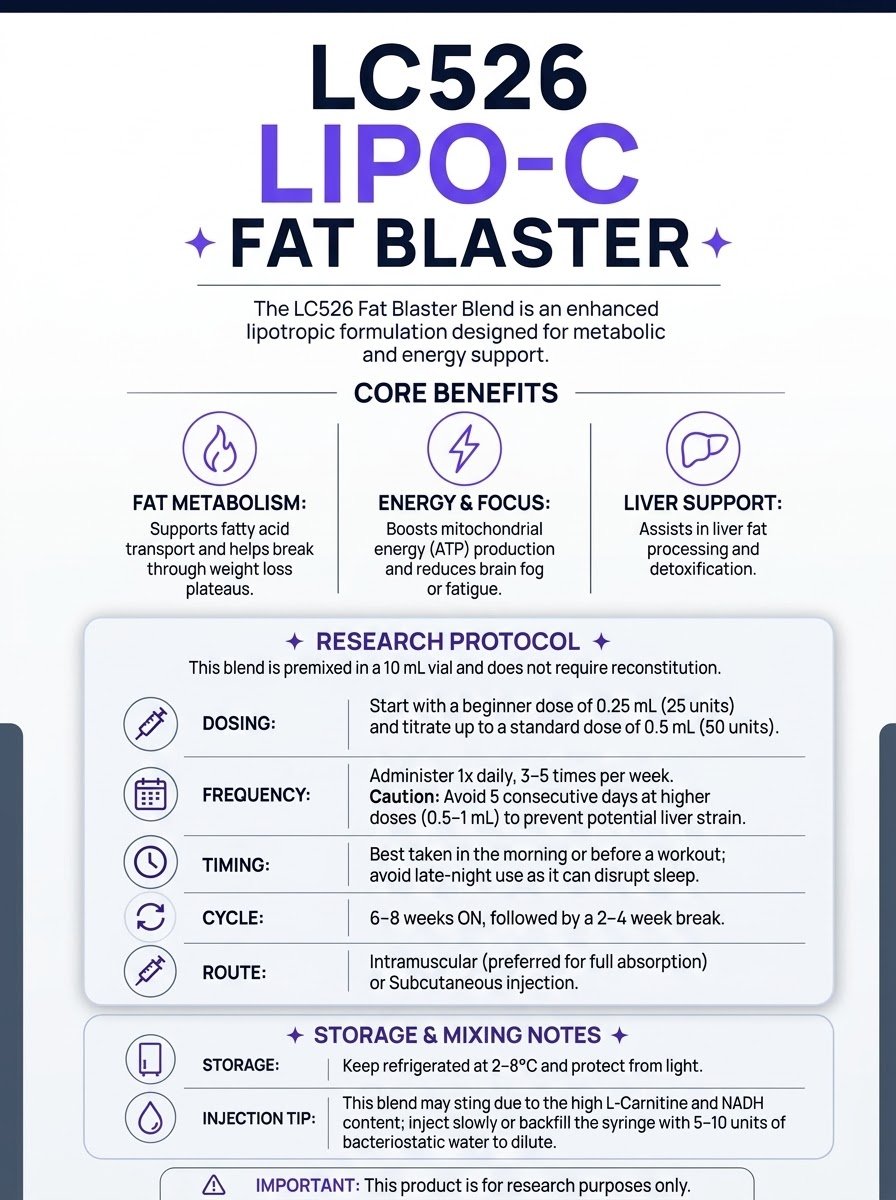
Overcoming stubborn fat loss plateaus requires more than just restricting calories. When circulating energy drops, the body often adapts by reducing spontaneous physical activity, downregulating thyroid conversion, and slowing mitochondrial beta-oxidation. While incretin mimetics suppress appetite centrally, they do not directly accelerate intracellular lipid transport or enhance cellular energy currency. To address this bioenergetic bottleneck, metabolic researchers evaluate multi-component lipotropic formulations. At the forefront of this category is the LC526 Lipo-C Fat Blaster blend—an enhanced lipotropic and coenzyme formulation engineered to optimize mitochondrial fatty acid shuttling, support hepatic lipid clearance, and elevate cellular ATP production.
Quick Summary: LC526 Lipo-C Fat Blaster at a Glance
Quick Answer: The LC526 Lipo-C Fat Blaster is an advanced, premixed 10 mL injectable lipotropic formulation containing high-potency L-Carnitine, the classic lipotropic triad (Methionine, Inositol, and Choline / MIC), essential metabolic B-vitamins (B6 and B12), and the mitochondrial coenzyme NADH. Unlike standard peptide cakes that require reconstitution, LC526 arrives ready to draw. It is designed to mobilize stored triglycerides into active mitochondria, support liver detoxification pathways, and reduce brain fog during rigorous cutting protocols.
| Active Component | Concentration (per mL) | Primary Biological Mechanism | Target Research Outcome |
|---|---|---|---|
| L-Carnitine | 300 mg | CPT-1 fatty acyl-CoA mitochondrial transport | Accelerated long-chain fatty acid oxidation & endurance |
| Choline | 50 mg | Phosphatidylcholine synthesis & VLDL packaging | Hepatic lipid export and prevention of fatty liver steatosis |
| Inositol | 50 mg | Phosphatidylinositol second-messenger signaling | Improved cellular insulin sensitivity and lipid partitioning |
| Methionine | 25 mg | S-Adenosylmethionine (SAMe) precursor & sulfur donor | Phase II hepatic methylation and glutathione regeneration |
| NADH (Reduced B3) | 50 mg | Direct Complex I electron donor in the ETC | Immediate mitochondrial ATP boost and reduced central fatigue |
| Vitamin B6 (Pyridoxine) | 50 mg | Transamination, glycogenolysis, and amino acid turnover | Optimized protein assimilation during caloric restriction |
| Vitamin B12 (Cobalamin) | 1 mg (1,000 mcg) | Methylmalonyl-CoA mutase and methionine synthase cofactor | Erythropoiesis, neurological integrity, and energy metabolism |
The Three Core Pillars of the LC526 Formula
Traditional "skinny shots" rely on simple vitamin B12 or rudimentary MIC ratios. The LC526 architecture differentiates itself by pairing lipotropics with high-concentration amino carriers and direct electron donors:
- 1. Direct Mitochondrial Fat Shuttling: Long-chain fatty acids cannot freely cross the impermeable inner mitochondrial membrane to undergo beta-oxidation. L-Carnitine serves as the rate-limiting cofactor for Carnitine Palmitoyltransferase-1 (CPT-1), attaching to acyl groups and shuttling fat molecules directly into the mitochondrial matrix to be burned for fuel.
- 2. Hepatic Lipid Clearance & Detoxification: When large amounts of stored body fat are mobilized during rapid weight loss, the liver handles immense lipid clearance demands. Methionine, inositol, and choline (MIC) work synergistically to build very-low-density lipoproteins (VLDL), clearing fat deposits out of hepatocytes and preventing hepatic steatosis while supporting Phase II conjugation pathways.
- 3. Cellular ATP Generation & Neuro-Focus: Caloric deficits commonly trigger lethargy, brain fog, and workout fatigue. By including NADH (the active, reduced form of nicotinamide adenine dinucleotide) alongside Vitamin B12, LC526 feeds high-energy electrons directly into Complex I of the electron transport chain, generating ATP without relying on central nervous system stimulant pathways.
LC526 Research Protocol & Dosing Architecture
Because LC526 is supplied as a sterile, ready-to-use liquid solution in a 10 mL multi-dose vial, researchers bypass the need for solvent mixing or complex mass-to-volume math:
| Protocol Parameter | Introductory Phase (Days 1–14) | Working Target Phase (Weeks 3–8) |
|---|---|---|
| Dose Volume (mL) | 0.25 mL | 0.50 mL (Standard) to 1.0 mL (Advanced) |
| Syringe Units (U-100) | 25 Units | 50 Units (Standard) to 100 Units |
| Administration Frequency | 3 times per week (e.g., Mon / Wed / Fri) | 3 to 5 times per week (Avoid 5+ consecutive days) |
| Diurnal Timing | Morning or 30–60 min pre-workout | Morning or pre-training; avoid evening administration |
| Cycle Architecture | 6 to 8 weeks active protocol | Followed by a mandatory 2 to 4 week washout break |
| Route of Administration | Intramuscular (IM) preferred; SubQ optional | Deep Intramuscular (IM) preferred for optimal absorption |
Administration Logistics: IM vs. SubQ and Injection Comfort
High-potency amino acid and coenzyme solutions behave differently than dilute peptide solutions under the skin:
- Route Selection (IM vs. SubQ): Deep Intramuscular (IM) injection into the deltoid, ventrogluteal, or vastus lateralis is strongly preferred. Skeletal muscle boasts rich capillary vascularization, ensuring rapid, painless absorption. While subcutaneous (SubQ) administration is possible, concentrated L-carnitine and NADH can cause localized tissue burning, temporary induration, or minor skin welts in delicate subcutaneous fat layers.
- Managing the "Carnitine / NADH Sting": Concentrated carnitine solutions are hypertonic, which can produce a noticeable transient sting during injection. To eliminate injection discomfort, inject the fluid slowly over 10 to 15 seconds. Alternatively, researchers frequently "backfill" or dilute the draw by adding 5 to 10 units (0.05–0.10 mL) of sterile Pfizer Hospira Bacteriostatic Water into the syringe before administration.
- Morning Administration Rule: Because NADH directly drives ATP synthesis and B-vitamins stimulate neurological alertness, administer LC526 in the morning or early afternoon prior to physical training. Late-night administration can interfere with sleep architecture and slow-wave delta rest.
Synergistic Research Pairings: The Ultimate Metabolic Stack
In metabolic research models, lipotropic cofactors are frequently stacked alongside targeted incretins and mitochondrial peptides to amplify fat oxidation while protecting lean mass:
- Incretin Co-Administration (Semaglutide & Tirzepatide): While GLP-1/GIP agonists curb appetite and delay gastric motility, they do not directly accelerate cellular fat oxidation. Stacking LC526 with Tirzepatide or Semaglutide provides the dual benefit of caloric deficit and mitochondrial fat burning.
- Mitochondrial Genome Activation (MOTS-c): Pair LC526 with the mitochondrial-derived peptide MOTS-c. While LC526 provides the L-Carnitine needed to transport fatty acids, MOTS-c activates AMPK to signal cells to burn that fat for energy. Learn more in our MOTS-c Protocols & Evidence Guide.
- Intracellular NNMT Inhibition (5-Amino-1MQ): To prevent metabolic slowdown and spare muscle tissue during intense fat loss, researchers evaluate 5-Amino-1MQ, which blocks NNMT to elevate intracellular NAD+ levels.
- Gastric Mucosal Protection (BPC-157): For research animals experiencing digestive shifts during rapid body recomposition, explore BPC-157 for its ability to maintain mucosal blood flow and gut-barrier integrity.
Laboratory Supplies & Safe Handling Standards
Maintaining sterile procedures and using dedicated equipment ensures repeatable outcomes across multi-week evaluation cycles:
- Precision Syringes: For intramuscular delivery into smaller muscle groups (deltoid), use high-gauge EasyTouch 31G Syringes with 0.5-inch needle lengths to minimize tissue disruption. For larger gluteal sites, standard 25G to 27G 1-inch needles ensure adequate intramuscular depth.
- Dilution Buffer: Keep certified Bacteriostatic Water on hand if syringe dilution is required to soften the hypertonic sting of concentrated amino acids.
- Storage Parameters: Store the LC526 10 mL vial refrigerated between 2°C and 8°C (36°F to 46°F) and protected from direct sunlight. Protect the amber glass from ultraviolet exposure to preserve light-sensitive cobalamin (B12) and NADH. Never freeze liquid lipotropic blends. Keep active vials upright inside a padded Compact 4-Slot Case or insulated Compact Peptide Travel Case.
- Digital Tracking Tools: Map cycle lengths and injection intervals with our Protocol Builder, and track daily metrics, site rotations, and liver-break intervals using the Protocol Tracker Tool. For custom volumetric calculations, use the free Peptide Calculator.
Frequently Asked Questions
Does the LC526 Lipo-C Fat Blaster require reconstitution?
No. LC526 comes fully dissolved and premixed as a sterile liquid solution in a 10 mL multi-dose vial. It is ready to draw immediately and does not require adding bacteriostatic water or mixing powders unless you choose to backfill 5 to 10 units of BAC water to reduce injection stinging.
Why is intramuscular (IM) preferred over subcutaneous (SubQ) injection?
LC526 contains 300 mg/mL of L-Carnitine along with 50 mg/mL of NADH. This makes the solution hypertonic. When injected into thin subcutaneous fat, it can cause temporary stinging, localized irritation, or a firm knot. Delivering it into rich muscular tissue (such as the shoulder or glute) ensures smoother absorption with minimal local irritation.
Why is there a mandatory break after 6 to 8 weeks?
Resting the receptor pathways and providing a 2 to 4 week washout break prevents metabolic habituation, avoids unnecessary hepatic processing strain from continuous high-dose amino acid clearance, and ensures the body responds vigorously when the protocol is resumed.
Related Reading & Scientific Resources
- What Is MOTS-c? Mitochondrial Signaling, Dosing Protocols & Evidence
- What Is Tirzepatide? Dual-Incretin Mechanisms Explained
- Semaglutide Explained: GLP-1 Receptor Action & Titration Research
- Best GLP-1 for Weight Loss: Multi-Target Comparison Guide
The LC526 Lipo-C Fat Blaster blend represents a functional upgrade over basic lipotropic injections. By coordinating the mitochondrial shuttling power of high-potency L-Carnitine, the liver-protective clearance of the MIC complex, and the direct electron-donating properties of NADH, it attacks metabolic fatigue and fat-loss plateaus at the cellular level. When paired with smart injection habits, intramuscular delivery, and proper protocol cycling, it serves as an indispensable tool in modern body recomposition research.
← View all peptide guides, research & protocols in our Blog Archive