
Semaglutide Explained: GLP-1 Receptor Action, Titration & Research
Semaglutide is the molecule that fundamentally launched the modern incretin era. Originally engineered to overcome the rapid enzymatic breakdown of native human GLP-1, it transitioned metabolic medicine from short-acting daily injections to potent once-weekly endocrine therapies.
While public attention centers largely on aesthetic weight-loss headlines, clinical pharmacologists examine semaglutide as a targeted neuroendocrine modulator. By selectively binding the glucagon-like peptide-1 (GLP-1) receptor, semaglutide recalibrates central appetite setpoints, decelerates gastric emptying, and triggers glucose-dependent insulin secretion. Understanding semaglutide requires analyzing its molecular lipidation, Phase 3 trial milestones, and documented research titration frameworks.
Quick Summary: What Is Semaglutide at a Glance?
Quick Answer: Semaglutide is a synthetic 31-amino-acid peptide analogue of human GLP-1 featuring 94% structural sequence homology. Engineered with a C18 fatty diacid chain that enables reversible albumin binding, it provides a prolonged 7-day terminal half-life. It acts primarily by stimulating hypothalamic satiety centers, suppressing mealtime glucagon release, and delaying gastric transit, producing an average 14.9% body weight reduction in landmark STEP trials.
| Parameter | Primary Biological Mechanism | Metabolic Research Impact |
|---|---|---|
| Receptor Selectivity | Pure, selective GLP-1 receptor (GLP-1R) agonist | Isolated incretin pathway activation without GIP or glucagon agonism |
| Half-Life Architecture | Aib8 substitution + C18 fatty diacid spacer at Lys26 | Protects against DPP-4 cleavage; extends circulation to ~165 hours (weekly cadence) |
| Central Nervous Action | Arcuate nucleus POMC/CART activation + NPY/AgRP inhibition | Directly silences central food noise and reduces daily caloric consumption |
| Landmark Trial Ceiling | 14.9% mean weight reduction at 2.4 mg weekly over 68 weeks in the STEP-1 trial | |
Molecular Structure & Pharmacokinetics
Endogenous GLP-1 is degraded within 2 to 3 minutes by the ubiquitous enzyme dipeptidyl peptidase-4 (DPP-4). Semaglutide overcomes this rapid clearance through three precise biochemical modifications:
- Position 8 Amino Acid Substitution: Native alanine is replaced by alpha-aminoisobutyric acid (Aib8). This synthetic substitution blocks steric access by DPP-4 enzymes, halting enzymatic cleavage.
- C18 Fatty Diacid Conjugation: A C18 fatty diacid chain is attached to lysine at position 26 via a hydrophilic spacer. This lipid moiety binds tightly and reversibly to circulating serum albumin, shielding the peptide from glomerular filtration in the kidneys.
- Lysine to Arginine Modification: Position 34 contains an arginine substitution to ensure the lipid side chain attaches specifically to the target lysine at position 26 during solid-phase synthesis.
These structural modifications extend semaglutide's elimination half-life to approximately 165 hours (~7 days), allowing steady weekly subcutaneous dosing.
Mechanisms of Action: How Semaglutide Works at the Cellular Level
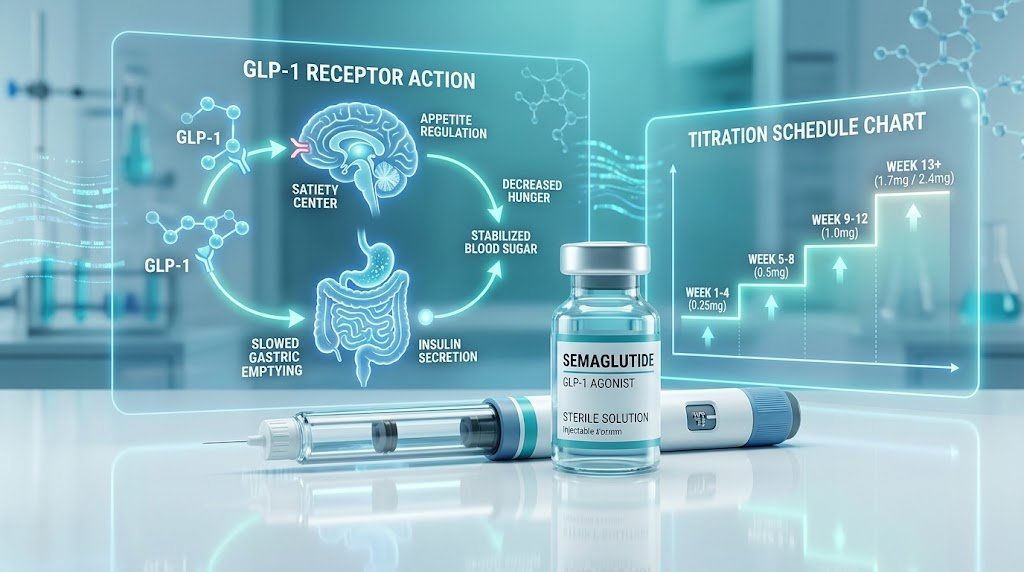
Semaglutide operates through targeted receptor pathways across the brain, pancreas, and gastrointestinal tract:
1. Central Hypothalamic Appetite Regulation
Semaglutide crosses into circumventricular brain regions that lack a complete blood-brain barrier, specifically accessing the arcuate nucleus of the hypothalamus and the area postrema. It stimulates pro-opiomelanocortin (POMC) and cocaine-and-amphetamine-regulated transcript (CART) neurons to promote satiety, while actively suppressing neuropeptide Y (NPY) and agouti-related peptide (AgRP) neurons that drive hunger. This signaling dampens persistent cravings and compulsive food focus.
2. Glucose-Dependent Pancreatic Modulation
In pancreatic beta cells, semaglutide binds GLP-1 receptors coupled to stimulatory G-protein alpha subunits (Gas), elevating intracellular cyclic AMP (cAMP) and Protein Kinase A (PKA). This cascade triggers insulin vesicle exocytosis exclusively in the presence of elevated blood glucose. When blood sugar drops to physiological levels, insulin release stops, minimizing the risk of severe hypoglycemia. Concurrently, it suppresses inappropriate post-meal glucagon secretion from alpha cells.
3. Deceleration of Gastric Emptying
By modulating autonomic vagal efferent signaling, semaglutide delays gastric transit. Solid food remains in the stomach longer, prolonging physical post-meal satiety and smoothing the entry of glucose into the small intestine to reduce postprandial glycemic spikes.
4. Systemic Vascular and Anti-Inflammatory Effects
GLP-1 receptors are expressed on circulating monocytes and vascular endothelial cells. Receptor engagement downregulates nuclear factor kappa B (NF-kB) transcription, leading to measurable decreases in high-sensitivity C-reactive protein (hsCRP), TNF-alpha, and IL-6. These vascular actions contribute to significant reductions in major adverse cardiovascular events (MACE).
Clinical Trial Evidence: The STEP & FLOW Milestones
Semaglutide's efficacy is substantiated across major Phase 3 clinical trial programs:
1. STEP-1 Trial (Overweight and Obesity)
In the double-blind STEP-1 trial evaluating 1,961 adults with obesity or overweight without diabetes, participants receiving semaglutide 2.4 mg weekly alongside lifestyle modifications achieved an average body weight loss of 14.9% at week 68, compared to 2.4% in the placebo cohort. More than one-third of participants achieved a mass reduction greater than or equal to 20%.
2. SELECT Trial (Cardiovascular Risk Reduction)
The SELECT trial evaluated 17,604 patients with pre-existing cardiovascular disease and overweight or obesity without diabetes. Over a mean follow-up of 39.8 months, semaglutide 2.4 mg reduced the primary composite cardiovascular endpoint (cardiovascular death, non-fatal myocardial infarction, or non-fatal stroke) by 20% compared to placebo, establishing cardioprotective effects independent of glycemic control.
3. FLOW Trial (Renal Function & Diabetic Kidney Disease)
The FLOW clinical trial evaluated renal outcomes in individuals with type 2 diabetes and chronic kidney disease. The study demonstrated a 24% reduction in major kidney disease events and cardiovascular mortality, demonstrating semaglutide's capacity to mitigate glomerular hyperfiltration and chronic renal decline.
Documented Research Titration & Dosing Protocols
Clinical trial architectures and experimental protocols adhere to mandatory 4-week step-up escalation schedules to mitigate gastrointestinal side effects. Researchers calculate syringe unit tick marks with our free Peptide Calculator and structure observation cycles inside the Protocol Tracker Tool.
| Titration Stage | Subcutaneous Dose (Once Weekly) | Evaluation Window | Primary Research Focus |
|---|---|---|---|
| Introductory Rung | 0.25 mg once weekly | Weeks 1–4 | Receptor initiation, gastric adaptation, and tolerability baseline |
| Escalation Step 1 | 0.50 mg once weekly | Weeks 5–8 | Initial active glycemic control and early appetite suppression |
| Escalation Step 2 | 1.0 mg once weekly | Weeks 9–12 | Established therapeutic metabolic stabilization and steady weight reduction |
| Escalation Step 3 | 1.7 mg once weekly | Weeks 13–16 | Advanced titration step for obesity-focused protocols |
| Full Target Maintenance | 2.4 mg once weekly | Weeks 17+ | Maximal GLP-1 receptor saturation for chronic weight management |
Standard Escalation vs. Targeted Microdosing
While standard label protocols require continuous escalation toward the 2.4 mg ceiling, clinical and community researchers frequently explore alternative schedules:
- Symptom-Gated Maintenance: Protocols often pause escalation at 0.5 mg or 1.0 mg indefinitely if glycemic markers and appetite control remain optimal, avoiding the higher gastrointestinal burden of maximum doses.
- Targeted Microdosing: Individuals evaluating incretin therapy for anti-inflammatory, joint, or autoimmune conditions without needing mass reduction often utilize micro-doses between 0.05 mg and 0.25 mg weekly. Learn more in our comprehensive analysis of GLP-1 microdosing protocols.
Recommended Laboratory Screening & Biomarkers
Laboratory research protocols evaluating semaglutide track specific baseline and periodic biomarkers:
- Glycemic & Metabolic Panels: Fasting plasma glucose, HbA1c, and fasting insulin to assess beta-cell sensitivity.
- Hepatic & Lipid Profiles: Comprehensive lipid panel, ALT, AST, and GGT to track reductions in intrahepatic steatosis.
- Renal Function & Hydration: Blood urea nitrogen (BUN), creatinine, and estimated glomerular filtration rate (eGFR). Because GLP-1 agonists blunt thirst perception, adequate daily fluid intake (2.5 to 3.0 liters plus electrolytes) is required to prevent acute hypovolemic renal strain.
- Thyroid History Screening: Semaglutide carries a boxed warning regarding thyroid C-cell tumors observed in rodent models. It remains contraindicated in subjects with a personal or family history of Medullary Thyroid Carcinoma (MTC) or Multiple Endocrine Neoplasia syndrome type 2 (MEN 2).
Synergistic Research Pairings & Multi-Incretin Comparisons
In modern metabolic and recovery research, semaglutide serves as the central reference compound against which newer multi-target therapies are compared:
- Tirzepatide: Combines GLP-1 agonism with glucose-dependent insulinotropic polypeptide (GIP) receptor activation to enhance adipose lipid buffering and reduce nausea. Compare mechanisms in our Tirzepatide Dual-Incretin Guide.
- Retatrutide: Adds glucagon receptor agonism to GIP and GLP-1 pathways, stimulating thermogenic energy expenditure and rapid liver fat clearance. Explore trial results in our Retatrutide Research Guide.
- Cagrilintide: A long-acting amylin analogue evaluated in co-formulation with semaglutide (CagriSema) to engage hindbrain calcitonin complexes alongside hypothalamic GLP-1 circuits. Read our Cagrilintide Analogue Guide.
- BPC-157: Frequently co-evaluated in gastrointestinal research models to observe mucosal barrier integrity and gastric tissue defense during incretin titration. Review our BPC-157 Guide.
- TB-500: Paired in body composition models with TB-500 (Thymosin Beta-4) to evaluate cellular structural repair and actin regulation alongside significant caloric restriction.
- GHK-Cu: Explored alongside incretins to examine dermal elasticity, extracellular matrix remodeling, and collagen deposition during rapid adipose reduction. Learn more in our GHK-Cu Tripeptide Guide.
Laboratory Handling, Reconstitution & Storage Standards
Ensuring analytical stability and peptide integrity requires adherence to standard laboratory protocols:
- Diluent Selection: Reconstitute lyophilized semaglutide using sterile, pharmaceutical-grade Pfizer Hospira Bacteriostatic Water containing 0.9% benzyl alcohol to prevent microbial growth across multidose testing intervals. For assays requiring preservative-free isotonic solutions, use 0.9% Sterile Bacteriostatic Saline.
- Reconstitution Protocol: Use a sterile EasyTouch 31G Syringe to direct diluent down the inner glass wall of the vial. Avoid spraying liquid directly onto the lyophilized cake. Do not shake; gently roll the vial between your palms until the powder dissolves into a clear, colorless liquid.
- Cold-Chain Storage: Store dry lyophilized vials at -20°C for long-term stability. Reconstituted liquid solutions must be refrigerated between 2°C and 8°C (36°F to 46°F) inside a light-shielded, vibration-damping Peptide Vial Case or insulated Compact Travel Case to prevent peptide shearing and photolytic degradation. Use within 28 to 30 days.
Semaglutide established a new standard in endocrine pharmacology by validating that selective, long-acting GLP-1 receptor agonism safely regulates central satiety, blood glucose, and systemic vascular health. Whether evaluated in formal Stepwise titration frameworks for maximum metabolic management or investigated at fractional microdoses for anti-inflammatory signaling, maintaining disciplined preparation and monitoring protocols ensures reproducible, high-integrity laboratory outcomes.
← View all peptide guides, research & protocols in our Blog Archive


30 comments