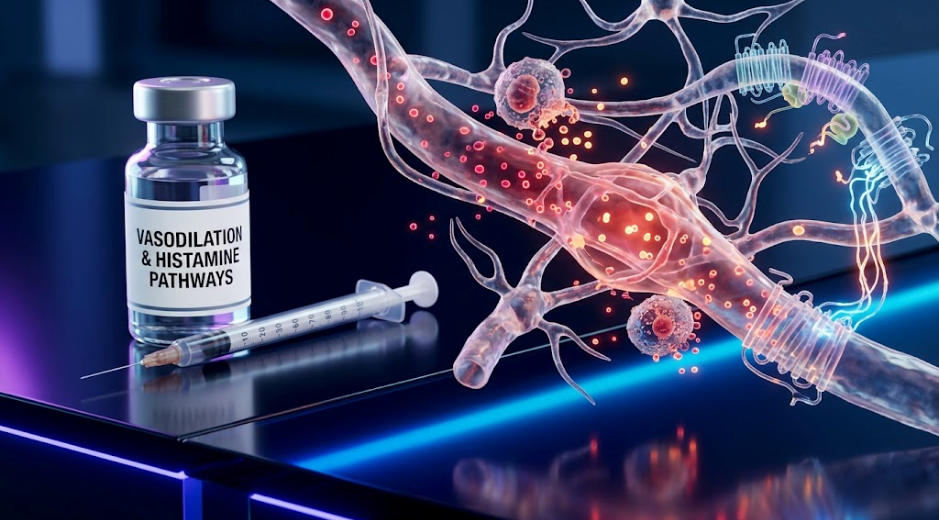
Peptide Flushing & Head Rush: Causes, Biology & Safety
Experiencing an acute peptide flushing head rush within seconds or minutes of an injection can be intensely startling. You depress the plunger, pull out the needle, and suddenly feel a wave of radiating heat climb up your neck into your face, accompanied by an audible thumping in your ears, lightheadedness, and a racing heart. The immediate thought is that you are having an allergic crisis or stroke.
Fortunately, while this sensation is alarming, it is rarely life-threatening. In pharmacological research, acute post-injection flushing and head rushes almost always trace back to rapid systemic vasodilation, incidental micro-vessel nicking, or specific peptide receptor signaling cascades. Below, we examine why a peptide flushing head rush happens, how vascular biology drives the sensation, and how to tell normal hemodynamic shifts apart from true medical hazards.
Quick Summary: Peptide Flushing & Head Rush at a Glance
Quick Answer: A peptide flushing head rush is typically caused by rapid systemic vasodilation triggered by incidental micro-vessel uptake or specific receptor pathways (such as GHRP secretagogues or melanocortins). While alarming due to sudden warmth, dizziness, and a racing pulse, benign flushes remain localized to transient vascular dilation without airway constriction.
| Peptide Sequence / Class | Primary Mechanism | Physical Sensation & Duration |
|---|---|---|
| Growth Hormone Releasing Peptides (GHRP-2, GHRP-6, Hexarelin) |
Direct ghrelin receptor (GHS-R1a) stimulation and rapid nitric oxide (NO) endothelial release. | Immediate facial warmth, pulsing ears, heavy head feeling, and mild hunger spike; lasts 5–15 minutes. |
| Melanocortin Agonists (Melanotan II, PT-141 / Bremelanotide) |
Central melanocortin (MC1R / MC4R) agonism; triggers acute peripheral vasodilation and transient blood pressure spikes. | Deep crimson facial flushing, nausea, yawning, and lightheaded warmth; lasts 20–60 minutes. |
| Thymic / Angiogenic Peptides (TB-500 / Thymosin Beta-4) |
Upregulates endothelial cell migration, VEGF pathways, and localized blood vessel relaxation. | Mild chest and neck warmth, slight head pressure, and temporary feeling of increased cardiac output. |
| Cytoprotective Peptides (BPC-157) |
Nitric oxide system modulation; balances endothelial nitric oxide synthase (eNOS) and vascular tone. | Rare flushing, but can cause a sudden, transient drop in blood pressure if micro-injected into a capillary. |
The Primary Culprit: Accidental Intravenous or Micro-Vessel Uptake
Subcutaneous injections are intended to deposit into adipose tissue, which acts as a slow-release depot. Fat tissue has relatively low vascular density, allowing peptide molecules to absorb gradually via capillaries and lymphatic ducts over 30 to 90 minutes.
However, subcutaneous fat is still interlaced with micro-vessels and venules:
- The "Flash" Uptake: If your needle tip grazes or pierces a tiny capillary or venule, a portion of the dose enters the venous bloodstream instantly rather than slowly diffusing through adipose tissue.
- Direct Cardiac Delivery: Intravenous delivery rushes the peptide straight to the right side of the heart, through the lungs, and out through the aorta into the carotid arteries in under ten seconds.
- Sudden Vasodilation: When high concentrations of bioactive peptides hit carotid and cranial receptors all at once, peripheral blood vessels relax and dilate instantly. Blood pools outward into cutaneous capillary beds, dropping peripheral vascular resistance and triggering a sudden compensatory rush of blood to the brain.
This explains why you can inject the exact same compound for weeks with zero issues, and then suddenly experience a dramatic head rush on a single day. You simply nicked a micro-vessel.
Autonomic Shock: The Vasovagal Reflex
Not every head rush is chemical; some are neurological. The human nervous system possesses a protective mechanism called the vasovagal reflex.
If you are subtly anxious, holding your breath, or bracing against needle pain, your sympathetic nervous system spikes your heart rate and constricts blood vessels. The moment the needle exits and you relax, your parasympathetic vagus nerve overcompensates:
- The vagus nerve releases acetylcholine onto the sinoatrial node, suddenly slowing your heart rate.
- Systemic blood vessels dilate rapidly, causing blood to pool in the lower extremities.
- Transient cerebral hypoperfusion (reduced blood flow to the brain) follows, producing lightheadedness, tunnel vision, a sudden cold sweat, and the distinct sensation that you are about to faint.
The Critical Safety Check: Benign Flush vs. Anaphylaxis
When an intense rush hits, it is vital to differentiate a benign vascular flush from life-threatening anaphylactic shock:
- Benign Flush / Head Rush: Redness, intense warmth across face/ears, brief tachycardia (racing pulse), mild lightheadedness. Your airways remain completely clear, you have no difficulty swallowing, no widespread hives, and the sensation peaks within 2 to 5 minutes before steadily resolving.
- Systemic Anaphylaxis (Emergency): Swelling of the lips, tongue, or uvula; feeling a "lump" or tightness in the throat; audible wheezing or gasping for air; full-body hives (urticaria); vomiting; or sudden loss of consciousness. This is a critical emergency requiring immediate medical intervention.
How to Prevent Flushing and Head Rushes
If you want to avoid future vascular rushes during administration, implement these laboratory adjustments (calculate precise volumes using the Peptide Calculator and track schedules inside the Protocol Tracker Tool):
- Aspirate or Slow Your Injection Speed: Never slam the syringe plunger down in a split second. Depress the plunger smoothly over 5 to 10 seconds. If liquid enters a tiny micro-vessel slowly, the concentration wave is diluted by passing blood flow, avoiding an acute systemic spike.
- Verify Injection Depth and Angle: Use an ultra-fine EasyTouch 31G Syringe with an 8 mm (5/16") needle length (learn safe handling in our Beginner's Guide to Peptides). Pinch skin to isolate adipose tissue and inject cleanly into fat, avoiding more fibrous, vascular transitional zones.
- Dilute Your Master Concentration: Highly concentrated solutions hit receptors harder if a capillary is nicked (review guidelines in How Much Bacteriostatic Water to Add). Reconstituting your peptide with 2 mL or 3 mL of certified Bacteriostatic Water rather than 1 mL flattens the absorption peak.
- Stay Hydrated and Seated: Always administer while seated comfortably in a chair. Being well-hydrated stabilizes baseline blood volume, blunting the lightheadedness caused by sudden peripheral vasodilation.
- Keep Vials Protected: Store sensitive peptide solutions safely between 2°C and 8°C (36°F to 46°F) inside a dedicated Peptide Vial Case or insulated Compact Travel Case to prevent thermal degradation and preserve molecular integrity (review reconstitution protocols in How to Reconstitute Peptides).
A sudden peptide flushing head rush is almost always the result of rapid vasodilation—either from nicking a tiny subcutaneous micro-vessel, an acute nitric oxide release from compounds like GHRPs or melanocortins, or a minor vasovagal response. If your airway is open and you have no swelling in your throat or face, sit back, breathe slowly, and let your vascular tone stabilize. The sensation will fade within minutes, leaving your research protocol completely intact. Explore more troubleshooting guides in our Blog Archive.
← View all peptide guides, research & protocols in our Blog Archive