Peptide Injection Site Welt: Allergy or Technique Error?
Discovering a red, raised peptide injection site welt hours after administration is one of the most common—and stressful—occurrences in laboratory protocols. The skin turns pink or red, a firm little bump develops beneath the surface, and a persistent itch sets in. The immediate fear is that you have developed a severe drug allergy to the peptide.
However, the vast majority of injection site reactions are localized, benign, and completely correctable. True systemic allergies represent a critical medical emergency requiring immediate protocol cessation, whereas local welts typically stem from localized histamine release, hardware depth mistakes, or preservative and tonicity mismatches. Below, we break down the critical difference between local and systemic reactions, explore the root causes of injection site welts, and outline how to troubleshoot them.
Quick Summary: Peptide Injection Site Welts at a Glance
Quick Answer: Most injection site welts are benign local reactions caused by intradermal depth errors, non-allergic mast cell histamine release, or hypotonic pH shifts. True systemic allergic reactions involve widespread hives, facial swelling, or breathing difficulties and require immediate cessation, whereas local welts can be resolved by ensuring proper subcutaneous depth, switching to isotonic Sodium Chloride Bacteriostatic 0.9% Saline, or diluting concentrations.
| Category | Clinical Presentation | Required Action & Protocol Status |
|---|---|---|
| Local Reaction (Remediable) |
Redness, firm swelling (wheal), and mild itchiness strictly confined to a 1–3 cm circle around the puncture site. Zero breathing, facial, or full-body symptoms. | Manageable: Protocol can typically continue. Adjust injection depth, switch to isotonic diluent, dilute concentration, or apply cold compresses. |
| Systemic Reaction (Immediate Stop) |
Hives (urticaria) spreading across distant body parts, facial or lip swelling, throat tightness, shortness of breath, dizziness, sudden drop in blood pressure, or rapid heart rate. | CRITICAL HAZARD: Stop the protocol immediately. This is an IgE-mediated anaphylactic or broad immune response that can escalate to life-threatening respiratory collapse. Seek emergency care. |
The Critical Line: Local Reaction vs. Systemic Reaction
Before evaluating injection mechanics, you must establish whether the physical presentation is confined to the skin or spreading systemically throughout the body. The required action depends entirely on this distinction:
Why Local Welts Happen (The Non-Allergic Causes)
If your reaction is purely local, what is actually causing that firm red bump? In scientific research, several common technical, physiological, and chemical culprits explain localized flares:
1. Intradermal Injection Error (Too Shallow)
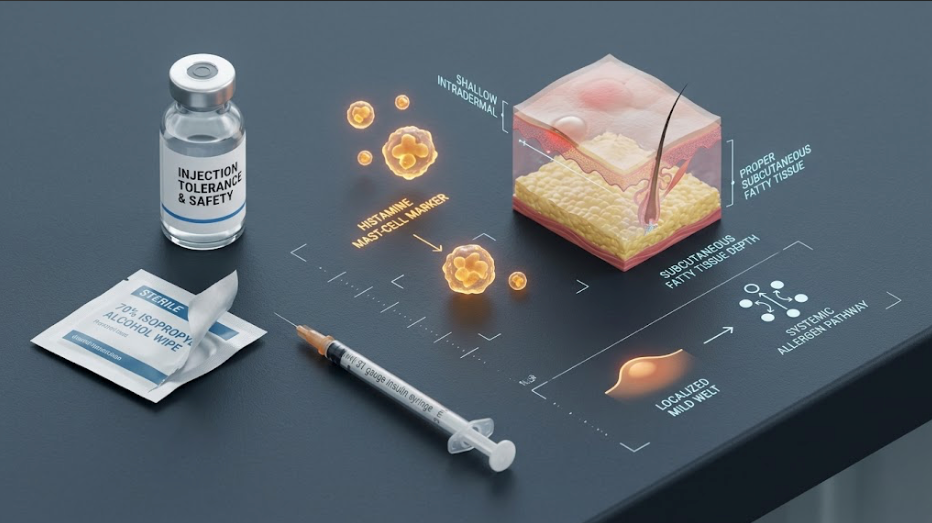
The single most common cause of an itchy bump is an injection delivered intradermally (into the dense upper skin layers) rather than into subcutaneous adipose tissue (the fatty layer beneath the skin).
The dermis is packed with dense capillary beds, sensory pain receptors, and resident mast cells. If you insert a short needle at too shallow of an angle, the fluid pools between dermal layers. This mechanical fluid pressure stretches nerve endings and triggers instant mast cell degranulation, forming a hard "mosquito-bite" wheal that remains itchy and inflamed for 24 to 72 hours. Subcutaneous adipose tissue, by contrast, has sparse innervation and low mast cell density, allowing fluid to absorb quietly without local irritation.
2. Osmotic Shock & pH: Why Some Compounds Need Saline BAC Water
An often overlooked driver of post-injection welts is an osmotic and pH clash between your reconstitution solution and interstitial body fluid:
- The Body's Natural Environment: Human subcutaneous tissue maintains a tightly regulated physiological pH of roughly 7.35 to 7.45 and an isotonic osmolality of approximately 290–300 mOsm/kg.
- Standard BAC Water Is Hypotonic & Acidic: Pure sterile water mixed with 0.9% benzyl alcohol has near-zero osmolarity (hypotonic) and frequently drifts into an acidic pH range (5.0 to 6.5) as it absorbs atmospheric carbon dioxide.
- The Cellular Rupture Flare: When hypotonic, unbuffered fluid is injected, water violently rushes into surrounding cells via osmosis to equalize pressure. This osmotic shock bursts micro-vessels and ruptures mast cells, causing immediate burning and a lingering, swollen welt.
- The Saline Solution: Certain peptides maintain their tertiary structure and comfort profile far better when reconstituted using Sodium Chloride Bacteriostatic 0.9% Saline instead of plain water. The 0.9% sodium chloride provides an isotonic fluid match that mirrors blood and extracellular tissue. This neutralizes osmotic pressure swings, buffers the injection depot closer to physiological pH, and drastically cuts down on localized post-injection redness and swelling.
3. Mast Cell Degranulation (Non-Allergic Histamine Release)
Certain peptides naturally trigger mast cells to dump histamine on contact without involving the adaptive immune system (IgE antibodies). This phenomenon—known as pseudo-allergic mast cell degranulation—is an inherent pharmacological property of specific sequences:
- Growth Hormone Secretagogues (GHRP-6, Hexarelin): Frequently stimulate local cutaneous mast cells, causing a temporary flare.
- GHK-Cu Copper Tripeptide: The copper ion complex is notorious for creating localized tissue burning, hard inflammatory nodules, and mild redness that can persist for several days.
- Endogenous Bradykinin/Histamine Pathways: In compounds like BPC-157 and TB-500, mild local vascular dilation is part of normal angiogenic signaling.
4. Preservative Sensitivity (Benzyl Alcohol)
Multi-dose vials are reconstituted with Bacteriostatic Water, which contains 0.9% benzyl alcohol ($9\text{ mg/mL}$) as an antimicrobial agent. While non-toxic, benzyl alcohol is a mild organic solvent. In concentrated pockets, it acts as a chemical irritant to delicate sub-dermal tissues, generating a localized stinging sensation followed by an erythematous (red) welt.
5. Bacterial Contamination vs. Sterile Inflammation
Researchers often worry that a red welt indicates a bacterial infection (cellulitis or an abscess). Here is how to tell the difference:
- Timing: A histamine or technique welt appears within 10 to 60 minutes and begins fading within 24 to 48 hours. A bacterial infection takes 48 to 72+ hours to incubate before rapidly worsening.
- Temperature & Expansion: Histamine welts remain cool or slightly warm to the touch. A bacterial infection generates radiating heat, spreading redness that expands daily, severe throbbing pain, and systemic fever.
- Suppuration: If a firm nodule softens into a fluctuant, pus-filled center, an infectious abscess has formed, requiring clinical medical drainage and antibiotic intervention.
How to Fix and Prevent Local Welts
If you have verified that your reaction is strictly localized, implement these bench corrections to eliminate the issue on future administrations (review proper reconstitution in our How to Reconstitute Peptides Guide and calculate concentrations using the Peptide Calculator):
- Switch to Bacteriostatic 0.9% Sodium Chloride: If plain water causes persistent burning or swelling, switch to Sodium Chloride Bacteriostatic 0.9% Saline for sequences that require isotonic parity. Matching subcutaneous osmolality prevents fluid-shift irritation.
- Ensure True Subcutaneous Depth: Use an ultra-fine EasyTouch 31G Syringe with an 8 mm (5/16") or 12.7 mm (1/2") needle length. Gently pinch an inch of subcutaneous fat and insert the needle at a clean 90-degree angle (or 45 degrees if very lean) to guarantee fluid deposits fully below the dermis.
- Dilute Your Working Solution: Highly concentrated solutions create excessive local osmotic pressure. If you mixed 5 mg into 1 mL of diluent, consider reconstituting with 2 mL or 3 mL of certified diluent on your next vial to reduce localized chemical concentration per draw.
- Bring Chilled Syringes to Room Temperature: Cold liquid straight from a 2°C to 8°C refrigerator (stored in a Peptide Vial Case or Compact Travel Case) shocks localized sensory nerves. Once loaded, let the syringe rest at room temperature for 3 to 5 minutes prior to administration.
- Let the Alcohol Swab Dry Completely: Wiping skin with an alcohol swab and piercing while the skin is still wet drags isopropyl alcohol directly through the puncture wound, causing immediate burning and a false histamine reaction. Let the skin air-dry for 15 to 30 seconds first.
- Rotate Administration Sites: Never inject into the exact same quadrant repeatedly. Rotate across abdominal fat pads, upper outer thighs, and gluteal zones to prevent localized subcutaneous scarring and tissue fatigue. Log administration cycles inside the Protocol Tracker Tool.
When you encounter a red peptide injection site welt, remain calm and assess the whole body. If you notice throat constriction, facial swelling, widespread hives, or lightheadedness, you are experiencing a systemic reaction—stop the compound immediately and seek medical attention. But if the reaction is merely an isolated red bump at the injection point, your compound is almost certainly safe. Adjust your needle depth, consider switching to isotonic saline BAC water, let your alcohol dry, and the vast majority of local welts will disappear entirely.
← View all peptide guides, research & protocols in our Blog Archive