Peptide Left Out Overnight: Is Your Vial Ruined?
Realizing you had a peptide left out overnight on your lab bench or counter triggers immediate dread. You walk in the next morning, spot the reconstituted vial sitting at room temperature instead of inside the refrigerator, and assume the entire solution has gone bad. Online communities often repeat strict warnings that reconstituted compounds degrade almost immediately once exposed to ambient warmth.
However, what does biophysical chemistry actually show about brief room temperature exposure? Did eight to twelve hours at 20°C (68°F) destroy your amino acid sequence, or is the concern overstated? Below, we examine the reaction kinetics of a peptide left out overnight, how sequence length dictates thermal resilience, and how to verify compound viability.
Quick Summary: Peptide Left Out Overnight at a Glance
Quick Answer: Finding a reconstituted peptide left out overnight on the counter is rarely cause for alarm. Brief room-temperature exposure (8 to 12 hours) causes negligible potency loss (<0.5% for short chains) because biochemical degradation follows slow reaction kinetics. Preserved with 0.9% benzyl alcohol in Bacteriostatic Water, short-to-medium length peptides remain fully viable when promptly returned to refrigeration (2°C to 8°C).
| Compound Category | Degradation Rate (Overnight Bench Exposure) | Scientific Significance |
|---|---|---|
| Short-Chain Peptides (<20 AA) | Negligible (<0.5% purity loss at 20°C–22°C). | Linear chains like BPC-157 and GHK-Cu Copper Tripeptide lack delicate tertiary folds; entirely stable overnight. |
| Medium-Chain Peptides (20–45 AA) | Minimal (<1.0% purity loss over 8–12 hours). | Compounds such as TB-500 and GLP-1 analogues retain conformational activity without structural collapse. |
| Large Hormones & Proteins (>150 AA) | Moderate (1%–4% aggregation risk over 12+ hours). | Complex macromolecules like human growth hormone (hGH) have folded secondary tertiary structures prone to thermal aggregation. |
| Heated Exposure (>30°C / Direct Sunlight) | Accelerated (Photodegradation and thermal cleavage). | Thermal degradation speeds up significantly above 30°C (86°F); UV sunlight breaks disulfide bonds rapidly. |
The Arrhenius Equation: How Temperature Governs Degradation
To understand what happens overnight, consider how chemical breakdown works in aqueous solution. Degradation does not act like a digital on/off switch. In reality, it follows chemical reaction kinetics defined by the Arrhenius equation.
Under the Arrhenius relationship, the rate constant of a chemical reaction increases exponentially as absolute temperature rises:
- The $Q_{10}$ Temperature Coefficient: In biochemical systems, every 10°C (18°F) rise in temperature generally increases the rate of chemical reaction by a factor of 2 to 3.
- The Cold Storage Baseline: When a vial sits in cold storage at 4°C (39°F), thermal degradation reactions occur very slowly.
- Room Temperature Acceleration: Moving a vial from 4°C to 20°C (68°F) represents a roughly 16°C jump. This temperature difference speeds up baseline degradation reactions by approximately 3 to 5 times.
As documented in research on aqueous protein stability and formulation pathways, an acceleration of 3 to 5 times does not mean instantaneous destruction. For example, if a compound takes 60 days in the refrigerator to lose 5% of its potency, leaving it at room temperature for 12 hours causes only a tiny fraction of a percent of degradation. In practical terms, short-term exposure causes negligible loss of potency for most resilient research compounds.
What Chemical Reactions Actually Occur in Solution?
When a reconstituted solution warms up, what chemical changes can theoretically take place? Temperature influences three primary aqueous degradation pathways:
- Deamidation: Peptides containing asparagine (Asn) or glutamine (Gln) residues can undergo non-enzymatic deamidation. While this reaction accelerates in warm liquid, it takes days to weeks at neutral pH to cause measurable shifts in purity.
- Aqueous Hydrolysis: Water molecules can break peptide bonds over time. However, uncatalyzed peptide bond cleavage requires substantial thermal activation energy, making it extraordinarily slow at normal room temperature.
- Oxidation: Amino acids like methionine, cysteine, and tryptophan are sensitive to dissolved oxygen. Warm temperatures facilitate oxidative changes, especially if the liquid was previously agitated and aerated.
Peer-reviewed literature on protein biophysics and stability kinetics confirms that overnight room-temperature exposure simply causes a brief, temporary increase in degradation rate rather than rapid destruction.
Structure Matters: Resilient Peptides vs. Fragile Proteins
Not every compound responds to thermal exposure in the exact same manner. The impact of a peptide left out overnight depends heavily on molecular size and structural complexity:
What About Bacterial Contamination? (The Role of Benzyl Alcohol)
The second primary concern is microbial growth. When a vial sits at room temperature, many researchers worry that bacteria will rapidly multiply inside the solution.
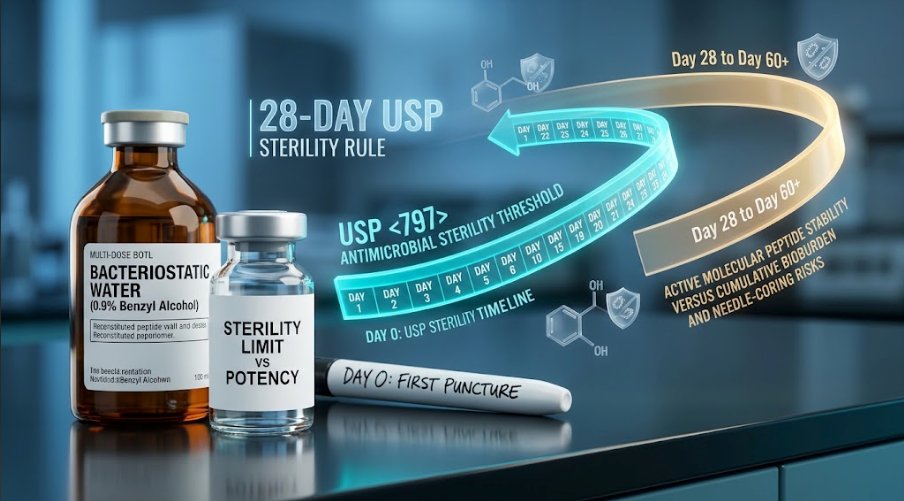
Fortunately, multi-dose laboratory reconstitution is performed using sterile Bacteriostatic Water. This diluent contains 0.9% benzyl alcohol (9 mg/mL), which serves as a potent antimicrobial preservative:
- Bacteriostatic Function: Benzyl alcohol disrupts microbial cell membranes, halting the proliferation of bacteria, yeast, and mold.
- Thermal Range of the Preservative: Benzyl alcohol does not break down at room temperature. It maintains active bacteriostatic protection at 20°C to 25°C just as effectively as it does inside a cold refrigerator.
- The Critical Distinction: If you reconstituted using unpreserved sterile water (sterile water for injection) rather than bacteriostatic water, room temperature exposure carries a much higher risk of microbial growth after rubber septum puncture.
Step-by-Step: How to Handle a Vial Left Out Overnight
If you discover that your vial spent the night on the counter, follow this systematic stabilization procedure:
- Assess Ambient Conditions: Determine what temperature the vial experienced. Was it a cool, shaded room at 19°C–21°C (66°F–70°F), or was the vial sitting on a hot surface in direct sunlight? Direct sunlight and heat sources cause far more degradation than ambient room air.
- Return Immediately to Cold Storage: Do not panic or discard the vial. Place it straight into cold refrigeration at 2°C to 8°C (36°F to 46°F) inside a protective Peptide Vial Case (or insulated Compact Travel Case) to resume standard storage kinetics.
- Inspect Solution Clarity: Hold the vial up against a clean light source. The liquid should remain water-clear, transparent, and free of visible haze, cloudiness, or suspended particles.
- Maintain Sterile Draw Standards: Always sanitize the rubber septum thoroughly with alcohol before inserting a sterile EasyTouch 31G Syringe to prevent introducing exogenous contaminants. Verify required concentrations with our Peptide Calculator and log your protocol status in the Protocol Tracker Tool.
When Is a Peptide Truly Compromised?
While an overnight stay on a cool bench will not ruin your research compound, there are clear scenarios where a solution should be discarded:
- Visible Cloudiness or Particulate: If the solution turns milky, hazy, or displays insoluble precipitation that does not resolve upon chilling, conformational aggregation or chemical breakdown has occurred.
- Prolonged Multi-Day Exposure: A single night (8 to 12 hours) is safe. Leaving a reconstituted vial at room temperature for five to seven consecutive days, however, leads to cumulative deamidation and loss of monomeric purity.
- High Heat and UV Light Exposure: If a vial was left in an enclosed vehicle, adjacent to a heat vent, or on a sunlit windowsill, high temperatures and UV radiation can break disulfide bonds and cause rapid thermal degradation.
In conclusion, having a peptide left out overnight is rarely a fatal error for short-to-medium length research compounds. Thanks to low reaction kinetics and the antimicrobial protection of benzyl alcohol, purity loss is negligible. Simply return the vial to refrigeration, verify clarity, and continue your protocol with confidence. For more reconstitution tips, review our How to Reconstitute Peptides Guide.
← View all peptide guides, research & protocols in our Blog Archive