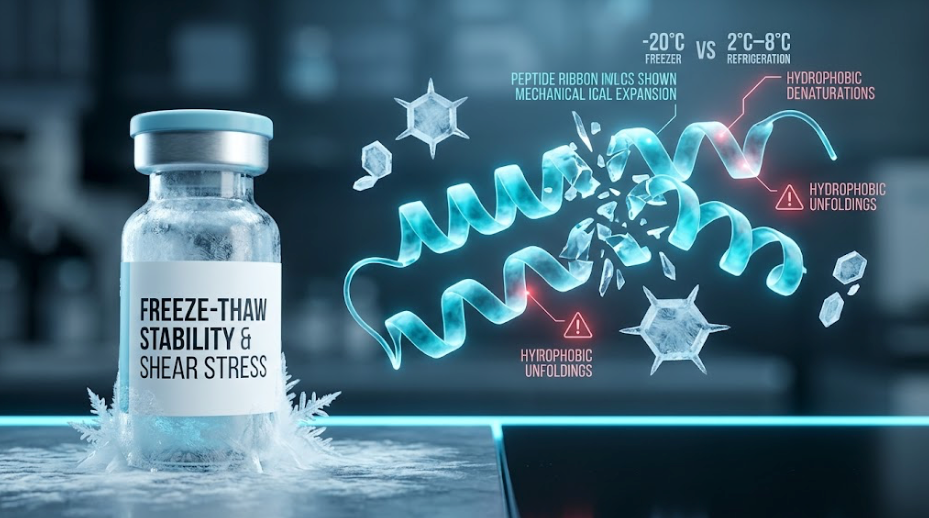
Can You Freeze Reconstituted Peptides? Stability Guide
Researchers often ask: can you freeze reconstituted peptides to extend their working lifespan? When working with multi-milligram vials, reaching the end of the standard 28-day refrigerated window can feel like a race against time. Because lyophilized powder stays stable in the freezer for years, freezing liquid solutions seems like an intuitive way to pause degradation.
However, liquid freeze-thaw kinetics work quite differently from dry storage. Placing reconstituted solutions into domestic freezers introduces physical stress that can damage molecular conformation. Below, we break down what happens when you freeze liquid solutions, how ice crystal shear affects molecules, and how to preserve sample integrity safely.
Quick Summary: Freezing Reconstituted Peptides at a Glance
Quick Answer: Freezing reconstituted peptide solutions is strongly discouraged for routine protocols. While dry lyophilized powder is exceptionally stable at -20°C, freezing liquid solutions creates sharp ice crystal dendrites that shear peptide chains and cause protein aggregation. If freezing is strictly required, single-use aliquots in manual-defrost freezers must be utilized to avoid repeated freeze-thaw damage.
| Compound Category | Freezing Feasibility | Scientific Impact |
|---|---|---|
| Short Linear Peptides (<20 AA) | High tolerance (Single freeze event). | Unstructured chains like BPC-157 and GHK-Cu Copper Tripeptide lack complex tertiary folding; they handle single-freeze cycles well. |
| Medium Peptides (20–45 AA) | Moderate tolerance (Aliquots required). | Molecules like TB-500 and GLP-1 analogues tolerate a single freeze, but repeated freeze-thaw cycles cause significant potency loss. |
| Complex Hormones (>150 AA) | Poor tolerance (Avoid freezing liquids). | Macromolecules like human growth hormone (hGH) have folded quaternary structures that readily aggregate when subjected to ice crystallization. |
| Repeated Freeze-Thaw Cycles | Completely unacceptable for all classes. | Successive freezing events break secondary bonds, resulting in visible precipitates and complete bioactivity loss. |
The Physics of Freezing Liquid Solutions: Why It Differs from Dry Powder
Lyophilized peptides tolerate sub-zero storage because the water has already been removed via sublimation. Without liquid water, ice crystals cannot nucleate. In contrast, freezing a reconstituted solution introduces several physical hazards:
- Ice Crystal Nucleation and Mechanical Shear: As liquid water freezes, it expands into an organized crystalline lattice. Sharp ice dendrites physically compress and slice through solute pockets, shearing delicate macromolecular structures.
- Cryo-Concentration Effects: Pure water freezes first. As ice forms, the remaining dissolved peptide, buffer salts, and benzyl alcohol become trapped in micro-pockets of unfrozen liquid. This extreme concentration shift creates severe local osmotic pressure and drastic pH swings.
- The Destructive "Freeze-Thaw" Cycle: While a single controlled freeze may cause minimal harm, repeated freezing and thawing causes progressive denaturation. Each round exposes the compound to another wave of crystal shear and interfacial tension.
Peer-reviewed investigations in aqueous biopharmaceutical stability literature confirm that repeated freeze-thaw cycles represent one of the primary drivers of secondary structural collapse and insoluble aggregation.
The Frost-Free Freezer Trap: The Hidden Threat to Peptides
A common laboratory error involves placing vials in standard commercial or residential frost-free freezers. These appliances run automatic defrost cycles multiple times every 24 hours to prevent ice buildup:
- Internal Heating Elements: Heating coils activate periodically to warm the internal freezer walls above 0°C (32°F).
- Micro-Thaw Transitions: Even if the vial appears frozen solid, these thermal fluctuations partially melt micro-pockets within the solution.
- Recrystallization Stress: When cooling resumes, the water refreezes into larger, more jagged crystals. Over several weeks, this continual thermal cycling degrades the compound far faster than standard refrigeration.
Therefore, if you ever freeze liquid solutions, you must utilize a manual-defrost freezer that maintains an unvarying -20°C temperature profile.
Can You Freeze Solutions Containing Bacteriostatic Water?
Most research peptides are reconstituted with Bacteriostatic Water, which contains 0.9% benzyl alcohol as an antimicrobial preservative. Freezing this solution introduces specific chemical considerations:
- Freezing Point Depression: The presence of 0.9% benzyl alcohol slightly depresses the freezing point of water below 0°C, extending the phase-change timeline.
- Phase Separation: During slow freezing, benzyl alcohol can separate from the aqueous matrix, concentrating into localized solvent zones that may alter surrounding peptide solubility.
- Preservative Efficacy: Freezing does not neutralize benzyl alcohol chemically, but improper crystal formation can induce persistent cloudiness or precipitation upon thawing.
As documented in research on protein formulation kinetics, freezing solutions preserved with benzyl alcohol requires rapid freezing methods to prevent phase separation.
The Gold-Standard Protocol: How to Freeze Safely via Aliquots
If you must freeze reconstituted liquid to preserve a large volume over several months, follow the single-use aliquot method to eliminate repeated freeze-thaw cycles:
- Divide into Single-Use Portions: Never freeze the entire master vial. Immediately after reconstitution, draw the solution into sterile micro-centrifuge tubes or pre-filled single-dose EasyTouch 31G Syringes corresponding to exact protocol doses.
- Prevent Air Exposure: Ensure minimal headspace in your aliquots to reduce interfacial oxidation during frozen storage.
- Use Manual-Defrost Freezers: Place the aliquots inside a dedicated Peptide Vial Case or Compact Travel Case located in the deepest section of a manual-defrost freezer at -20°C. Never store them in door shelves.
- Thaw Gently in the Refrigerator: When retrieving an aliquot, transfer it to a 2°C to 8°C (36°F to 46°F) refrigerator and let it thaw slowly. Never apply heat, hot water, or microwave radiation. Once thawed, use it immediately and discard any remaining liquid.
Best Practice Summary: Keep It Simple
While you can freeze certain reconstituted solutions if you utilize strict single-use aliquots, the safest practice is simpler: keep dry powder frozen, and keep reconstituted liquid refrigerated. Reconstitute only what you plan to use within 28 to 30 days, maintain steady 2°C to 8°C cold-chain storage (verify instructions in our How to Reconstitute Peptides Guide), and avoid unnecessary freeze-thaw stress entirely. Calculate your target draws with the Peptide Calculator and log active cycles inside the Protocol Tracker Tool.
Freezing reconstituted liquid peptides introduces mechanical shear from ice crystals and cryo-concentration stress, which can degrade sensitive structures over time. If long-term frozen storage is required, strictly adhere to single-use aliquoting in a manual-defrost freezer. For everyday testing, maintaining standard 2°C to 8°C refrigeration ensures maximum molecular stability.
← View all peptide guides, research & protocols in our Blog Archive